What is E163?
Complete guide to understanding E163 (Anthocyanins) in your food
The Quick Answer
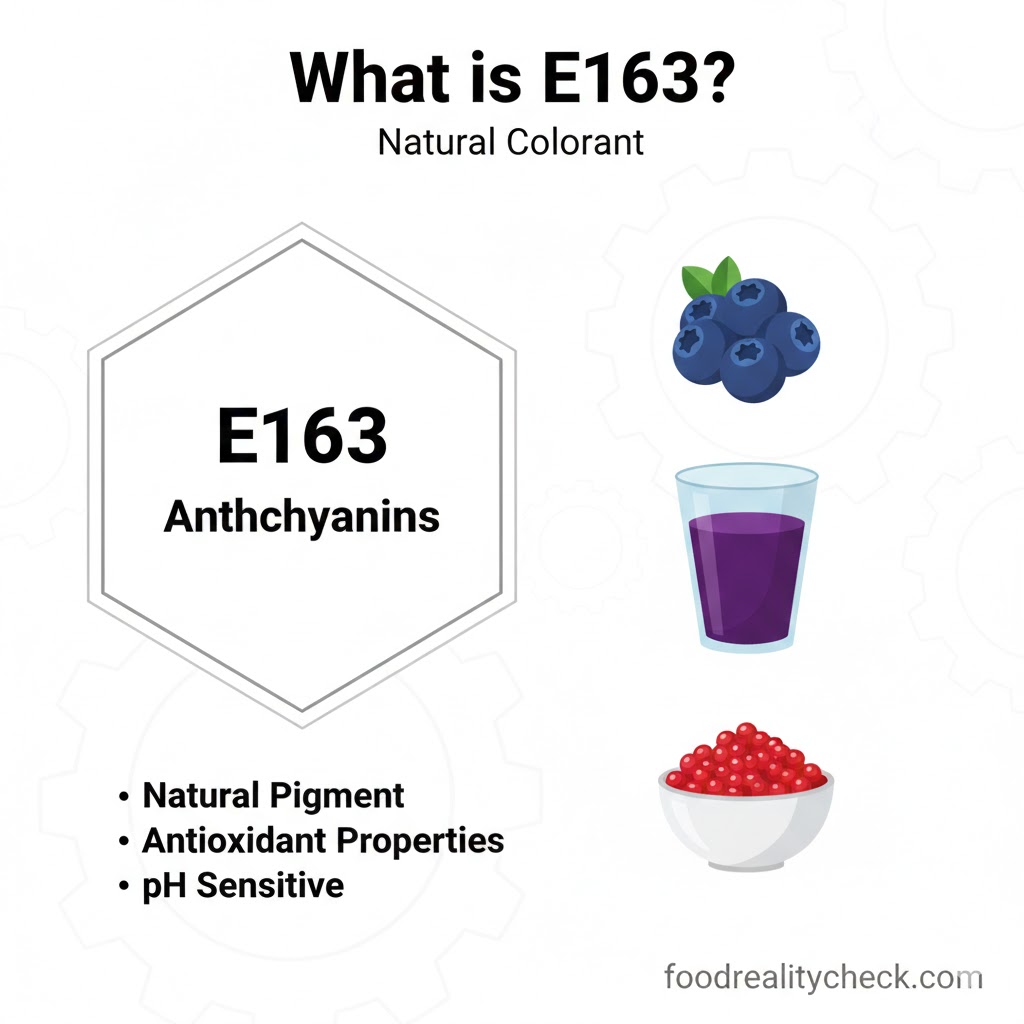
E163 is anthocyanins, natural water-soluble pigments extracted from fruits, vegetables, and flowers that produce vibrant red, purple, and blue colors while providing documented antioxidant and anti-inflammatory health benefits.
It’s used as a natural food colorant with superior safety and health profiles compared to synthetic dyes, providing color enhancement while contributing genuine nutritional and wellness properties.
Most people consuming colored beverages, yogurts, jams, and confectionery regularly encounter E163, though regulatory status for some anthocyanin sources remains contested—reflecting a divide between traditional food use and modern food additive standards.
📌 Quick Facts
- Category: Natural Food Colorant, Antioxidant, Anti-inflammatory Agent, Flavonoid Polyphenol
- Source: 100% natural—extracted from berries, grapes, red cabbage, purple corn, blackcurrants, and other colored fruits/vegetables
- Found in: Beverages, yogurts, ice cream, jams, confectionery, dairy products, fruit preparations, syrups
- Safety: EFSA approved (with caveats); FDA approved for certain sources; JECFA no ADI specified for general anthocyanins, 2.5 mg/kg for E163ii
- Natural or Synthetic: 100% natural—extracted from plants, not synthesized
- Vegan/Vegetarian: Yes
- Key Advantage: Documented antioxidant, anti-inflammatory, cardiovascular, and potential anticancer benefits; no known toxicity
- Critical Limitation: 2013 EFSA concluded most anthocyanin sources “insufficiently characterized” for safety; red grape skin and blackcurrant excepted
What Exactly Is It?
E163 is anthocyanins, a broad group of naturally occurring water-soluble flavonoid pigments with the basic chemical structure of 2-phenylbenzopyrylium or flavylium cations, typically consisting of an anthocyanidin (the sugar-free parent molecule) with one or more sugar moieties attached.
Anthocyanins are members of the larger polyphenol family of plant compounds and exist in thousands of structural variants depending on: (1) the anthocyanidin core (cyanidin, delphinidin, malvidin, pelargonidin, peonidin, petunidin), (2) the number and type of sugar molecules attached, (3) the hydroxylation and methylation patterns on the molecule, and (4) the presence of co-pigments and metal complexes.
Physically, anthocyanins appear as dark blue, purple, or red liquids or powders depending on the source material and processing method. They are water-soluble—dissolving readily in aqueous solutions—and their color is pH-dependent: appearing red in acidic conditions, purple-red at neutral pH, and blue in alkaline conditions. This pH-dependent coloration has led to historical use of anthocyanins (particularly from red cabbage) as pH indicators in chemistry.
The color production mechanism is caused by the conjugated double-bond system in the flavylium cation structure, which absorbs light across the visible spectrum. Importantly, anthocyanins are among the least stable natural colorants—degrading readily with heat, light, and oxygen exposure, particularly at pH >5. This instability limits their applicability in certain food formulations while also providing evidence of their natural origin.
Where You’ll Find It
E163 appears in a wide range of foods, particularly beverages and dairy products:
• Soft drinks and non-alcoholic beverages
• Fruit and vegetable juices
• Yogurts and yogurt drinks
• Ice cream and frozen desserts
• Smoothies and smoothie products
• Jams, jellies, marmalades, and preserves
• Fruit preparations and fillings
• Confectionery and hard candies
• Chocolate coatings
• Gum and lozenges
• Glazé fruits (particularly glacé cherries)
• Pickles and pickled products
• Sauces and gravies
• Baked goods and pastry fillings
• Soups and broths
• Dairy products (flavored milk, puddings)
• Energy drinks and sports beverages
• Wine and alcoholic beverages (wine color restoration)
• Cosmetics and personal care products
E163’s prevalence reflects its increasing popularity as manufacturers replace synthetic dyes with natural alternatives.
Why Do Food Companies Use It?
E163 performs three critical functions, with unique advantages over synthetic dyes:
1. Natural coloring with health appeal: Anthocyanins provide vibrant red, purple, and blue colors from entirely natural sources, allowing marketing as “naturally colored” or “naturally sourced.” This resonates powerfully with consumer preferences for clean labels and natural additives—a competitive advantage over synthetic dyes.
2. Documented health benefits: Unlike synthetic dyes which are tested only for safety, anthocyanins come with extensive research documentation of antioxidant, anti-inflammatory, cardiovascular support, and potential anticancer properties. This allows manufacturers to market products with health claims—”antioxidant-rich,” “heart-healthy,” “naturally supporting wellness.”
3. Superior safety and consumer acceptance profile: Compared to synthetic colorants (particularly azo dyes like tartrazine E102 and sunset yellow E110, which are linked to hyperactivity in children), anthocyanins have documented zero adverse behavioral effects, zero known toxicity, and extensive traditional use in food across cultures for millennia.
Why it’s increasingly selected: The combination of natural origin, documented health benefits, superior safety profile, and consumer clean-label preference has driven rapid adoption of E163. Many manufacturers have explicitly shifted marketing to “synthetic dye-free” and “naturally colored” positioning—a market-driven transition toward anthocyanins and away from synthetic alternatives.
Is It Safe?
E163’s safety is officially approved in Europe and Australia/New Zealand, though with important regulatory caveats reflecting incomplete safety characterization for some sources.
Regulatory Status—Complex and Source-Dependent:
• EFSA (Europe): 2013 re-evaluation concluded that anthocyanins from most fruits and vegetables are “insufficiently characterized by safety and toxicology studies” to approve as food additives. EXCEPTIONS: Red grape skin extract and blackcurrant extract specifically approved as sufficiently safe based on historical food use evidence.
• Australia/New Zealand: Approved for certain applications; similar source-specific restrictions
• FDA (USA): NOT approved as a direct food additive. However, grape juice, red grape skin, and many fruit/vegetable juices (which contain anthocyanins naturally) are approved as colorants—creating a regulatory loophole where anthocyanins from these sources are permitted indirectly.
• JECFA (WHO/FAO): No ADI specified for general anthocyanins; 2.5 mg/kg body weight per day for E163ii (blackcurrant extract)
• Compositional uncertainty: The EU does not specify which fruits or vegetables can be used for E163 extraction, nor does it specify the precise types of anthocyanins that must be present. This creates inconsistency in what is labeled “E163.”
• Incomplete characterization: Different fruit sources produce different anthocyanin profiles; safety of one source cannot be assumed for another
• Purple corn concern: Purple corn extracts (increasingly used as E163 sources) lack specific regulatory approval despite growing use
• Insufficient ADI establishment: For most anthocyanin sources, no Acceptable Daily Intake (ADI) can be established without adequate toxicological data
Documented health benefits (extensively researched):
• Antioxidant activity: Potent free radical scavenging; among the highest ORAC (Oxygen Radical Absorbance Capacity) values of dietary compounds
• Anti-inflammatory effects: Multiple research studies document reduction of inflammatory markers and modulation of inflammation pathways
• Cardiovascular benefits: Research indicates improved endothelial function, reduced atherosclerosis risk, and improved circulation
• Cognitive and neuroprotective effects: Evidence of potential protection against cognitive decline and neurodegenerative diseases
• Metabolic support: Emerging evidence of potential benefits in diabetes management and glucose control
• Potential anticancer properties: Research documents multiple mechanisms of cancer cell growth inhibition, though human evidence remains limited
Important distinction from synthetic dyes: Anthocyanins are documented to have ZERO behavioral effects in children—unlike azo synthetic dyes (tartrazine E102, sunset yellow E110) which have demonstrated associations with hyperactivity. Anthocyanins actually have opposite effects: neuroprotective rather than neurotoxic.
Stability and pH Dependence
A critical limitation of E163 is poor stability:
Anthocyanins are notoriously unstable compared to other colorants. They degrade with: heat exposure (particularly above 50°C), light exposure, neutral to alkaline pH (becoming unstable above pH 5), and oxygen exposure. This instability necessitates: protective packaging (opaque containers), refrigeration in some applications, acidic pH maintenance, and often combination with stabilizing agents (metal ions, sulfites). This instability also provides evidence of anthocyanin authenticity—synthetic dyes are stable across extreme conditions, while anthocyanins degrade under realistic conditions.
Production Methods
E163 anthocyanins are produced through natural extraction:
1. Fruit, vegetable, or flower material is harvested and processed (crushing, pressing, fermenting)
2. Extraction using solvents: acidified water (most common for food safety), ethanol, methanol, or carbon dioxide
3. The anthocyanin-rich extract is filtered to remove solids
4. Purification: concentration through evaporation or membrane filtration; precipitation to remove unwanted compounds; column chromatography for high-purity products
5. Stabilization: Addition of cofactors (metal ions like iron or aluminum) can stabilize anthocyanins; sulfites may be added as antioxidants
6. Drying (if powder form): spray drying, freeze drying, or drum drying
7. Standardization for anthocyanin content (percentage specification varies by source)
The entire process is extraction and purification—no chemical synthesis. All anthocyanins originate directly from plant sources.
Natural vs Synthetic Version
E163 is entirely natural—there is no synthetic version.
Anthocyanins exist only as naturally occurring plant compounds. While they can be extracted, purified, concentrated, and stabilized through various methods, they cannot be created synthetically. All E163 originates from botanical sources.
Comparison with Synthetic Colorants
E163 anthocyanins represent a fundamentally superior alternative to synthetic dyes:
• E102 (Tartrazine): Synthetic azo dye; linked to hyperactivity in children; allergenic potential; no health benefits
• E110 (Sunset Yellow): Synthetic azo dye; similar behavioral concerns; no health benefits
• E104 (Quinoline Yellow): Synthetic non-azo dye; aluminum contamination; behavioral concerns; banned in USA, Canada, Australia
• E133 (Brilliant Blue): Synthetic triphenylmethane dye; cellular toxicity at high concentrations; no health benefits
• E163 (Anthocyanins): Natural; documented antioxidant and anti-inflammatory benefits; zero behavioral effects; zero toxicity; extensively studied with positive health outcomes
This comparison explains the market-driven shift toward E163 and away from synthetic dyes—anthocyanins are safer, healthier, and more appealing to modern consumer values.
Historical and Traditional Use
Anthocyanins have extensive traditional food use history:
• Grape use: Red grapes and grape products have been consumed for over 6,000 years; anthocyanins are primary color compounds
• Berry traditions: Berries (strawberries, raspberries, blueberries, blackberries) have been staple foods for millennia; anthocyanins define their color
• Vegetable traditions: Red cabbage, purple cabbage, and other colored vegetables have been dietary staples for centuries in various cultures
• Modern scientific validation: While recent, the body of research validating anthocyanin health benefits has exploded since 2000, with thousands of peer-reviewed studies documenting antioxidant and anti-inflammatory properties
This centuries-long history of safe consumption provides regulatory confidence for approved anthocyanin sources.
Environmental and Sustainability
Anthocyanin production uses agricultural byproducts (grape skin waste from juice production, vegetable processing residues) and dedicated cultivation of high-anthocyanin varieties. Sustainability is generally positive—uses waste streams and renewable agricultural resources with minimal environmental impact. Growing demand has incentivized cultivation of anthocyanin-rich plant varieties, supporting agricultural biodiversity.
Natural Alternatives
E163 anthocyanins are themselves the natural alternative choice to synthetic dyes. Other natural colorants include:
• E100 (Curcumin): Natural yellow from turmeric; antioxidant benefits
• E101 (Riboflavin): Natural B-vitamin; yellow color
• E160a (Beta-carotene): Natural orange-yellow; vitamin A source
• E160b (Annatto): Natural orange-yellow from seeds
• E160c (Paprika): Natural red-orange from peppers
• E140 (Chlorophyllins): Natural green from plants
• E150 (Caramel): Natural brown from sugars
Among these, E163 is unique in combining color function with extensive documented health benefits.
The Bottom Line
E163 (anthocyanins) is a 100% natural food colorant extracted from fruits, vegetables, and flowers that provides red, purple, and blue coloring while offering documented antioxidant, anti-inflammatory, cardiovascular, and potential anticancer health benefits—making it among the most beneficial food additives available.
E163 is EFSA-approved (with source-specific restrictions), Australia/New Zealand-approved, and indirectly permitted in the USA through fruit juice and grape skin extract exemptions. The safety profile for approved sources (red grape skin, blackcurrant) is excellent, with no documented toxicity, no behavioral effects, and centuries of traditional food use history. The 2024 peer-reviewed research on cyanidin documented “high oral safety” at doses far exceeding dietary exposure.
The critical regulatory caveat is the 2013 EFSA conclusion that anthocyanins from most fruit/vegetable sources are “insufficiently characterized” for full approval—a scientific statement reflecting regulatory caution about incomplete safety data rather than demonstrated harm. This creates an important distinction: approved sources (red grape, blackcurrant) have adequate safety history; unapproved sources (purple corn, elderberry, etc.) lack adequate formal toxicological studies despite extending from approved sources.
Uniquely among colorants, anthocyanins come with extensive research documentation of health benefits: antioxidant activity superior to most dietary compounds, anti-inflammatory effects comparable to some pharmaceuticals, cardiovascular support, neuroprotection, and potential cancer-preventive properties. No synthetic dye offers these benefits; most synthetic dyes (azo dyes) show opposite effects (behavioral harm, allergenic potential).
E163 represents the modern consumer preference embodied in regulatory approval: natural origin, documented health benefits, superior safety profile, and clean-label appeal. For consumers and manufacturers seeking to replace synthetic dyes with natural alternatives, anthocyanins represent the optimal choice—providing superior color, genuine health benefits, and unmatched safety profile among food colorants.