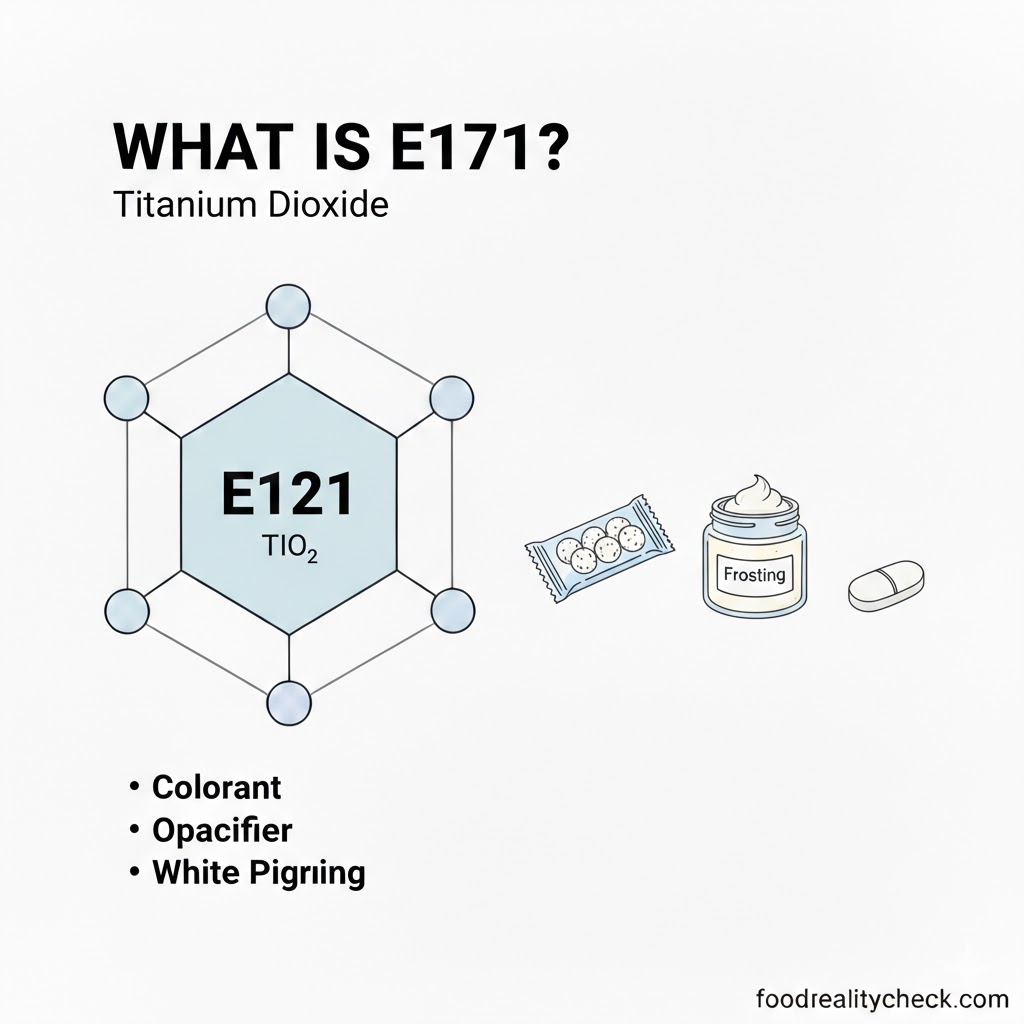
What is E171?
Complete guide to understanding E171 (Titanium Dioxide) in your food
The Quick Answer
E171 is a synthetic white mineral pigment made from titanium dioxide containing nanoparticles.
It’s used in foods to make them appear whiter, brighter, and more visually appealing.
It has been officially banned in the EU (since August 2022) due to genotoxicity concerns—making it one of the very few food additives actually removed from approval after decades of use.
📌 Quick Facts
- Category: Synthetic white colorant/pigment (contains up to 50% nanoparticles)
- Chemical Name: Titanium dioxide (TiO₂)
- Found in (historically): Cake icings, chocolate, sweets, chewing gum, breadcrumbs, yogurts, cheeses, sauces
- Safety Status: BANNED in EU (August 7, 2022); France banned in 2020; Still approved in USA (FDA)
- Reason for Ban: EFSA concluded genotoxicity cannot be ruled out; nanoparticle accumulation in body
- ADI: Cannot be established (no safe level determined)
What Exactly Is It?
E171 is a white powder made from titanium dioxide particles with a critical difference: it contains up to 50% nanoparticles smaller than 100 nanometers.
Its chemical formula is TiO₂.
E171 is synthetically manufactured—though titanium dioxide exists naturally as the mineral rutile, the food-grade E171 is produced industrially with specific particle size distributions.
It appears as a bright white powder, insoluble in water, used primarily for its opacifying (whitening) properties in foods.
The critical concern: E171 is NOT pure micron-sized particles. It contains a significant proportion of nanoparticles—particles smaller than 100 nanometers—that can behave differently from larger particles, potentially accumulating in organs.
Where You Found It (Historical)
E171 historically appeared in many common foods (before EU ban):
• Cake icings and frostings
• Breadcrumbs and coatings
• Chocolate and confectionery
• Chewing gum
• Yogurts and dairy desserts
• Cheese and processed cheese
• Sauces and condiments
• Candies and sweets
• Marshmallows
• Nutritional supplements
• Toothpastes (still permitted in many jurisdictions)
• Medicines and pharmaceuticals (6,000+ medications in EU contained it)
Current Status: E171 is banned in the EU food supply as of August 7, 2022. It remains approved in the USA and some other countries, though usage has declined due to regulatory uncertainty.
Why Did Food Companies Use It?
E171 served one purpose before the ban: provide bright white coloring and opacity to foods.
Food manufacturers preferred it because:
Exceptional whiteness: No other natural white pigment provides the same intense, pure white as titanium dioxide.
Opacity: Covers underlying colors and imperfections, making foods look whiter and fresher.
Cost-effective: Cheaper than natural alternatives like calcium carbonate or talc.
Stable: Resists degradation from heat, light, and acid/alkali.
Historical safety record: Used for 60+ years with regulatory approval.
What Happened? Why Was It Banned?
The pivotal moment came in May 2021 when the EFSA fundamentally reversed its safety assessment.
Timeline:
• 1971-2020: E171 approved in EU, considered safe for decades
• 2016: EFSA conducted safety review, said more data needed
• 2019: France’s ANSES published report expressing concerns about genotoxicity
• January 2020: France banned E171 unilaterally based on safety concerns
• May 6, 2021: EFSA published groundbreaking updated safety assessment concluding E171 “can no longer be considered safe,” citing genotoxicity concerns and inability to rule out DNA damage
• October 8, 2021: EU Standing Committee voted to ban E171
• August 7, 2022: Ban took effect across EU
What Are The Health Concerns?
E171 poses multiple health concerns identified by EFSA, leading to its ban:
Genotoxicity (DNA Damage): The primary reason for the ban. EFSA concluded “a concern for genotoxicity of TiO₂ particles cannot be ruled out.” Studies show titanium dioxide nanoparticles can induce DNA strand breaks and chromosomal damage. No threshold dose (safe level) could be identified where genotoxicity wouldn’t occur.
Nanoparticle Accumulation: Although gastrointestinal absorption of E171 is low (1-5%), the titanium dioxide nanoparticles that ARE absorbed can accumulate in organs (liver, spleen, kidneys) and lymph nodes over time. Chronic accumulation raises long-term toxicity concerns.
Immunotoxicity & Inflammation: Studies show E171 consumption can trigger immune system dysfunction and inflammatory responses. E171 can promote chronic inflammation in the gastrointestinal tract, potentially increasing disease risk.
Neurotoxicity: Titanium dioxide nanoparticles have been linked to neurotoxic effects, particularly potential impacts on brain development and function. Nanoparticles can cross the blood-brain barrier.
Aberrant Crypt Foci (Pre-cancerous Lesions): Some E171 studies observed aberrant crypt foci (ACF) in the colon—microscopic lesions considered pre-cancerous markers associated with colorectal cancer risk. However, this finding was inconsistent across studies.
Reproductive & Developmental Toxicity (Uncertain): Animal studies examining reproductive effects were inconsistent. EFSA noted data gaps but couldn’t definitively rule out reproductive concerns.
Carcinogenicity (Unproven but Uncertain): No animal studies were specifically designed to test carcinogenicity of E171 nanoparticles. The combination of genotoxicity + nanoparticle accumulation + ACF observations raised carcinogenic potential concerns.
Why the Reversal from “Safe” to “Unsafe”?
Key factors leading to EFSA’s reversal:
1. New Nanotoxicology Methodology: EFSA applied new 2018 nanotoxicology guidance for the first time. Previous assessments hadn’t properly distinguished nanoparticle behavior from bulk particles. Nanoparticles have unique properties—smaller size = greater cellular uptake, potential for organ accumulation.
2. Nanoparticle Content Recognition: Regulatory focus shifted to the fact that E171 contains up to 50% nanoparticles (< 100 nm). Previous assessments treated E171 as a bulk material.
3. New Genotoxicity Data: Recent studies provided credible evidence that TiO₂ nanoparticles can damage DNA through oxidative stress mechanisms. No threshold dose was identified.
4. Precautionary Principle: Given multiple concerning observations (genotoxicity potential + accumulation + inflammation + ACF), EFSA applied the precautionary principle: when uncertainty exists about safety, restrictions are warranted.
Is E171 Safe? Current Regulatory Positions
Regulatory divergence on E171 safety:
EU Position (Protective): BANNED since August 2022. EFSA determined E171 “can no longer be considered safe” due to genotoxicity concerns and inability to establish a safe intake level.
FDA Position (Permissive): Still approved in the USA. The FDA has not banned E171 and maintains it is safe for consumption. The FDA disputes EFSA’s interpretation of genotoxicity data.
UK Position (Uncertain): The UK’s Committee on Toxicity (COT, 2024) noted the EFSA safety concerns but stated it would conduct its own review. Currently, E171 remains authorized in Great Britain pending this review.
Australia/New Zealand (Permissive): FSANZ conducted its own review and concluded there is “no evidence to suggest that dietary exposures to food-grade E171 titanium dioxide particles are a concern for human health,” disagreeing with EFSA.
Natural Alternatives
Food companies now use natural white colorants instead of E171:
• Calcium carbonate – natural white mineral (chalk)
• Rice flour – natural white opacifier
• Talc – natural mineral (though also controversial)
• Diatomaceous earth – natural silica-based white powder
• No coloring – accept naturally colored products
• Titanium dioxide without nanoparticles – larger particle-sized TiO₂ (not currently approved for food in EU)
The Bottom Line
E171 is a synthetic white pigment containing titanium dioxide nanoparticles that was officially banned in the EU (August 2022) after EFSA concluded it “can no longer be considered safe” due to genotoxicity (DNA damage) concerns and nanoparticle accumulation.
Historic Significance: This is one of the very few cases where a food additive, after being approved and widely used for decades, was actually removed from approval based on new safety evidence. It represents a shift toward more protective nanotoxicology assessments.
Regulatory Divergence: The FDA still approves E171 in the USA, disagreeing with EFSA’s assessment. This reflects genuine scientific disagreement about risk and regulatory philosophy—precautionary (EU) vs. permissive (USA).
If you’re in the EU: E171 is banned in foods as of August 2022. Products may still contain it from manufacturing before the cutoff, but new products should not.
If you’re outside the EU: E171 remains approved in the USA, Canada, UK (pending review), and Australia. If you’re concerned about nanoparticle accumulation and DNA damage potential, minimizing consumption of brightly whitened foods is prudent until regulatory clarity emerges.
Broader Implication: E171’s ban signals that regulatory agencies are increasingly scrutinizing nanoparticles in food. Other synthetic additives containing nanoparticles may face similar reviews in coming years.