What is E200?
Complete guide to understanding E200 (Sorbic Acid) in your food
The Quick Answer
E200 is sorbic acid—a chemically-synthesized preservative that inhibits growth of molds, yeasts, and some bacteria in foods, extending shelf-life by preventing microbial spoilage.
It’s used in cheeses, baked goods, fruit juices, jams, beverages, and processed meats.
It is considered safe by regulatory authorities with no major health concerns at approved food-use levels. EFSA and FDA have set ADIs with comfortable safety margins. Sorbic acid is regarded as one of the safest preservatives with the lowest allergenic potential of all food preservatives. Rare individual sensitivities may cause mild digestive or skin effects, but general population risks are very low at regulatory use levels.
📌 Quick Facts
- Category: Chemically-synthesized preservative (antimicrobial)
- Chemical Name: 2,4-Hexadienoic acid or sorbic acid
- Chemical Formula: C₆H₈O₂
- Appearance: Colorless needle-like crystals or white crystalline powder; tasteless and odorless
- Natural Source: Occurs naturally in rowan berries and some fruits; food-grade E200 is chemically synthesized
- Found in: Cheeses, baked goods, fruit juices, jams, yogurt, wine, beverages, processed meats, dried fruits
- Safety Status: FDA GRAS; EFSA approved; ADI 11 mg/kg body weight/day (for sorbic acid + potassium sorbate combined); globally approved
- Key Advantage: One of the safest and most effective preservatives; lowest allergenic potential of all food preservatives
What Exactly Is It?
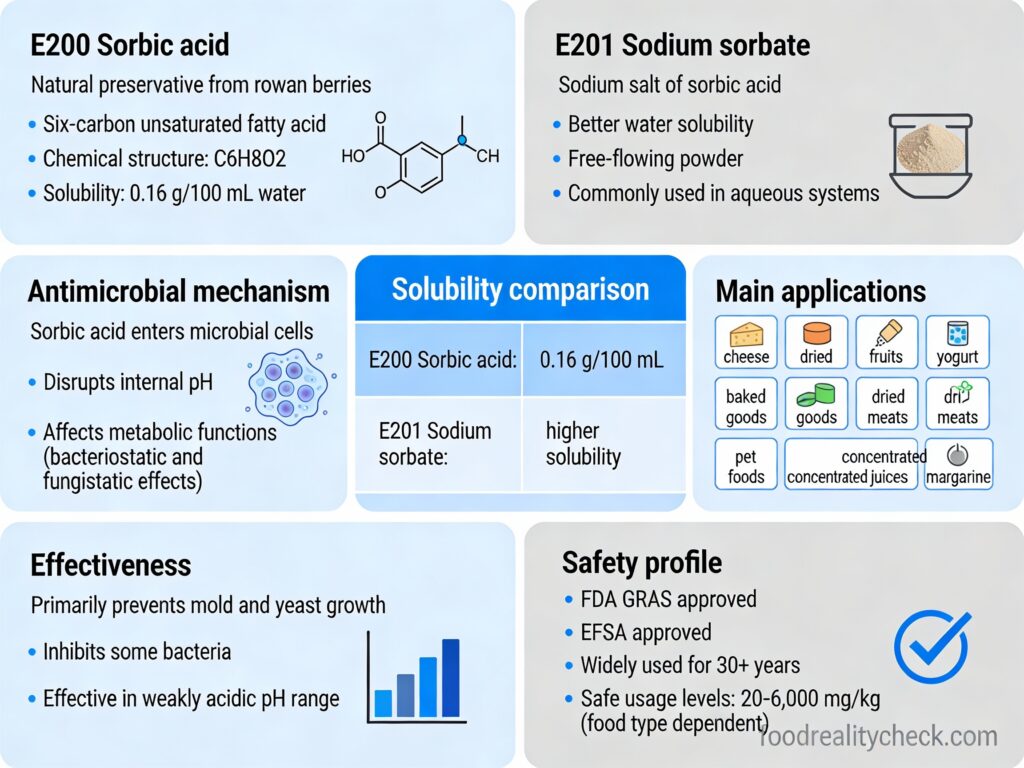
E200 is sorbic acid—a chemically-synthesized unsaturated six-carbon fatty acid that functions as a preservative by inhibiting growth of molds, yeasts, and some bacteria.
Chemical formula: C₆H₈O₂; molecular weight 112.13.
E200 appears as colorless needle-like crystals or white crystalline powder that is slightly soluble in water (0.16 g/100 mL at 20°C). Its low water solubility is why potassium sorbate (E202, more water-soluble) is more commonly used in aqueous foods, while E200 is used in low-water-content products like baked goods, cheese, and dried fruits.
Production: Sorbic acid is chemically synthesized from ketene and crotonaldehyde, or from other chemical precursors. While sorbic acid occurs naturally in small amounts in rowan berries (Sorbus aucuparia) and some other fruits, the amounts are negligible; all food-grade E200 is chemically synthesized for consistency and purity.
Mechanism: Sorbic acid’s antimicrobial action is strongest at pH below 6.5 (acidic conditions). The undissociated sorbic acid molecules can cross microbial cell membranes and disrupt essential metabolic pathways, inhibiting mold, yeast, and some bacterial growth. It is bacteriostatic (inhibits growth) rather than bactericidal (kills) for most microorganisms.
Metabolism: In the human body, sorbic acid is rapidly absorbed and metabolized via β-oxidation pathways to carbon dioxide and water. It does not accumulate in tissues or organs.
Where You’ll Find It
E200 appears in many preserved foods:
• Cheese and cheese products (primary use)
• Baked goods (breads, cakes, pastries)
• Fruit juices and soft drinks
• Jams, jellies, and preserves
• Yogurt and dairy products
• Wine and fermented beverages
• Processed and cured meats
• Dried fruits
• Salad dressings and sauces
• Pet food
• Cosmetics and personal care products
E200 is one of the most widely used food preservatives globally, particularly valued for cheese preservation where it’s selective against molds while not affecting beneficial lactic acid bacteria.
Why Do Food Companies Use It?
E200 serves critical functional advantages:
Highly effective mold and yeast inhibition: Primary function is preventing mold and yeast spoilage—major causes of food waste and foodborne illness. E200 is particularly effective in these functions.
Selective preservation: In cheese production, E200 inhibits molds and yeasts while not affecting beneficial lactic acid bacteria, making it ideal for fermented dairy products.
Low use levels: Effective at very low concentrations (0.025-0.1%), making it cost-effective and enabling labeling simplicity.
Safety track record: FDA GRAS designation and 50+ years of global use with excellent safety profile reduce manufacturer liability.
pH compatibility: Works effectively in acidic and mildly acidic products (pH <6.5), suitable for many food types.
Metabolism reassurance: Rapidly metabolized to harmless CO₂ and water—does not accumulate in organs or tissues.
Minimal impact on taste and aroma: Does not impart strong off-flavors when used at proper levels.
Is It Safe?
Yes—E200 is considered safe by regulatory authorities with no major health concerns at approved food-use levels. EFSA and FDA have set protective ADIs with comfortable safety margins. Sorbic acid is regarded as one of the safest preservatives with the lowest allergenic potential among all food preservatives.
The FDA classifies sorbic acid as GRAS (Generally Recognized As Safe).
The EFSA in 2019 established a group ADI of 11 mg/kg body weight per day for sorbic acid (E200) and potassium sorbate (E202) combined, based on comprehensive review of toxicological data.
The JECFA (WHO Expert Committee) also approved sorbic acid as safe for food use.
✓ GREEN SAFETY RATING – SAFE: E200 has:
• No documented genotoxicity (DNA damage) at approved levels
• No documented carcinogenicity at food-use levels
• No documented reproductive or developmental toxicity at food levels
• No documented organ toxicity at food-use levels
• Very low acute toxicity
• Does not bioaccumulate; rapidly metabolized to CO₂ and water
• Lowest allergenic potential of all food preservatives
• ADI with comfortable safety margin: 11 mg/kg body weight/day
• 50+ years of safe global use without serious adverse event reports
• FDA GRAS designation (highest safety confidence)
This is a solid green rating—one of the safest preservatives available.
What Are The Health Concerns?
E200 has no major documented health concerns at food-use levels. However, some minor considerations exist for sensitive individuals:
No health concerns at food-use levels: EFSA, FDA, and JECFA all concluded no adverse effects at approved levels. Typical consumer intakes are well below the ADI.
Rare allergic hypersensitivity (very uncommon): While sorbic acid has “the lowest sensitizing properties of all preservatives,” extremely rare individuals may experience hypersensitivity reactions such as hives, dermatitis, or skin/eye irritation. This is exceptional, not common.
Mild gastrointestinal effects (high local concentrations only): Sensitive individuals may experience mild oral or gastric irritation only at very high local concentrations well above food-use levels. Normal food consumption poses no risk.
Potential microbiome effects (under investigation): One mouse study showed potassium sorbate (sorbic acid salt) reduced bacterial diversity in gut flora. However, human impact cannot be assessed; long-term population use has shown no documented harm.
In vitro cell damage (non-food relevant): Test tube experiments at high doses show cell damage; this does NOT translate to in vivo effects at food-use levels and has not been documented in humans.
No carcinogenicity documented: Extensive testing shows no evidence of cancer risk at food-use levels.
Safe for children and special populations: E200 is approved for all population groups including infants in special dietary foods, pregnant women, and elderly.
Natural vs Synthetic Version
E200 is chemically synthesized—it does not occur naturally in foods at meaningful levels.
While sorbic acid occurs naturally in trace amounts in rowan berries (Sorbus aucuparia) and some other fruits, the amounts are negligible and not harvested commercially. All food-grade E200 is chemically synthesized for consistency, purity, and cost-effectiveness.
Natural Alternatives
Want to avoid E200?
Alternative preservatives include:
• Benzoic acid (E210) – chemically-synthesized preservative (similar safety profile)
• Ascorbic acid (E300/Vitamin C) – natural antioxidant (less effective as preservative)
• Rosemary extract – natural antioxidant
• Salt-based preservation – traditional method (high sodium)
• Refrigeration/Freezing – alternative preservation methods
• Accept shorter shelf-life – consume fresh foods quickly without preservatives
The Bottom Line
E200 (Sorbic Acid) is a chemically-synthesized preservative that is considered safe by all major regulatory authorities with no major health concerns at approved food-use levels. EFSA set an ADI of 11 mg/kg body weight per day; FDA classifies it as GRAS. E200 is regarded as one of the safest preservatives with the lowest allergenic potential among all food preservatives.
Regulatory Consensus: FDA GRAS, EFSA approved (ADI 11 mg/kg), JECFA approved—unanimous safety agreement from major authorities.
Excellent Safety Profile: 50+ years of global use without serious adverse event reports; FDA considers it the highest safety category (GRAS).
Lowest Allergenic Potential: Scientific literature indicates sorbic acid has “by far the lowest sensitizing properties of all preservatives,” making it ideal for sensitive populations.
Rapid Metabolism: Quickly absorbed and metabolized to harmless CO₂ and water; does not accumulate in organs or tissues.
Comfortable ADI Safety Margin: Current ADI of 11 mg/kg is protective; typical consumer intakes are well below this level.
No Carcinogenicity Documented: Extensive testing shows no cancer risk at food-use levels.
Rare Allergic Reactions: While extremely rare individuals may experience hypersensitivity reactions, sorbic acid has the lowest sensitizing properties of all preservatives.
Effective Mold/Yeast Prevention: Particularly valuable in cheese preservation where it prevents mold while preserving beneficial bacteria.
Recommendation: E200 is safe and beneficial. It is NOT something most people should avoid. For general consumers, sorbic acid is one of the safest preservatives available and has been approved for over 50 years with excellent safety data. Those with documented sorbic acid sensitivity can avoid it, but population-wide avoidance is not warranted. E200 is significantly safer and more dependable than alternatives like benzoic acid, making it preferred by safety-conscious manufacturers.