What is E202?
Complete guide to understanding E202 (Potassium Sorbate) in your food
The Quick Answer
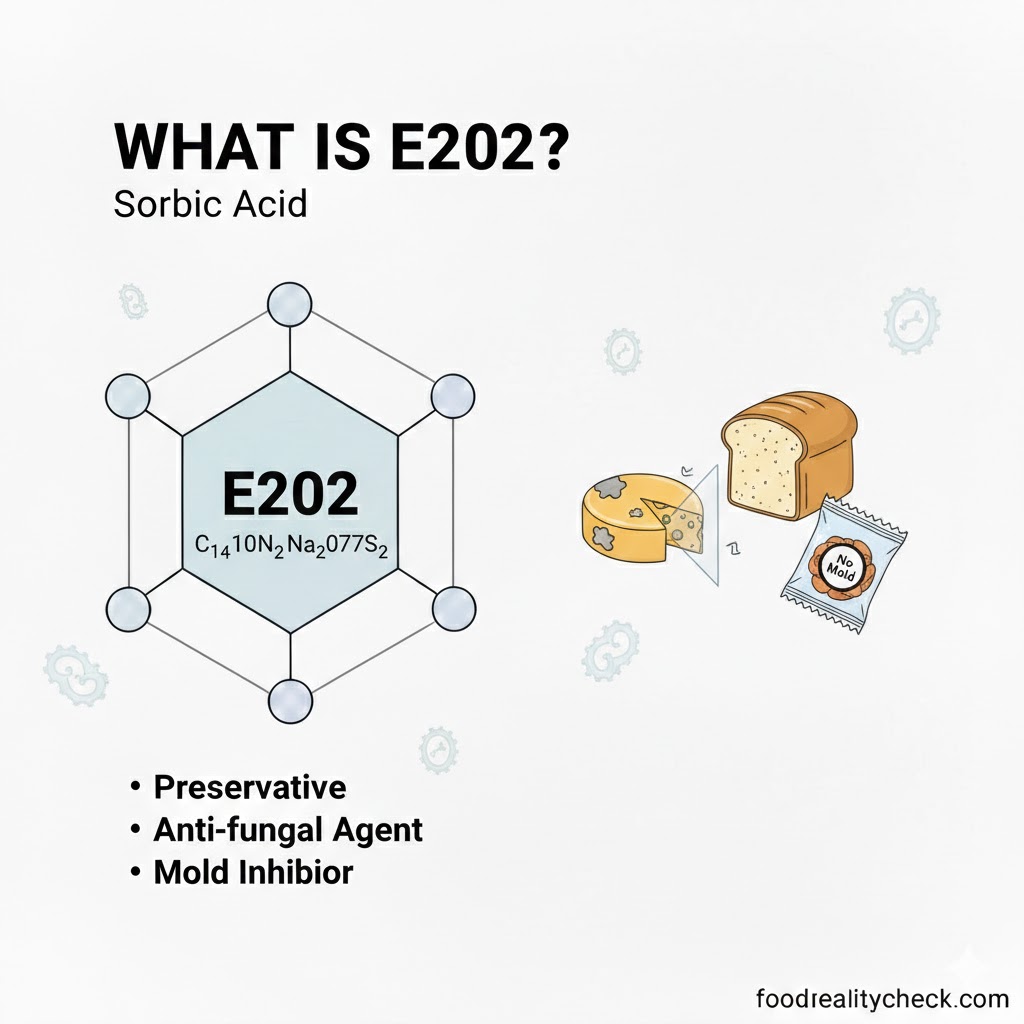
E202 is a synthetic preservative that prevents mold and yeast growth.
It’s used in food to extend shelf-life and prevent spoilage without refrigeration.
It’s widely considered one of the safest preservatives available, with minimal health risks at approved levels.
📌 Quick Facts
- Category: Preservative (antimicrobial agent)
- Chemical Name: Potassium salt of sorbic acid (potassium 2,4-hexadienate)
- Found in: Wine, cheese, baked goods, beverages, dried fruits, cured meats
- Safety: Generally Recognized as Safe (GRAS) by FDA; extensively approved globally
- ADI (EFSA/JECFA): 25 mg/kg body weight per day (group limit for sorbic acid E200 + potassium sorbate E202)
What Exactly Is It?
E202 is a synthetic salt compound made by combining sorbic acid with potassium hydroxide.
Its chemical name is potassium 2,4-hexadienate or potassium hexa-2,4-dienoate (C₆H₇O₂K).
Sorbic acid was first isolated from rowan berries (Sorbus aucuparia) in the 1850s, but modern E202 is entirely synthetically manufactured for food use.
It appears as a white crystalline powder with neutral odor, highly soluble in water (unlike sorbic acid alone, which is poorly soluble).
The antimicrobial active ingredient is sorbic acid, which is released when potassium sorbate dissolves in food.
Where You’ll Find It
E202 appears in many common foods:
• Wine and fermented beverages (wine stabilizer to prevent refermentation)
• Cheese and dairy products (inhibits mold/yeast on rinds and in processed cheese)
• Baked goods (bread, cakes, muffins, pastries)
• Fruit juices and soft drinks
• Dried fruits and raisins
• Cured and processed meats (fish, ham, sausages)
• Cider and mead
• Confectionery and icings
• Pickles and relishes
• Jams and preserves
• Margarine and spreads
• Salad dressings and sauces
Potassium sorbate is one of the most widely used preservatives globally—far more common than sodium sorbate (E201) or calcium sorbate (E203).
Why Do Food Companies Use It?
E202 serves one critical function: prevent mold, yeast, and some bacterial growth.
It works by disrupting microbial cell membranes and metabolic processes, effectively stopping spoilage organisms from proliferating.
E202 is effective particularly in acidic foods (pH < 6.5), making it ideal for:
Wine preservation: Stops refermentation after bottling, preventing exploding bottles and vinegar spoilage.
Cheese ripening: Prevents mold and yeast from colonizing cheese surfaces during aging.
Baked goods: Extends shelf-life from days to weeks by preventing mold growth.
Dried fruits: Prevents mold proliferation in moisture-prone products.
Cost reduction: Allows manufacturers to reduce added preservatives like salt, sugar, or heat treatment—all expensive preservation methods.
Is It Safe?
Yes, E202 is widely considered one of the safest preservatives available.
The FDA classifies potassium sorbate as “Generally Recognized as Safe” (GRAS) with no daily intake limit specified—a classification indicating minimal safety concern.
The EFSA and WHO Expert Committee (JECFA) established a group ADI of 25 mg/kg body weight per day for sorbic acid (E200) and potassium sorbate (E202) combined.
To reach this limit, an adult would need to consume approximately 1,750 mg (1.75 grams) of potassium sorbate daily—far exceeding realistic food consumption.
Potassium sorbate is metabolized rapidly in the body via β-oxidation (fatty acid metabolism) and eventually breaks down into water and CO₂, the same endpoint as natural fat metabolism.
What Are The Health Concerns?
E202 has relatively few documented health concerns, though some minor issues exist:
Rare allergic reactions: In very rare cases, sensitive individuals report allergic dermatitis, hives, or hypersensitivity reactions to sorbates. However, true allergies are uncommon—most reactions are sensitivities rather than IgE-mediated allergies.
Microbiome alteration: Some animal studies suggest potassium sorbate may reduce bacterial diversity in the gut microbiome. However, human studies are limited, and the clinical significance remains unclear. Most people show no adverse health effects.
Skin/respiratory irritation (undiluted form): Concentrated potassium sorbate powder can irritate skin, eyes, and airways. However, the dilute amounts in food pose no risk.
Genotoxicity debate: In vitro (test tube) studies at very high concentrations showed cell damage, but these doses are incompatible with human food consumption and have no in vivo (human body) evidence of harm.
Historical sodium sorbate (E201) banning: Sodium sorbate (the sodium salt) was banned in Germany until 1998 due to mutagenic concerns, but potassium sorbate (E202) and calcium sorbate (E203) were retained and approved. This distinction shows regulatory confidence in the non-sodium forms.
Overall, E202 is considered exceptionally safe among food preservatives.
Natural vs Synthetic Version
E202 is entirely synthetically manufactured.
While sorbic acid was historically first isolated from rowan berries, modern E202 potassium sorbate is produced through laboratory synthesis:
Sorbic acid is synthesized by condensing ketene with crotonaldehyde, then neutralized with potassium hydroxide to form potassium sorbate.
No commercial E202 is extracted from berries; all is synthetic.
Natural Alternatives
Want to avoid E202?
Food companies sometimes use natural preservation methods:
• Salt (sodium chloride) – ancient preservation method
• Sugar – high sugar content preserves (jams, syrups)
• Vinegar (acetic acid) – natural acidulant and preservative
• Lactic acid fermentation – natural preservation (kombucha, kimchi, sauerkraut)
• Heat treatment/pasteurization – kills microbes thermally
• Refrigeration or freezing – slows microbial growth
• Nisin (E234) – natural bacteriocin from lactic acid bacteria
• Natamycin (E235) – natural antifungal from Streptomyces bacteria
However, these alternatives are often more expensive, less effective, or alter taste/texture, so E202 remains the industry standard for extending shelf-life safely.
The Bottom Line
E202 is a synthetically manufactured preservative considered one of the safest food additives available globally.
Regulatory bodies (FDA, EFSA, JECFA) extensively studied it and found no safety concerns at approved use levels.
It’s metabolized as a fatty acid, breaking down into water and CO₂—the same endpoint as natural fat metabolism.
Rare allergic sensitivities exist, but true food allergies to potassium sorbate are uncommon.
The main health considerations are microbiome effects (still being studied in humans) and the rare allergic reaction.
For most people, E202 in food at approved levels is safe and actually improves food safety by preventing mold and spoilage.