What is E219?
Complete guide to understanding E219 (Sodium Methylparaben) in your food
The Quick Answer
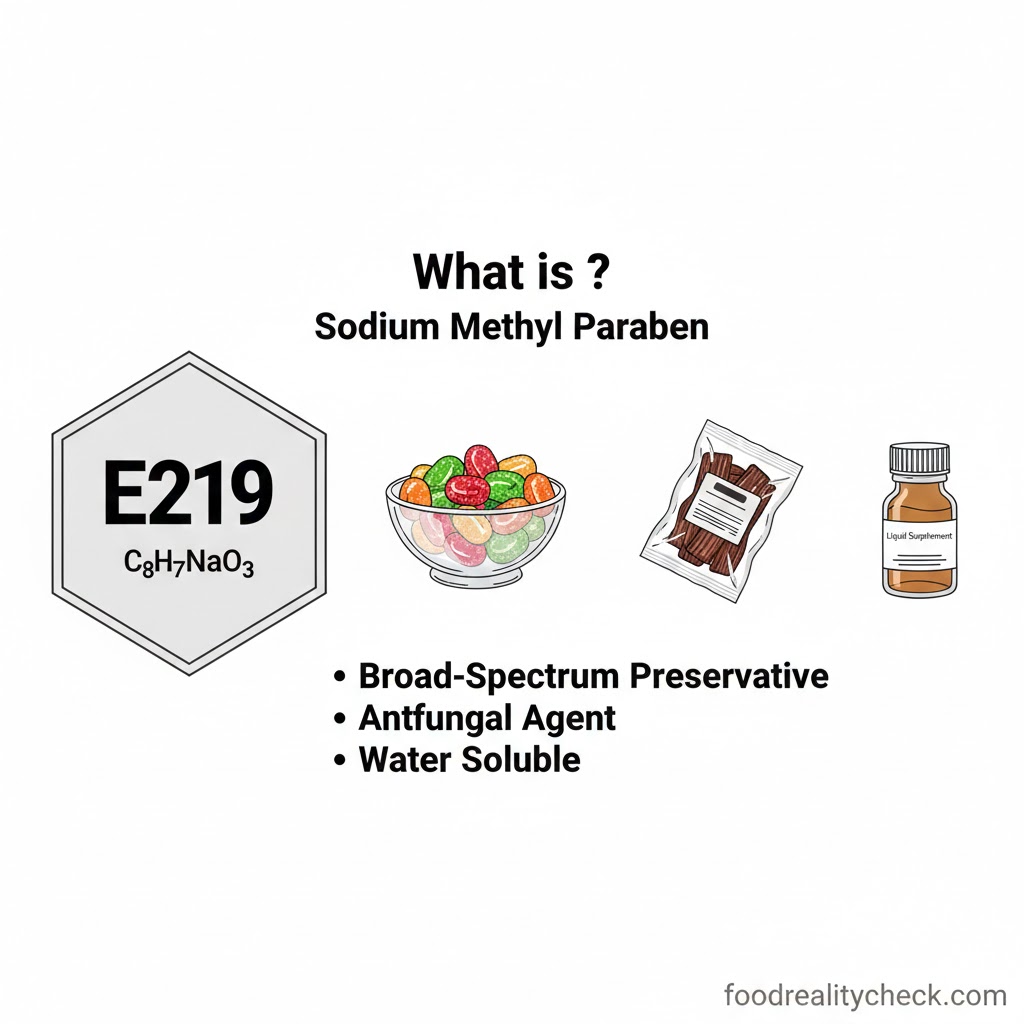
E219 is sodium methylparaben (sodium methyl p-hydroxybenzoate), a synthetic preservative used to prevent bacterial, fungal, and yeast spoilage in foods, beverages, cosmetics, and pharmaceuticals.
It’s used to extend shelf life and maintain food safety—preventing mold and yeast growth particularly in baked goods, beverages, and processed foods.
Most people consuming soft drinks, beverages, baked goods, and processed foods regularly encounter E219, though it remains one of the more controversial food additives due to concerns about potential endocrine disruption and allergic reactions despite regulatory approval.
📌 Quick Facts
- Category: Synthetic Preservative, Paraben, Antimicrobial Agent
- Source: Fully synthetic; sodium salt of methylparaben derived from p-hydroxybenzoic acid
- Found in: Soft drinks, beverages, baked goods, jams, dairy products, processed meats, sauces, cosmetics, pharmaceuticals
- Safety: FDA GRAS approved; EFSA approved; JECFA ADI 0-10 mg/kg body weight
- Natural or Synthetic: Fully synthetic (though methylparaben occurs naturally in small quantities in some fruits)
- Vegan/Vegetarian: Yes
- Key Concern: Potential endocrine disruption; allergic reactions; debate about estrogenic activity at food levels
- Chemical Formula: C₈H₇O₃Na; sodium salt of methylparaben
What Exactly Is It?
E219 is sodium methylparaben, the sodium salt of methylparaben (methyl p-hydroxybenzoate). The chemical formula is C₈H₇O₃Na with molecular weight of 174.13 g/mol.
Methylparaben is a compound consisting of a p-hydroxybenzoic acid core with a methyl ester group (—COOCH₃). The sodium salt form (E219) is created by adding sodium, making it more water-soluble than the non-sodium form (E218). This increased water solubility makes the sodium form particularly useful in water-containing food and cosmetic products.
Physically, E219 appears as a white to off-white crystalline powder that is odorless or nearly odorless. It is freely soluble in water and moderately soluble in ethanol, making it suitable for aqueous food systems and beverages. The compound is thermally stable—resistant to degradation across typical food processing temperature ranges (up to approximately 160°C).
E219 is one of several paraben preservatives: methylparaben (E218, the non-sodium form) is the smallest ester; propylparaben (E216), butylparaben (E215), and their sodium salts follow with increasing hydrocarbon chains. Methylparaben and E219 are the most commonly used in food applications due to their balance of antimicrobial efficacy and regulatory acceptance.
Where You’ll Find It
E219 appears in a wide range of foods and beverages:
• Soft drinks and non-alcoholic beverages
• Fruit juices and juice drinks
• Syrups and concentrates
• Baked goods (bread, cakes, pastries)
• Confectionery and candies
• Jams, jellies, and fruit spreads
• Processed fruit and vegetables
• Dairy products (yogurt, milk drinks)
• Salads and ready-to-eat meals
• Mayonnaise and salad dressings
• Sauces and condiments
• Fish and shellfish products
• Processed meats (sausages, pâté)
• Seasonings and spice mixes
• Oils and oil-based products
• Cosmetics (creams, lotions, shampoos)
• Pharmaceuticals (tablets, syrups)
• Toothpastes and oral care products
E219 is particularly common in products with significant water content where fungal and yeast contamination is a primary risk—beverages, baked goods, and processed foods.
Why Do Food Companies Use It?
E219 performs one critical function:
Broad-spectrum antimicrobial preservation: E219 is particularly effective against yeasts and molds (which cause spoilage in beverages and baked goods) while being less effective against bacteria. It works across a wide pH range, making it suitable for acidic beverages (soft drinks, fruit juices) and neutral/slightly alkaline products. The sodium salt form’s water solubility makes it particularly valuable for aqueous systems.
Why it’s used selectively: Despite regulatory approval, E219 is becoming less common in premium and health-conscious brands due to consumer concerns about parabens and endocrine disruption (whether scientifically justified or not). Manufacturers increasingly market “paraben-free” products, using alternative preservatives like sorbic acid, benzoic acid, or natural preservatives (rosemary extract, grapefruit seed extract). The shift reflects consumer perception rather than demonstrated safety deficiencies.
Is It Safe?
E219’s safety status is officially approved but remains contested, with significant consumer and scientific controversy.
Regulatory Status:
• FDA (USA): Generally Recognized As Safe (GRAS) for food use
• EFSA (Europe): Approved as direct food additive (E219)
• JECFA (WHO/FAO): ADI 0-10 mg/kg body weight per day
⚠️ Controversial Safety Concerns—Evidence of Potential Effects: Despite regulatory approval, E219 faces significant scientific and consumer concerns:
• Estrogenic activity and endocrine disruption: Research demonstrates that methylparaben (and other parabens) can bind to estrogen receptors, potentially mimicking estrogen activity in the body. While regulatory agencies argue this occurs only at concentrations far exceeding food levels, the debate persists about cumulative exposure from multiple sources (cosmetics, foods, pharmaceuticals).
• Bioaccumulation in tissues: Research by Darbre et al. documented presence of parabens in breast tissue (though causality to breast cancer was not established). While absorption and urinary excretion rates suggest limited accumulation, some research suggests potential tissue-specific accumulation not captured by whole-body kinetics studies.
• Allergenicity and contact dermatitis: While paraben allergy prevalence (0.6-0.8%) is lower than some other preservatives, it remains a documented concern, particularly with cross-sensitivity to methylparaben (most common), propylparaben, and butylparaben.
• Reproductive and developmental effects: Animal studies document reproductive concerns at high doses (far exceeding food levels). While regulatory agencies conclude no reproductive toxicity at approved use levels, the evidence exists and creates caution, particularly for pregnant women and infants.
• Antibacterial versus broader antimicrobial profile: E219 is less effective against bacteria than yeasts and molds—meaning products containing E219 may still require additional bacteriostatic agents, reducing the additive’s efficiency.
• Cumulative exposure uncertainty: A significant unresolved issue is cumulative paraben exposure from cosmetics, pharmaceuticals, and foods. While each source individually uses regulated amounts, the combined daily exposure (estimated at 0.5-3.6 mg/kg bw/day depending on cosmetic use patterns) may approach or exceed some safety margins, particularly in heavy cosmetic users.
Documented toxicological findings:
• Acute toxicity: Very low; methylparaben is practically non-toxic by oral and injection routes
• Genotoxicity: Not genotoxic in standard assays
• Carcinogenicity: Not carcinogenic in animal studies; no conclusive evidence in humans
• Estrogenic activity: Documented in vitro and in some in vivo models, but at concentrations exceeding typical food exposure
• Reproductive toxicity: Animal studies show reproductive effects at very high doses; human relevance questioned by regulatory agencies
Regulatory Disagreement on Endocrine Effects
A key source of controversy is the disagreement about whether estrogenic activity at food levels poses real risk:
Regulatory agencies argue that in vitro evidence of estrogenic binding (documented by Darbre and others) occurs at concentrations (>10 μM) far exceeding physiological levels after food consumption. They emphasize that food-level exposure (estimated at 0.09-0.20 mg/kg bw/day in children; lower in adults) presents negligible estrogenic risk.
Critics counter that cumulative exposure from cosmetics + food + pharmaceuticals may create meaningful endocrine-active levels, particularly in children and heavy cosmetic users. The debate remains unresolved, with both positions having scientific merit but different risk tolerance levels.
Production Process
E219 is produced through chemical synthesis:
1. P-hydroxybenzoic acid is synthesized or sourced from petroleum-derived chemical precursors
2. The carboxylic acid group (—COOH) is esterified with methanol under acidic catalysis, creating methylparaben
3. The methylparaben is neutralized with sodium hydroxide or sodium carbonate, converting the compound to its sodium salt form (E219)
4. The product is crystallized, filtered, and dried
5. The final product is purified and standardized
The entire process is synthetic chemical creation—no natural extraction. However, methylparaben occurs naturally in small quantities in some fruits (blueberries, bananas), though in negligible amounts compared to food-additive levels.
Natural vs Synthetic Version
E219 is fully synthetic—there is no natural version.
While methylparaben occurs naturally in trace amounts in some fruits, commercial E219 is entirely synthetically produced. There is no practical source of extracted methylparaben from natural materials. All food-grade E219 is created through chemical synthesis.
Comparison with Other Preservatives
E219 occupies a contested position among food preservatives:
• E210 (Benzoic acid): Synthetic; broader antimicrobial spectrum than E219; less controversial regarding endocrine effects
• E211 (Sodium benzoate): Synthetic; water-soluble; less estrogenic concerns; more commonly used today
• E200 (Sorbic acid): Natural or synthetic; broader antimicrobial spectrum; less estrogenic concerns
• E202 (Potassium sorbate): Water-soluble version; similar benefits to sorbic acid
• E392 (Rosemary extract): Natural; documented antioxidant benefits; increasingly preferred alternative
• E216 (Propylparaben): Related synthetic paraben; similar endocrine concerns
• E214 (Butylparaben): Related synthetic paraben; similar endocrine concerns
The shift in the food industry is clearly away from parabens toward benzoic acid/sorbates and especially toward natural preservatives (rosemary extract, grapefruit seed extract), reflecting consumer preference even if regulatory agencies maintain parabens are safe.
Natural Alternatives Gaining Traction
E219 is increasingly replaced by alternatives:
• E392 (Rosemary extract): Natural; documented health benefits; increasingly preferred
• E211 (Sodium benzoate): Synthetic but more water-soluble; less endocrine concerns; FDA approved
• E200 (Sorbic acid): Effective against molds/yeasts; less bacterial effectiveness but considered safer
• Grapefruit seed extract: Natural; antimicrobial; increasingly used despite limited regulation
• Citric acid/vitamin C: Natural antioxidants; different mechanism than parabens
• Essential oils: Natural antimicrobial agents; variable efficacy
• Vacuum/modified atmosphere packaging: Non-chemical preservation reducing preservative need
The “paraben-free” movement has substantially reduced E219 use in consumer-facing products, replaced primarily by benzoic acid, sorbic acid, and natural preservatives.
Environmental and Sustainability
E219 production involves petroleum-derived chemical precursors and chemical synthesis creating moderate environmental footprint. Parabens have been detected in wastewater and aquatic environments, raising concerns about aquatic toxicity (though at concentrations exceeding typical discharge levels). Parabens are not readily biodegradable in conventional wastewater treatment, potentially accumulating in aquatic ecosystems. Overall environmental impact is negative compared to natural preservatives.
The Bottom Line
E219 (sodium methylparaben) is a fully synthetic preservative that is FDA GRAS approved, EFSA approved, and JECFA approved, but faces significant consumer and scientific controversy regarding potential endocrine disruption and allergic reactions despite official regulatory approval.
E219 functions as a broad-spectrum antimicrobial preservative, particularly effective against yeasts and molds, extending shelf life in beverages, baked goods, and processed foods. It is completely absorbed and excreted with no evidence of accumulation.
The official regulatory assessment maintains that E219 is safe at approved use levels, with paraben allergy rates (0.6-0.8%) notably lower than some other preservatives. However, research demonstrates estrogenic binding activity—whether this translates to meaningful physiological risk at food levels remains contested. The cumulative exposure from cosmetics, pharmaceuticals, and foods is a significant unresolved concern.
Notably, the food industry is voluntarily shifting away from parabens toward alternatives (benzoic acid, sorbic acid, natural preservatives) not due to regulatory mandates but due to consumer perception and marketed “paraben-free” positioning. This market-driven shift suggests that while regulatory agencies maintain safety, many manufacturers and consumers consider the controversy sufficient to warrant alternative choices.
For consumers seeking to minimize paraben exposure, reading labels for “paraben-free” claims and choosing products preserved with sorbic acid, benzoic acid, or natural preservatives is straightforward. Regulatory agencies continue to support E219 use, but the practical trajectory in consumer markets is toward alternatives—a situation where regulatory approval and consumer preference have diverged.