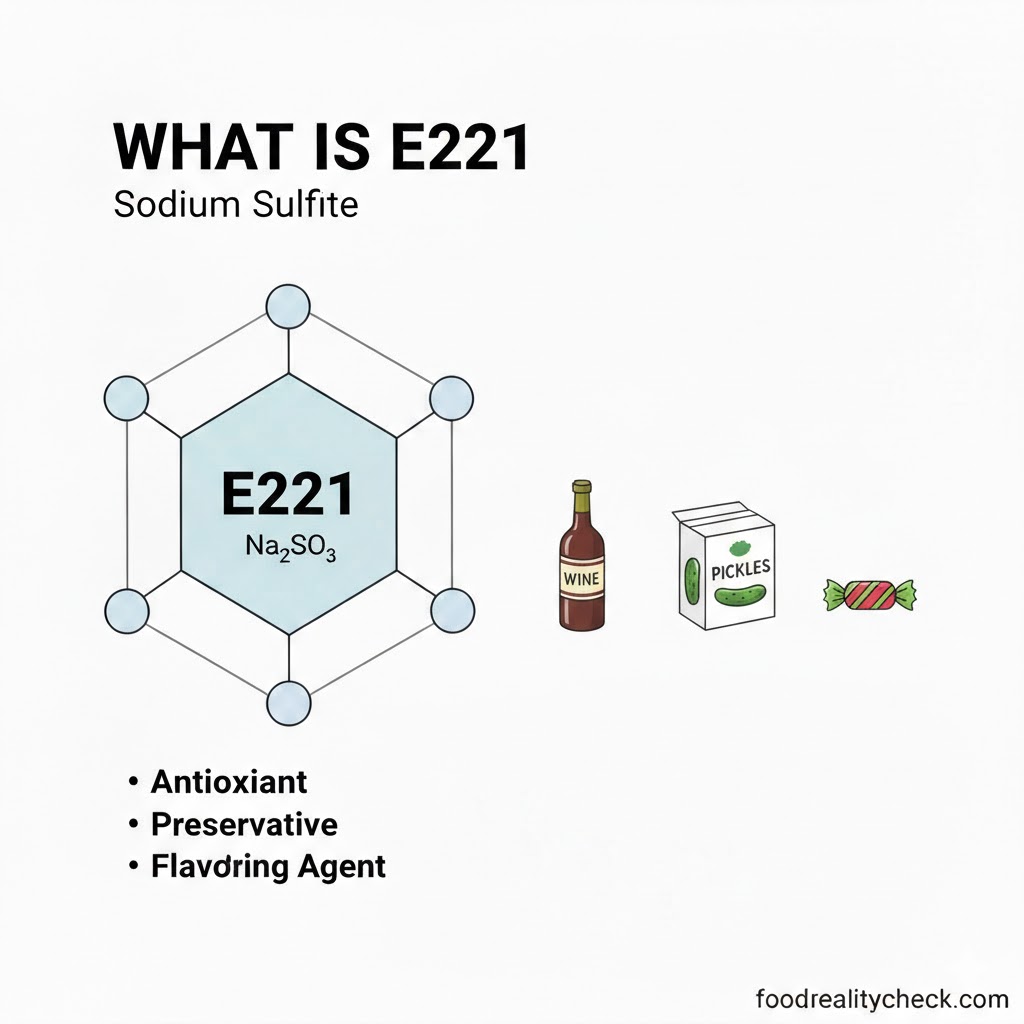
What is E221?
Complete guide to understanding E221 (Sodium Sulfite) in your food
The Quick Answer
E221 is sodium sulfite—a sodium salt of sulfurous acid that functions as a preservative, antioxidant, and bleaching agent to prevent spoilage and discoloration in dried fruits, vegetables, processed meats, and other foods.
CRITICAL SAFETY WARNING: E221 (and the broader sulfite family E220-E228) carries serious documented health risks, particularly for individuals with asthma. EFSA’s 2016 re-evaluation found that 60% of high consumers of sulfite-containing foods could belong to a group at risk of adverse health effects (margin of exposure below safe threshold). Key documented concerns include: (1) respiratory distress and bronchial constriction in 5-10% of chronic asthmatics, even at food-use levels; (2) allergic-like reactions (anaphylaxis, urticaria, swelling) documented in sensitive individuals; (3) destruction of vitamin B1 (thiamine); (4) promotion of harmful sulfur-reducing bacteria (Desulfovibrio) in the intestine potentially causing inflammatory bowel disease; (5) high consumption by adults (up to 2.6× ADI) and children (up to 12× ADI). This is NOT a safe additive for asthmatics or those with sulfite sensitivity, and represents a significant regulatory concern even at approved levels.
📌 Quick Facts
- Category: Synthetic preservative, antioxidant, bleaching agent; sodium salt of sulfurous acid
- Chemical Formula: Na₂SO₃
- Appearance: Unstable white powder; reacts with oxygen to form sulfate
- Safety Status: FDA approved; EFSA approved (but with safety warnings); JECFA approved
- ADI (Acceptable Daily Intake): 0.7 mg/kg body weight/day (but high consumers exceed this by 2.6-12×)
- Found in: Dried fruits, dried vegetables, processed meats, potato products, sauces, seafood, wine
- KEY CONCERN: EFSA 2016: 60% of high consumers at risk of adverse health effects; respiratory triggers; allergic reactions in sensitive individuals
- REGULATORY WARNING: The most common intolerance trigger among chemical food additives; mandatory labeling required
What Exactly Is It?
E221 is sodium sulfite—a sodium salt of sulfurous acid produced by dissolving sulfur dioxide in sodium carbonate or sodium hydroxide solution, functioning as a preservative and antioxidant through its reducing properties.
Chemical formula: Na₂SO₃; molecular weight 126.04.
E221 appears as unstable white powder that readily reacts with oxygen to form sulfate (oxidation). In acidic conditions, it forms sulfurous acid (H₂SO₃), which has strong preservative, oxidizing, and bleaching properties.
Production: Sodium sulfite is produced industrially by treating sulfur dioxide with sodium carbonate or sodium hydroxide solution.
Mechanism: Sulfites work by releasing sulfur dioxide gas and sulfurous acid in acidic conditions. These disrupt microbial metabolic processes, preventing growth of molds, yeasts, and bacteria. Additionally, sulfites act as reducing agents, binding to sugars and other compounds to prevent browning (enzymatic discoloration).
Where You’ll Find It
E221 (and related sulfites E220-E228) are widely used despite safety concerns:
• Dried fruits (apricots, raisins, figs; major use)
• Dried vegetables
• Potato products (flakes, powders, hash browns; major use)
• Processed meats (hamburger, sausage)
• Pickles and pickled vegetables
• Sauces and condiments (mustard, mayonnaise)
• Wine and beer
• Seafood (shrimp, crabs)
• Jams and preserves
• Soft drinks and beverages
• Canned fruits and vegetables
• Cereals
EFSA data shows sulfites are approved for 61 food groups throughout Europe—making them one of the most widely used preservatives.
🛑 RED SAFETY RATING – SERIOUS HEALTH RISK WARNINGS: E221 has:
• EFSA 2016: 60% of high consumers at risk of adverse health effects (margin of exposure below safe threshold)
• Documented respiratory distress in 5-10% of chronic asthmatics (bronchial constriction, wheezing, airway swelling)
• Documented allergic-like reactions: anaphylaxis, urticaria (hives), swelling, skin irritations, sneezing, runny nose, headaches
• Death reported in Canada from sulfite reaction; restaurant bans on sulfite additives implemented
• Asthma sufferers 13%+ more sensitive to sulfite reactions
• Vitamin B1 (thiamine) destruction when used in foods
• Promotes harmful gut bacteria (Desulfovibrio) potentially causing inflammatory bowel disease
• High consumer exposure: Adults consume up to 2.6× ADI; children up to 12× ADI
• Most common intolerance trigger among chemical food additives
• Mandatory labeling required (one of only 14 major allergens in UK)
This is markedly different from “safe” additives. E221 carries serious documented health risks, particularly for asthmatics. EFSA found 60% of high consumers at risk.
Is It Safe?
NO—Not for everyone. E221 carries serious documented health risks, particularly for individuals with asthma, known sulfite sensitivity, or high consumption patterns. While technically approved, EFSA’s 2016 re-evaluation explicitly found that 60% of high consumers could belong to a group at risk of adverse health effects. This is a significant regulatory warning.
EFSA’s 2016 comprehensive re-evaluation of sulfites noted:
“The EFSA working group on sulfur dioxide and sulfites calculated a margin of exposure (MOE) of 80, below which adverse health effects can no longer be safely excluded. Therefore, 60% of adult consumers who consume a large amount of sulfite-containing foods could belong to the group at risk of adverse health effects.”
This MOE warning is extraordinarily serious. An MOE below 80 indicates potential safety concerns.
What Are The Health Concerns?
E221 has multiple serious documented health concerns, not theoretical risks:
1. Respiratory Distress in Asthmatics (PROVEN): 5-10% of chronic asthma patients experience bronchial constriction, wheezing, respiratory distress, and airway swelling when exposed to sulfites. This is not theoretical—it’s documented clinical phenomenon affecting hundreds of thousands of people.
2. Allergic-Like Reactions (PROVEN): Documented reactions include anaphylactic shock (potentially fatal), urticaria (hives), angioedema (dangerous swelling), skin irritations, sneezing, runny nose, headaches, stomach pain, vomiting, and worsening eczema. A death in Canada was attributed to sulfite reaction, leading to restaurant bans on sulfite additives.
3. Asthma-Sulfite Sensitivity Link (DOCUMENTED): Studies show 13%+ of people with asthma also suffer from sulfite sensitivity—much higher than general population. If you have asthma, your risk is dramatically elevated.
4. EFSA Safety Margin Warning (CRITICAL): EFSA’s 2016 finding that 60% of high consumers are at risk of adverse health effects (MOE below 80) is a massive regulatory red flag. This means exposure levels for high consumers potentially exceed safe safety thresholds.
5. High Population Exposure (CONCERNING): Adults consume up to 2.6× the ADI; children up to 12× the ADI in typical Western diets. A single 125-gram hamburger with maximum permitted sulfites (450 mg/kg) exceeds the daily ADI for a 70-kg adult; a child would exceed their 15-kg limit by 4-fold.
6. Vitamin B1 Destruction: Sodium sulfite destroys thiamine (vitamin B1), reducing nutritional value of foods, particularly when used in rice bleaching.
7. Gut Dysbiosis and Inflammatory Bowel Disease (EMERGING RESEARCH): Some researchers suspect chronic inflammatory bowel diseases may be causally related to sulfite consumption. Sulfur-reducing bacteria (Desulfovibrio) proliferate on sulfite compounds and may damage intestinal mucosa, promoting inflammatory processes. This remains speculative but warrants caution.
8. Used to Mask Meat Spoilage (SAFETY/FRAUD CONCERN): Sulfites can illegally mask bacterial degradation in meat products by preventing browning while spoilage occurs invisibly—a serious food safety concern.
Regulatory Status and Inconsistencies
E221 remains approved despite serious documented concerns. This reflects regulatory caution but also illustrates regulatory limitations:
• Approved but cautioned: EFSA approved E221 but with explicit warnings about high-consumer risks and asthmatic sensitivity
• Mandatory labeling required: Sulfites are one of only 14 major allergens requiring label emphasis in UK, indicating regulatory acknowledgment of serious concerns
• Thresholds low: Only 10+ ppm triggers labeling requirements—some sensitive individuals react below this threshold
• High consumption unmonitor: Despite knowing 60% of high consumers are at risk, regulatory monitoring of actual consumption is lax
• Approved for 61 food groups: Extraordinarily broad approval in EU despite documented risks
Natural Alternatives
Want to avoid E221 and sulfites?
• Sorbic acid (E200) or potassium sorbate (E202) – alternative preservatives without asthma trigger concerns
• Ascorbic acid (E300/Vitamin C) – natural antioxidant
• Rosemary extract – natural antioxidant
• Salt-based preservation – traditional method
• Refrigeration/Freezing – avoid additives entirely
• Fresh products – accept shorter shelf-life without preservatives
The Bottom Line
E221 (Sodium Sulfite) is an approved preservative that carries serious documented health risks, particularly for asthmatics and high consumers. EFSA’s 2016 re-evaluation explicitly found that 60% of high consumers are at risk of adverse health effects. Respiratory distress, allergic reactions, and even anaphylaxis are documented. Mandatory labeling as a major allergen reflects regulatory acknowledgment of risks. High consumption by adults (2.6× ADI) and children (12× ADI) in typical diets exceeds safe levels. This is NOT a “safe” additive and should be avoided by asthmatics and those with sulfite sensitivity.
EFSA 2016 Critical Finding: 60% of high consumers at risk of adverse health effects; margin of exposure below safe threshold.
Documented Respiratory Risk: 5-10% of chronic asthmatics experience bronchial constriction and respiratory distress; 13%+ of asthmatic population has sulfite sensitivity.
Documented Allergic Reactions: Anaphylaxis, urticaria, angioedema, skin reactions, respiratory symptoms—even at food-use levels; death reported in Canada.
High Population Exposure Problem: Adults consume 2.6× ADI; children 12× ADI in typical diets; single hamburger can exceed daily ADI.
Mandatory Allergen Labeling: Sulfites are one of only 14 major allergens in UK, reflecting serious regulatory concern.
Vitamin B1 Destruction: Reduces nutritional value of foods where used.
Potential Gut Health Concern: May promote harmful bacteria (Desulfovibrio) and inflammatory bowel disease, though research ongoing.
Fraud/Safety Concern: Can be used illegally to mask meat spoilage.
Recommendation (STRONG): E221 should be avoided by asthmatics and those with documented sulfite sensitivity. For general population, awareness of high consumption rates and potential health effects is warranted. The fact that 60% of high consumers face adverse health risk per EFSA is a serious regulatory finding that should not be dismissed. Those concerned about health should prefer alternative preservatives (sorbic acid, ascorbic acid) or fresh products with shorter shelf-life. The regulatory approval of E221 despite documented risks reflects historical decisions rather than contemporary safety assessment, and this additive deserves far more caution than typical “approved” additives.