What is E225?
Complete guide to understanding E225 (Potassium Sulfite) in your food
The Quick Answer
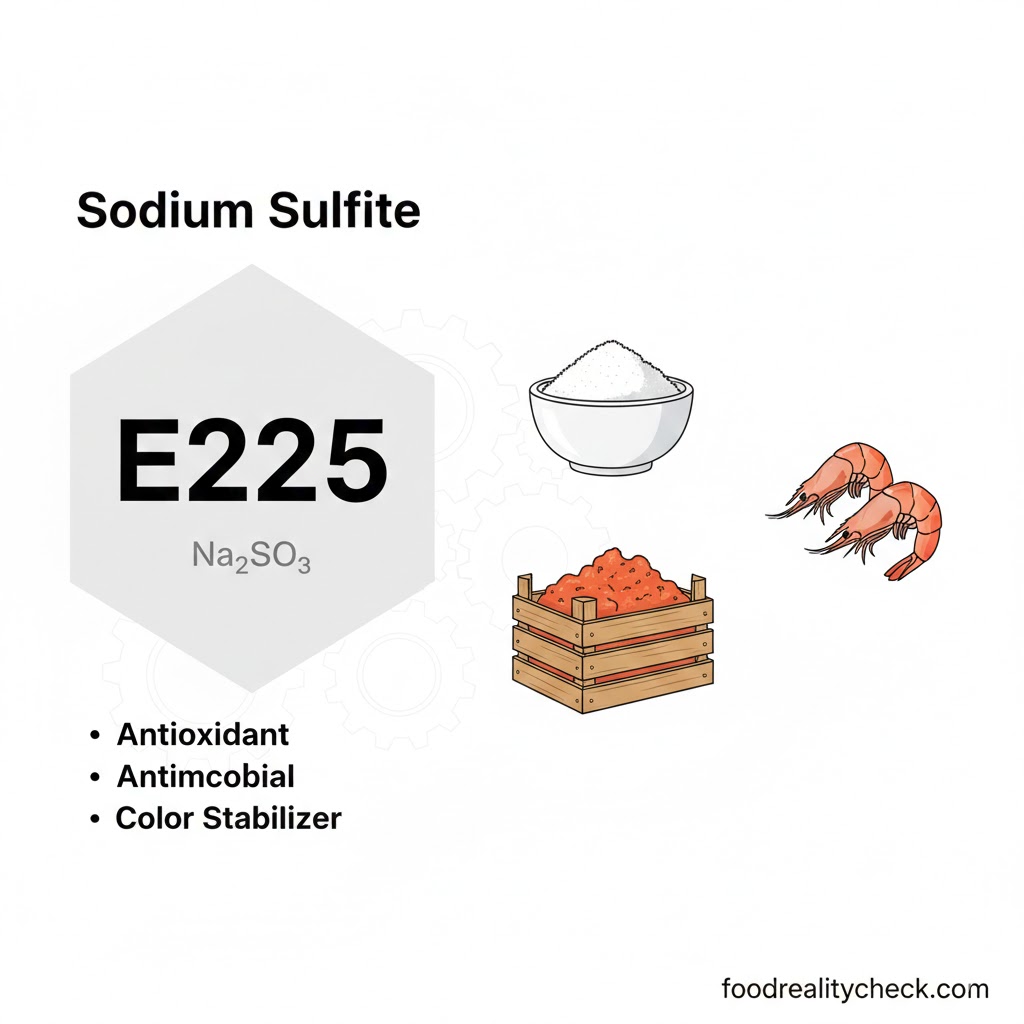
E225 is potassium sulfite, a food preservative and antioxidant.
It’s used in food to prevent spoilage, inhibit bacterial and fungal growth, and maintain color and flavor.
Most people eat it multiple times per week, especially if they consume wine, dried fruit, or processed foods.
📌 Quick Facts
- Category: Preservative and Antioxidant
- Found in: Wine, dried fruit, pickled vegetables, seafood, canned soups, baked goods
- Safety: Generally Recognized As Safe (GRAS) by regulatory bodies, but with restrictions
- Approved by: FDA (USA), EFSA (Europe), and most major regulatory agencies worldwide
What Exactly Is It?
E225 is made from potassium sulfite, which is the chemical compound K₂SO₃—a salt of potassium and sulfite.
It appears as a white, water-soluble solid. The sulfite compound has been used for centuries, with the first sulfite discovered by chemist Georg Ernst Stahl in the early 18th century.
In technical terms, E225 is an inorganic preservative that works through antioxidant and antimicrobial mechanisms. But simply put: it’s a salt that stops food from spoiling.
Both natural and synthetic versions exist, but they are chemically identical once in food.
Where You’ll Find It
E225 appears in a wide range of processed and fermented foods:
• Wine and alcoholic beverages (especially common)
• Dried fruits (raisins, apricots, dates)
• Pickled vegetables and canned vegetables
• Seafood and fish products
• Baked goods and bread
• Fruit juices and dried fruit products
• Cheese and dairy products
• Sauces and condiments
If you drink wine or eat dried fruit regularly, you’ve consumed E225 multiple times this week.
Why Do Food Companies Use It?
E225 performs three critical functions:
1. Preservation: It prevents the growth of bacteria, mold, and yeast that cause food to spoil. Without it, wine would turn to vinegar, dried fruit would rot, and pickled goods would become unsafe.
2. Antioxidant protection: It stops oxidation—the chemical process that causes browning, color loss, and nutrient degradation. This is why E225 keeps dried fruit looking golden and wine maintaining its color.
3. Flavor maintenance: It preserves the natural taste and aroma of food, particularly important for wines and fruit products.
Without E225, most foods would have dramatically shorter shelf lives, requiring either more frequent consumption or additional processing methods.
Is It Safe?
E225 is generally considered safe by regulatory bodies, with important caveats.
The FDA, EFSA, and WHO’s Joint Expert Committee on Food Additives (JECFA) have all approved potassium sulfite for food use. The approved daily intake limit is set based on extensive safety studies.
You would need to consume extremely large quantities in one day to exceed safe limits—far more than appears in normal food consumption.
Regulatory limits: In the USA, wine can contain up to 350 mg/L of sulfites. In the EU, limits vary by product type (typically 250-300 mg/L for wine). These limits were established to ensure safety while maintaining food preservation effectiveness.
Historical Context: Why the Restrictions?
Sulfites have been used for centuries—winemakers have relied on them since the 19th century. However, in the 1980s, their use expanded dramatically to fresh foods like salad bars and fresh fruit, which led to increased adverse reactions. In 1986, following documented cases of severe reactions in asthmatics, the FDA banned sulfites on fresh fruits and vegetables meant to be eaten raw. This restriction remains in place, though some limited exceptions exist for processed potatoes.
The “Contains Sulfites” labeling requirement came directly from this history.
Natural vs Synthetic Version
E225 can be produced in two ways, but both are identical:
Natural version: Produced through thermal decomposition of potassium metabisulfite at 190°C, using naturally-derived sulfite compounds.
Synthetic version: Manufactured through controlled chemical synthesis in industrial facilities.
Once in your food and body, there is no chemical difference between them. Your body processes both identically.
Natural Alternatives
Want to avoid E225? Food companies sometimes use these alternatives:
• Ascorbic acid (Vitamin C, E300): A natural antioxidant that slows browning and oxidation
• Sorbic acid and sorbates (E200-E203): Another preservative class with antimicrobial properties
• Benzoic acid (E210): An antimicrobial preservative
• Advanced technologies: Micro-oxygenation, electrodialysis, or modified atmospheric packaging in wine and produce
These alternatives often work similarly but typically cost more or require additional processing, so sulfites remain widely used in commercial food production.
The Bottom Line
E225 is a sulfite-based preservative that has been safely used in food for centuries.
It’s found in most wines, dried fruits, and many processed foods. Regulatory agencies worldwide consider it safe in approved amounts. However, people with sulfite sensitivity must avoid it—the 1986 FDA ban on fresh produce reflects real documented risks for sensitive individuals.
You have the right to know what’s in your food. If you’re concerned about sulfites, check labels carefully, look for “sulfite-free” products, or consult your doctor if you suspect sensitivity.