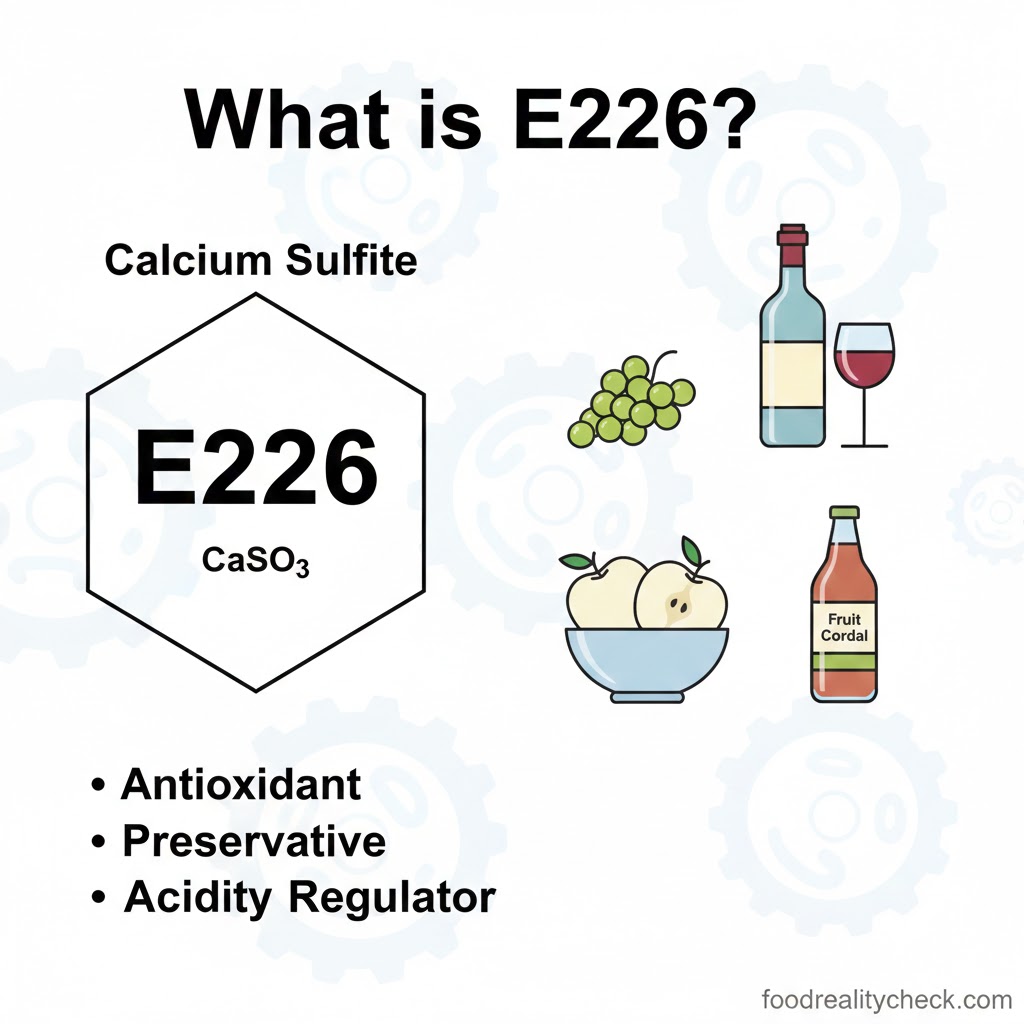
What is E226?
Complete guide to understanding E226 (Calcium Sulfite) in your food
The Quick Answer
E226 is calcium sulfite, a preservative and antioxidant additive used in food.
It’s used to prevent spoilage, inhibit bacterial and fungal growth, maintain color and flavor, and extend shelf life.
Most people consume it regularly if they drink wine, eat dried fruit, or consume canned vegetables.
📌 Quick Facts
- Category: Preservative and Antioxidant
- Found in: Wine, cider, dried fruits, canned vegetables, fruit juices, some baked goods
- Safety: Approved by major regulatory agencies, but with ongoing safety evaluation
- Approved by: FDA (USA), EFSA (Europe), UK Food Standards Authority, and most major regulatory bodies
What Exactly Is It?
E226 is calcium sulfite, a chemical compound with the formula CaSO₃. It’s the calcium salt of sulfurous acid.
It appears as a white, crystalline powder or solid. Two crystal forms exist: the hemihydrate (CaSO₃·½H₂O) and the tetrahydrate (CaSO₃·4H₂O). Both forms are white solids with minimal water solubility.
In technical terms, E226 is an inorganic preservative that works as an antioxidant and antimicrobial agent—it stops food from going bad by preventing oxidation and microbial growth.
E226 can be produced naturally from flue-gas desulfurization (a process that removes SO₂ from industrial emissions) or synthesized in laboratories, but both forms are chemically identical.
Where You’ll Find It
E226 appears in a wide range of foods and beverages:
• Wine and cider (one of its most common uses)
• Dried fruits (apricots, raisins, peaches, apples)
• Canned vegetables and fruit
• Fruit juices and grape juice
• Beer and soft drinks
• Pickled vegetables
• Frozen seafood (especially cephalopods and crustaceans)
• Jams, jellies, and marmalades
• Baked goods and grain products
If you consume wine regularly or eat dried fruit, you’ve likely consumed E226 multiple times this week.
Why Do Food Companies Use It?
E226 performs three critical functions in food preservation:
1. Preservation and antimicrobial action: It prevents the growth of bacteria, mold, wild yeast, and other unwanted microorganisms that cause food to spoil, ferment improperly, or become unsafe. This is especially important in wine production, where it controls fermentation and prevents spoilage.
2. Antioxidant protection: E226 acts as an oxygen scavenger, stopping oxidation—the chemical process that causes browning, discoloration, flavor loss, and nutrient degradation. This is why dried fruit stays golden and wine maintains its color and flavor profile.
3. Color and flavor maintenance: By preventing oxidation, E226 preserves the natural appearance and taste of foods, particularly important for wines, dried fruits, and canned goods.
Without E226, most fermented beverages and dried products would have dramatically shorter shelf lives or require additional processing that affects their quality.
Is It Safe?
E226 is officially approved by major regulatory authorities, but its safety profile requires attention.
The FDA (USA), EFSA (Europe), and the UK Food Standards Authority all permit E226 in specific food categories with defined maximum use levels. The accepted daily intake (ADI) for all sulfites (E220-E228 group) is set at 0.7 mg/kg of body weight per day, as SO₂ equivalent.
Regulatory limits: The UK permits E226 in wine up to 160 mg/L, in dried fruit up to 2000 mg/kg, and in canned vegetables up to 100 mg/kg. These limits vary by country and food category.
Who should avoid E226: People with sulfite sensitivity, asthma, or allergies should exercise caution. About 5-10% of people with asthma may experience adverse reactions including wheezing, chest tightness, cough, and respiratory distress. Non-asthmatic individuals can also develop sulfite sensitivity, experiencing symptoms such as rash, gastrointestinal upset, or respiratory symptoms. In rare cases, severe anaphylactic reactions have been reported, though researchers are still investigating the exact mechanism of these reactions.
Historical Context: Regulatory Evolution
Sulfites, including calcium sulfite, have been used as food preservatives for centuries. However, their safety profile has evolved. In the 1980s, after documented cases of severe adverse reactions in people with asthma and allergies, regulatory agencies began restricting their use on fresh, uncooked produce. The FDA banned sulfites on fresh fruits and vegetables intended to be eaten raw, though some limited exceptions exist for processed potatoes. This regulatory action followed evidence that sulfite sensitivity was more common and serious than previously understood, particularly in asthmatic populations.
Natural vs Synthetic Version
E226 can be produced in two ways:
Natural/industrial version: Produced through flue-gas desulfurization, where sulfur dioxide is scrubbed from industrial emissions using calcium hydroxide (hydrated lime) or calcium carbonate (limestone), producing calcium sulfite as a byproduct. This calcium sulfite is then purified for food use.
Synthetic version: Manufactured through controlled chemical synthesis in industrial facilities using similar reactions.
Once in your food and digestive system, there is no chemical difference between them. Your body processes both identically.
Natural Alternatives
Want to avoid E226? Food companies sometimes use these alternatives:
• Ascorbic acid (Vitamin C, E300): A natural antioxidant that slows browning and oxidation
• Sorbic acid and sorbates (E200-E203): Another preservative class with antimicrobial properties
• Benzoic acid (E210): An antimicrobial preservative
• Advanced technologies: Micro-oxygenation, modified atmospheric packaging, or electrodialysis (especially for wine)
These alternatives often work similarly but typically cost more or require additional processing, which is why sulfites remain widely used in commercial food production.
The Bottom Line
E226 (calcium sulfite) is a long-established preservative that has been safely used in food production for decades.
It’s found in most wines, dried fruits, canned vegetables, and many processed foods. Regulatory agencies worldwide have approved its use within specific limits. However, recent EFSA evaluations have identified potential safety concerns for sensitive subpopulations, particularly people with asthma, allergies, or sulfite sensitivity.
If you have asthma, allergies, or suspect sulfite sensitivity, check labels carefully and avoid products containing E226, other sulfites, or “sulfur dioxide.” For the general population consuming these foods in normal amounts, E226 is considered safe within approved limits.