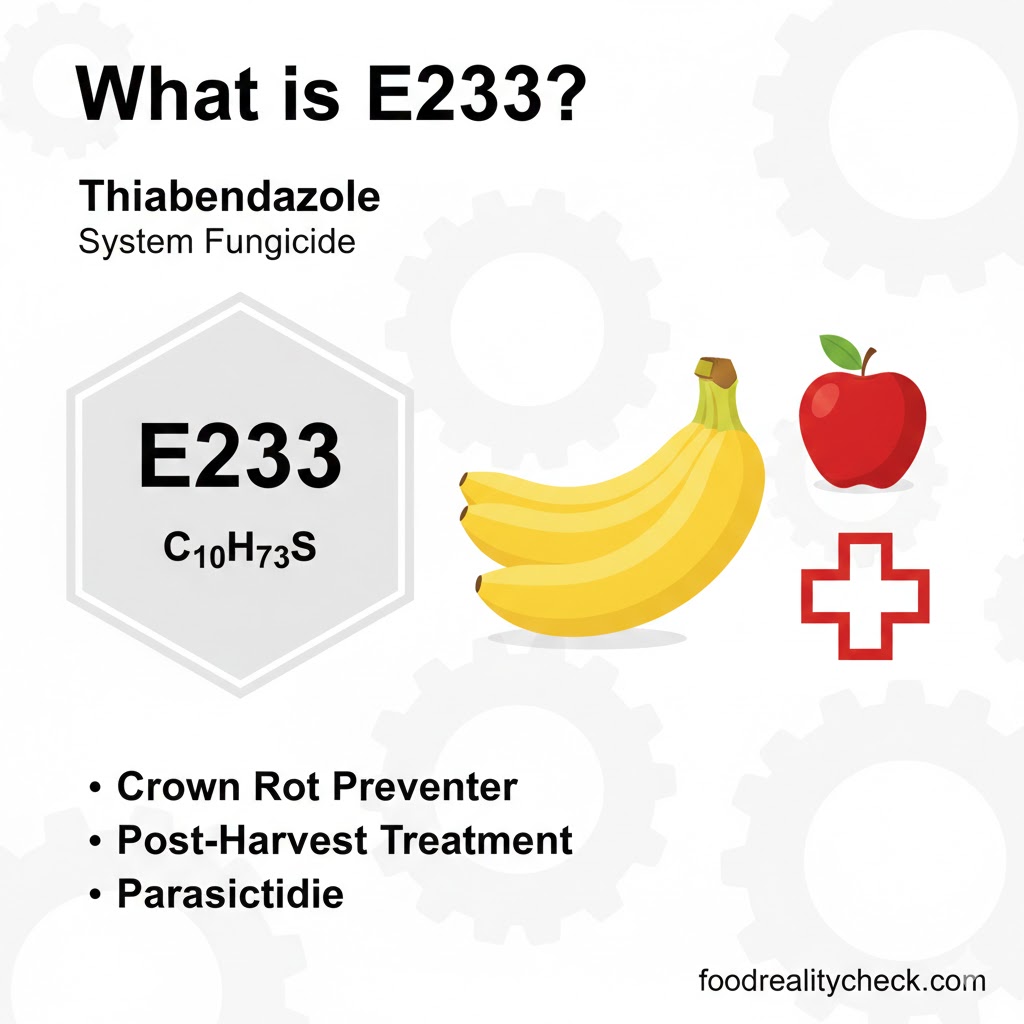
What is E233?
Complete guide to understanding E233 (Thiabendazole) in your food
The Quick Answer
E233 is thiabendazole (TBZ), a synthetic benzimidazole fungicide and antiparasitic agent used as a preservative to prevent mold and fungal growth on citrus fruits, bananas, and other produce during storage and transportation.
It’s used as a post-harvest treatment applied to fruit surfaces to extend shelf life and prevent spoilage—functioning similarly to E230-E232 but with a different chemical structure and a significantly better safety profile than its predecessors.
Most people consuming imported citrus and bananas regularly encounter E233 residues on fruit surfaces. Unlike E230-E232 which are phasing out due to documented toxicity, E233 represents the modern replacement preservative—approved in most major markets, though with emerging concerns about genotoxicity that warrant careful consumer awareness.
📌 Quick Facts
- Category: Synthetic Fungicide, Preservative, Antiparasitic Agent, Benzimidazole Derivative
- Source: Fully synthetic organic compound (first introduced 1962)
- Found in: Citrus fruits (oranges, lemons, grapefruit), bananas, apples, pears, other produce
- Safety: FDA approved; JECFA approved; NOT approved in EU, Australia, New Zealand as food additive (though residues permitted in imports)
- Natural or Synthetic: Fully synthetic
- Vegan/Vegetarian: Yes
- Key Concern: Recent research documents GENOTOXIC EFFECTS; potential carcinogenicity; cannot be effectively removed by washing; not approved in EU/AU/NZ markets
- Chemical Formula: C₁₀H₇N₃S; benzimidazole structure with thio group
What Exactly Is It?
E233 is thiabendazole (TBZ), a benzimidazole derivative with the molecular formula C₁₀H₇N₃S and molecular weight of 201.25 g/mol. Thiabendazole was first introduced as an antiparasitic and fungicide in 1962, making it one of the older synthetic fungicides still in wide use.
Physically, E233 appears as a white crystalline powder. It is moderately soluble in water (approximately 5 mg/mL at 25°C) and soluble in organic solvents. The compound is relatively heat-stable and resistant to degradation during food processing and storage, allowing persistence on fruit surfaces.
Chemically, thiabendazole is a benzimidazole—a bicyclic structure containing fused benzene and imidazole rings with a thio (sulfur-containing) group attached. This structure gives the compound its biocidal properties: it disrupts fungal tubulin (a structural microtubule protein), preventing normal cell division and causing fungal cell death. The same mechanism that makes it effective against fungi also makes it antiparasitic—it binds to helminth tubulin with similar mechanism.
Where You’ll Find It
E233 appears on produce surfaces, particularly citrus and bananas:
• Oranges (the primary application)
• Lemons and limes
• Grapefruit
• Tangerines and other citrus varieties
• Bananas (applied post-harvest to ensure freshness)
• Apples and pears (in some applications)
• Other fruits and vegetables
• Fruit waxing formulations
• Mixed with imazalil for combination fungicide treatment
E233 is applied directly to fruit skin as a post-harvest surface treatment to prevent mold and fungal colonization. The compound remains on the fruit surface and does not penetrate into flesh. Critically, E233 cannot be effectively removed by washing—it is formulated into wax or absorbed into fruit cuticle, making it largely wash-resistant.
Why Do Food Companies Use It?
E233 thiabendazole performs one critical function and is replacing E230-E232 globally:
Mold and fungal prevention with improved safety profile: E233 prevents mold growth (particularly Penicillium fungi) on fruit during long-distance shipping and storage. Unlike E230 (genotoxic), E231 (neurotoxic), and E232 (toxic to environment), E233 was historically considered to have superior safety profile, making it the selected replacement for phasing-out predecessors. It can be formulated into waxes and is often combined with imazalil for broader spectrum fungicide coverage.
Why it’s becoming increasingly questioned: Recent research (2025) documenting genotoxic effects in E233 has raised new concerns. While historically considered safer than E230-E232, emerging evidence suggests genotoxic potential comparable to or exceeding its predecessors. This has created market uncertainty—E233 is not approved in EU, Australia, and New Zealand, and is increasingly facing scientific scrutiny despite FDA and JECFA approval.
Is It Safe?
E233’s safety status is shifting from “relatively safe replacement” to “potentially genotoxic,” creating significant regulatory divergence and emerging consumer concerns.
Regulatory Status—Major Geographic Divergence:
• FDA (USA): Approved; no explicit ADI specified; commonly used
• JECFA (WHO/FAO): Approved
• EFSA (Europe): NOT APPROVED as food additive; residues in imported produce are “tolerated” but new approval unlikely
• Australia/New Zealand: NOT APPROVED as food additive; residues in imported produce monitored but not encouraged
• Maximum Residue Levels (MRL): EU permits 7 mg/kg in citrus imports; varies by product and market
⚠️ CRITICAL EMERGING SAFETY CONCERN—GENOTOXIC EFFECTS DOCUMENTED: Recent 2025 peer-reviewed research has documented concerning genotoxic effects with E233:
• DNA strand breaks: 2025 PMC research documented DNA-strand breaks in lymphocytes treated with thiabendazole and related fungicides
• Genotoxic potential: Findings suggest thiabendazole has genotoxic effects—markers of potential DNA damage and carcinogenicity
• Long-term health risks: The research explicitly states: “The long-term exposure and consumption of fruits and vegetables treated with fungicides can increase the risks of developing genotoxic tumors”
• Mixture effects: Combined with other fungicides (imazalil, pyrimethanil), genotoxic effects are compounded
• Historical assessment vs. current findings: E233 was “long considered safe,” but emerging research contradicts this historical assumption
• Kidney damage documented: Mouse studies documented kidney damage at high doses
• Mechanism uncertainty: While genotoxic effects are documented, the specific mechanism and human-relevant thresholds remain incompletely characterized
Important distinction—Historical vs. Current Evidence: E233 was historically promoted as a safer replacement for E230-E232 based on older toxicological assessments. However, recent 2025 research using more modern genotoxicity testing methods has documented concerning effects not previously recognized. This represents a pattern: additives deemed “safe” by earlier standards may show concerning effects with more rigorous testing.
Documented effects and concerns:
• Genotoxicity: DNA strand breaks in lymphocytes; potential carcinogenicity concerns
• Kidney effects: Kidney damage in animal studies at high doses
• Resistance development: Fungi develop resistance to E233, potentially reducing fungicide efficacy over time
• Wash-resistance: Cannot be effectively removed by washing—unlike E230-E232, which can be partially removed
• Stability during processing: Stable through food processing; residues persist
• Mixture effects: Combined exposure with imazalil and other fungicides documented to increase genotoxic effects
• Agricultural concerns: Workers applying E233 face occupational exposure risks; use classified as “toxic substances and human health hazards” in some agricultural assessments
Why Not Approved in EU/AU/NZ?
The EU, Australia, and New Zealand do not approve E233 as a food additive, despite FDA and JECFA approval:
These regulatory systems apply more stringent precautionary standards and have not found sufficient evidence to warrant approval as food additive despite allowing residues in imported produce at defined limits. This geographic regulatory split is significant—major developed markets have not approved E233, while it remains approved in the USA and by JECFA. Recent genotoxicity findings may accelerate restrictions.
Production Method
E233 thiabendazole is produced through complex organic chemical synthesis:
1. Benzene undergoes electrophilic aromatic substitution with acetyl chloride and aluminium chloride (Friedel-Crafts reaction) to produce acetophenone
2. Acetophenone undergoes condensation with ammonium acetate and sulfur in an autoclave at high temperature and pressure
3. The resulting product undergoes cyclization to form the benzimidazole ring structure
4. Alternative synthesis: Aniline derivatives can be oxidized and cyclized through various routes to produce benzimidazoles with thio substitution
5. The crude product is purified through recrystallization, distillation, and chromatography to meet food-grade purity specifications
All production is fully synthetic—no natural sources exist. Food-grade E233 requires significant purification from industrial synthesis.
Natural vs Synthetic Version
E233 is entirely synthetic—there is no natural version.
Thiabendazole is entirely a synthetic organic compound created through complex petroleum-derived chemical synthesis. No natural sources exist.
Dual Use—Food Additive AND Pharmaceutical
A unique distinction of E233 is its dual use as both food additive and pharmaceutical agent:
E233 thiabendazole is approved as a broad-spectrum antiparasitic drug (sold under trade names including Mintezol) for treating parasitic worm infections in humans—a use demonstrating systemic absorption and biological activity. The compound also has anti-inflammatory and analgesic properties. This pharmaceutical use as direct drug therapy contrasts with most food additives—it’s not merely a preservative but an active pharmaceutical at food-use levels.
Comparison with E230-E232 and Alternative Fungicides
E233 occupies a transitional position as the modern replacement for phasing-out predecessors:
• E230 (Biphenyl): Precursor; genotoxic; increasingly phased out
• E231 (Orthophenylphenol): Neurotoxic; classified toxic; phasing out
• E232 (Sodium orthophenylphenol): Water-soluble; classified toxic; phasing out
• E233 (Thiabendazole): Benzimidazole; historically safer reputation; now showing genotoxic concerns; replacement fungicide; FDA/JECFA approved; not approved EU/AU/NZ
• Imazalil: Alternative benzimidazole; EPA classifies as probable carcinogen; often combined with E233
• Pyrimethanil: Alternative fungicide; part of genotoxicity research with E233
• Natamycin (E235): Natural-origin fungicide; increasing adoption
E233 was positioned as safer than E230-E232 but faces emerging concerns suggesting this historical positioning may require reassessment.
The Pharmaceutical Connection—Dual Use Implications
E233’s use as both food additive and pharmaceutical drug raises specific health considerations:
The compound is absorbed systemically and produces pharmacological effects—it binds to tubulin, disrupts microtubule formation, and has demonstrated anti-inflammatory effects. At food-use levels, systemic exposure is lower than pharmaceutical dosing, but chronic consumption combined with pharmaceutical use (if treating parasitic infections) could create cumulative exposure concerns. The compound’s demonstrated biological activity at systemic levels suggests potential for effects at food-additive levels that extend beyond traditional “preservative” function.
Environmental and Sustainability
E233 production through complex petroleum-derived synthesis carries environmental costs. The compound is relatively stable and persistent in environmental contexts. Aquatic toxicity is not explicitly characterized in available sources, but the compound’s biological activity suggests potential aquatic concerns. Environmental impact assessment is less comprehensive than for E230-E232.
Natural Alternatives Gaining Traction
Want to avoid E233? Alternatives for fruit preservation include:
• Natamycin (E235): Natural-origin fungicide derived from Streptomyces; increasing adoption; better regulatory acceptance
• Imazalil: Alternative synthetic fungicide; often combined with E233 but faces same carcinogenicity concerns
• Essential oil coatings: Cinnamon oil, citral, other natural compounds providing antifungal properties
• Wax coatings (non-fungicide): Physical barrier without synthetic fungicides
• Modified atmosphere packaging: Oxygen reduction prevents mold growth
• Reduced storage duration: Faster distribution reducing preservation need
• Organic certification: No E233 treatment; alternative preservation methods
Consumer Actions to Minimize E233 Exposure
For consumers concerned about E233 exposure:
• Choose citrus and bananas from EU, Australia, New Zealand (E233-free by regulation)
• Select “organic” produce (no E233 treatment)
• Peel citrus completely—E233 cannot be effectively washed away but is surface-only (peeling removes it)
• Be aware E233 persists through food processing—it’s not degraded by heating, storage, or processing
• Reduce consumption of USA-produced imported citrus if concerned about E233 exposure
• Support alternative preservation methods; choose retailers promoting E233-free produce
• Monitor emerging research on E233 genotoxicity; expect regulatory changes if concerns increase
The Bottom Line
E233 (thiabendazole) is a synthetic benzimidazole fungicide approved by FDA and JECFA but NOT APPROVED in EU, Australia, and New Zealand as a food additive, with recent 2025 peer-reviewed research documenting GENOTOXIC EFFECTS in lymphocytes—marking a significant shift in safety perception for this previously considered “safer replacement” for phasing-out E230-E232.
E233 is used as a post-harvest surface treatment on citrus, bananas, and other produce to prevent mold growth during shipping and storage. The compound remains on fruit surface, cannot be effectively removed by washing, and persists through food processing unchanged.
The critical distinction of E233 is its shifting safety narrative: historically promoted as a safer replacement for increasingly recognized toxic predecessors (E230-E232), recent research using modern genotoxicity testing documents DNA strand breaks and potential carcinogenicity concerns not previously identified. This represents a pattern in food additive assessment—additives deemed safe by earlier standards may show concerning effects under more rigorous modern testing.
The geographic regulatory split is significant—major developed markets (EU, Australia, New Zealand) have not approved E233 as food additive, while USA and JECFA approve it. This divergence, combined with emerging genotoxicity evidence, suggests E233 faces increasing scrutiny and potential future restrictions.
For consumers, E233 represents an additive in regulatory transition—approved in some major markets, not approved in others, facing emerging scientific concerns about genotoxicity. The compound’s pharmaceutical use as direct antiparasitic therapy and documented pharmacological activity suggests it operates beyond simple preservation function. The inability to remove E233 through washing (unlike some alternatives) means peeling is necessary for complete removal.
Recent research explicitly states that “long-term exposure and consumption of fruits and vegetables treated with fungicides can increase the risks of developing genotoxic tumors.” This warning should alert consumers to emerging concerns about E233 justifying minimized consumption through sourcing from E233-free markets or selecting organic alternatives.