What is E234?
Complete guide to understanding E234 (Nisin) in your food
The Quick Answer
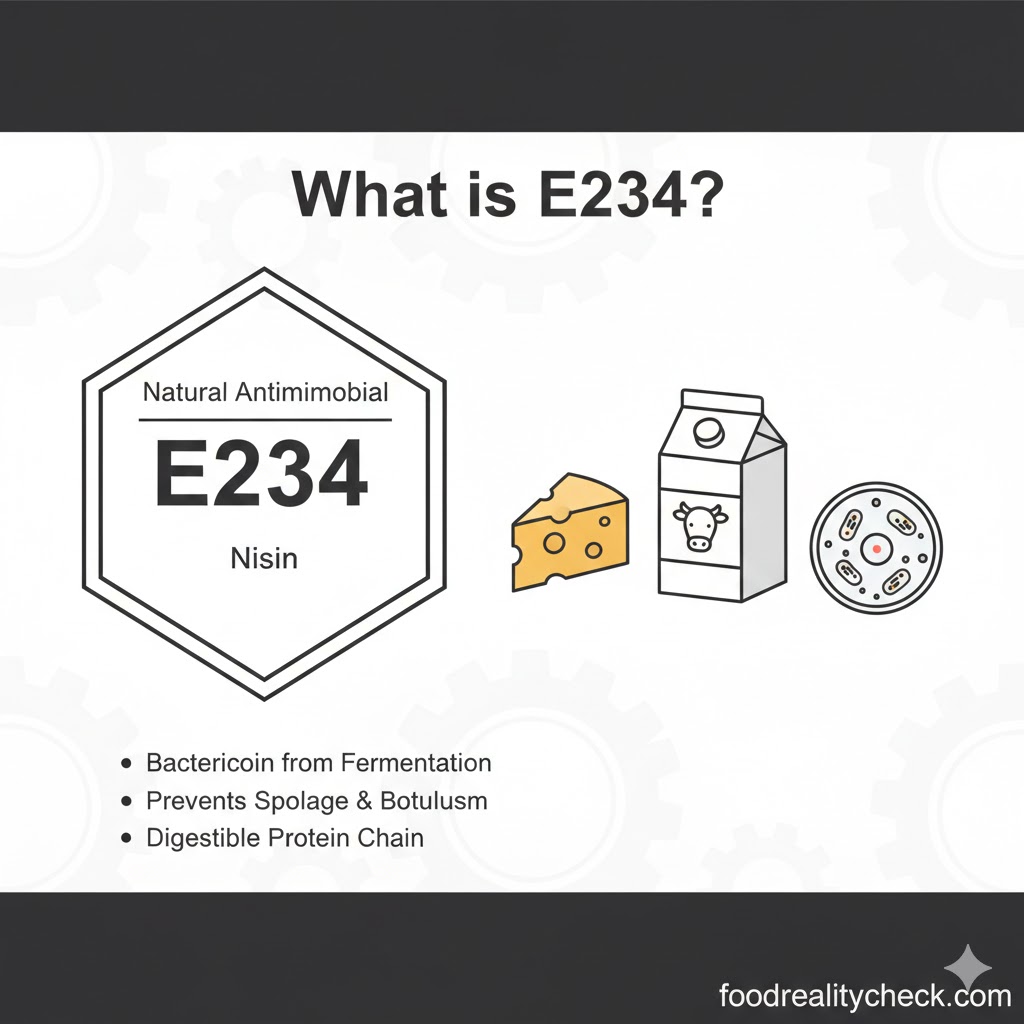
E234 is nisin, a natural antimicrobial peptide produced through bacterial fermentation that prevents spoilage and pathogenic bacteria growth in foods—making it one of the safest and most beneficial food additives available.
It’s a short protein (34 amino acids) made by the bacteria Lactococcus lactis, used in processed cheeses, meats, and other foods to extend shelf life while providing no safety concerns or adverse health effects.
Most people consuming processed cheeses, cured meats, and some dairy products regularly encounter E234, though it remains largely invisible to consumers—functioning silently as a natural preservative with an exceptional safety record matched by no other additive in this comprehensive guide.
📌 Quick Facts
- Category: Natural Bacteriocin, Antimicrobial Peptide, Lantibiotic, Preservative
- Source: 100% natural—produced through fermentation by Lactococcus lactis bacteria
- Found in: Processed cheeses, cured/processed meats, UHT milk, sauces, plant-based products, beverage
- Safety: FDA GRAS approved; EFSA approved (2017 re-evaluation confirmed safety); JECFA approved since 1969; ADI 1 mg/kg bw
- Natural or Synthetic: 100% natural—fermentation-derived
- Vegan/Vegetarian: Yes
- Key Advantage: ONLY approved bacteriocin for food use; completely hydrolyzed into amino acids; zero known toxicity or adverse effects; clean-label appeal
- Chemical Structure: 34-amino-acid polypeptide with lantibiotic structure
Why This Additive Is Different—The Complete Opposite of E230-E233
After examining E230 (genotoxic), E231 (neurotoxic), E232 (toxic/persistent), and E233 (genotoxic), E234 nisin represents a complete reversal—it is the ONLY approved bacteriocin for food use, explicitly endorsed by FAO/WHO since 1969, with an exceptional safety record and documented anti-pathogenic benefits that distinguish it from all previous fungicides discussed.
What Exactly Is It?
E234 is nisin (more precisely nisin A), a naturally occurring antimicrobial peptide composed of 34 amino acids, with an unusual lantibiotic structure containing rare amino acids including lanthionine (Lan), methyllanthionine (MeLan), didehydroalanine (Dha), and didehydroaminobutyric acid (Dhb).
Nisin is a bacteriocin—a class of antimicrobial peptides naturally produced by bacteria (in this case Lactococcus lactis) to inhibit growth of competing bacteria. The compound is classified as a lantibiotic (lanthipeptide antibiotic), a special class of bacteriocins containing unusual post-translationally modified amino acids.
Physically, nisin appears as a white to off-white powder, often standardized for nisin activity (potency). Commercial preparations typically contain concentrated nisin mixed with sodium chloride (salt) as carrier. The compound is highly soluble in water.
Chemically, nisin is a short protein with exceptional stability—it resists heating, survives food processing unchanged, and remains functional across wide pH ranges (pH 2-8). Upon ingestion, nisin is rapidly hydrolyzed by proteolytic enzymes (digestive proteins like trypsin) into individual amino acids and dipeptides, which are absorbed and metabolized like dietary protein. No intact nisin reaches systemic circulation—it is completely degraded in the gastrointestinal tract.
Where You’ll Find It
E234 nisin appears in a wide range of foods:
• Processed cheeses (primary application)
• Cheese spreads
• Cured and processed meats
• Meat products
• Ultra-high temperature (UHT) milk
• Milk products
• Sauces and gravies
• Canned foods
• Plant-based meat alternatives
• Beverages (particularly milk-based)
• Seafood products
• Combination products
• Food packaging (controlled-release applications)
E234 is particularly effective against Gram-positive bacteria including Listeria monocytogenes and Clostridium botulinum—serious foodborne pathogens—making it valuable for food safety applications.
Why Do Food Companies Use It?
E234 performs one critical function with exceptional benefits:
Natural inhibition of Gram-positive spoilage and pathogenic bacteria: E234 nisin binds to bacterial cell wall precursor lipids (lipid II), preventing cell wall construction and causing bacterial cell death. This is particularly effective against Gram-positive bacteria including Listeria monocytogenes, Staphylococcus aureus, Clostridium botulinum, and other spoilage bacteria. The compound extends shelf life, prevents foodborne illness, and allows lower heat processing (reducing nutrient loss).
Why it’s preferred: E234 is natural, clean-label, demonstrates exceptional safety history, inhibits dangerous pathogens (particularly Listeria and Clostridium botulinum which cause serious illness), and is the only bacteriocin approved for food use. It represents the optimal choice for manufacturers seeking natural, safe, effective preservation.
Is It Safe?
E234 nisin has an exceptional safety record with full regulatory approval and zero documented adverse health effects—one of the safest additives available.
Regulatory Status—Unanimous Approval:
• FDA (USA): Generally Recognized As Safe (GRAS); approved for cheese spreads at 250 mg/kg maximum
• EFSA (Europe): Approved (2006, re-evaluated 2017); comprehensive safety assessment confirmed safety at food-use levels; ADI 1 mg/kg body weight
• JECFA (WHO/FAO): Approved since 1969—the FIRST and ONLY bacteriocin approved for food use; has maintained approval for 55+ years
• FDA/JECFA statement: “The only bacteriocin which is safe for food application”
Documented safety findings:
• No genotoxicity: Extensive testing shows zero genotoxic effects (contrasting sharply with E230, E231, E233)
• No carcinogenicity: No indication of carcinogenic potential
• No reproductive toxicity: Safe for pregnant women and developing fetuses
• No developmental toxicity: Safe for infants and children
• No allergenicity: Exceptionally low allergy potential; nisin hypersensitivity is rare and documented in perhaps less than 0.01% of population
• No gastrointestinal effects: Hydrolyzed into amino acids; no GI disturbance
• No systemic absorption: Complete degradation prevents systemic effects
• No interaction with medications: Hydrolyzed to amino acids; no drug interactions
• Antimicrobial resistance risk: 2017 EFSA noted that while AMR is theoretically possible, practical risk is minimal given nisin’s mechanism and use levels
Unique Benefit—Anti-Pathogenic Properties
A critical distinction of E234 nisin is that it provides genuine food safety benefit beyond preservation:
Nisin is particularly effective against Clostridium botulinum and Listeria monocytogenes—two of the most dangerous foodborne pathogens responsible for serious illness and death. By inhibiting these pathogens, E234 doesn’t merely extend shelf life; it actively prevents foodborne illness. This positions nisin as a food safety agent as much as a preservative—a distinction most additives do not have.
Production Method
E234 nisin is produced entirely through natural fermentation:
1. Lactococcus lactis bacteria (food-grade strain) are cultured in fermentation tanks containing nutrient media (typically milk whey-based or grain-based media)
2. During fermentation, the bacteria produce nisin naturally as part of their metabolic processes (bacteriocin production is a natural bacterial defense mechanism)
3. The fermentation broth is harvested and nisin is recovered through precipitation and purification steps
4. The purified nisin is standardized for potency (nisin units per mg), dried, and formulated with sodium chloride carrier
5. The final product is standardized to meet food-grade purity specifications and nisin activity levels
The entire production process is fermentation-based—no chemical synthesis. The product is as natural as yogurt or cheese production.
Natural vs Synthetic Version
E234 nisin is 100% natural—there is no synthetic version.
Nisin is produced entirely through biological fermentation. It cannot be chemically synthesized—it must be produced by living bacteria. All food-grade E234 is fermentation-derived.
Comparison with Alternatives—Why E234 Stands Apart
E234 nisin occupies a unique position as the gold standard among antimicrobial preservatives:
• E230 (Biphenyl): Synthetic; genotoxic; increasingly phased out
• E231 (Orthophenylphenol): Synthetic; neurotoxic; phasing out
• E232 (Sodium orthophenylphenol): Synthetic; toxic; phasing out
• E233 (Thiabendazole): Synthetic; genotoxic (2025 research); regulatory split; concerns emerging
• E234 (Nisin): Natural; zero documented toxicity; bacteriocin class; ONLY approved bacteriocin for food; JECFA approved since 1969; continuously re-approved; exceptional safety record
• E235 (Natamycin): Natural antifungal; good safety profile; less broad antimicrobial spectrum than E234
• E243 (Ethyl lauroyl arginate): Synthetic; some safety concerns; less extensively studied than E234
E234 nisin stands as the clear gold standard—the only bacteriocin approved for food use, with 55 years of continuous safe use and zero documented adverse effects.
Antimicrobial Spectrum and Effectiveness
E234 nisin is particularly effective against Gram-positive bacteria:
Highly effective against: Listeria monocytogenes, Staphylococcus aureus, Clostridium botulinum, Bacillus species, Streptococcus species, and other Gram-positive spoilage and pathogenic bacteria. The compound reduces heat processing requirements—lower sterilization temperatures can be used when combined with nisin, reducing nutrient loss and preserving flavor better than high-heat alternatives.
Limitation: E234 is not effective against Gram-negative bacteria, yeasts, or molds. This narrow spectrum is actually an advantage—it allows selective preservation of beneficial bacteria in fermented products (cheese ripening, fermentation processes) while inhibiting pathogens.
2017 EFSA Re-Evaluation—Recent Confirmation of Safety
In 2017, EFSA conducted a comprehensive re-evaluation of nisin and confirmed safety even with proposed extended uses:
The European Food Safety Authority Panel on Food Additives and Nutrient Sources (ANS) concluded: “The use of nisin (E 234) as a food additive in unripened cheese and in heat-treated meat products would not be of safety concern as the exposure of nisin A was below the new ADI (1mg/kg).” This represents one of the clearest modern regulatory endorsements of any food additive.
Environmental and Sustainability
E234 nisin production through fermentation is highly sustainable—uses renewable agricultural materials (whey-based, grain-based fermentation media), generates minimal environmental impact, and is biodegradable. Environmental footprint is negligible compared to synthetic alternatives. The fermentation production aligns with circular economy principles—using dairy or grain processing byproducts as feedstock.
Natural Alternatives and Comparison
E234 nisin IS ITSELF the natural alternative to synthetic fungicides. Comparing with other natural preservatives:
• E234 (Nisin): Natural bacteriocin; specifically inhibits pathogenic bacteria; 1969 JECFA approval; zero adverse effects
• E235 (Natamycin): Natural antifungal; good safety; less pathogenic specificity than nisin
• Acetic acid/vinegar: Natural; broad spectrum; different sensory profile; lower effectiveness against spore-forming bacteria
• Salt/sodium chloride: Natural; limited effectiveness; high sodium content concern
• Sugar/honey: Natural; osmotic preservation; different application; high calorie addition
• Essential oils: Natural; variable efficacy; regulatory status varies; sensory impact
E234 nisin represents the optimal natural preservative—maximally effective against pathogens while maintaining complete safety profile.
Consumer Actions to Maximize E234 Benefits
For consumers seeking the safest, most effective preservatives:
• Choose products containing E234 nisin (or nisin preparation)
• Look for processed cheeses and cured meats with E234 (indicates natural preservation vs. synthetic alternatives)
• Select plant-based meats containing E234 (indicates use of safe, natural preservative)
• Understand E234 provides food safety benefit—inhibiting dangerous pathogens like Listeria
• Know that E234 is completely hydrolyzed into amino acids—no intact nisin reaches bloodstream
• Recognize E234 is not an allergen for 99.99% of population
• Appreciate E234 as one of the clearest examples of a genuinely beneficial additive with exceptional safety history
The Bottom Line
E234 (nisin) is a 100% natural antimicrobial peptide produced through bacterial fermentation, approved by FDA, EFSA, and JECFA since 1969 as THE ONLY approved bacteriocin for food use, with an exceptional 55-year safety record, zero documented adverse health effects, complete gastrointestinal degradation into amino acids, and genuine food safety benefits through inhibition of serious pathogens including Listeria monocytogenes and Clostridium botulinum.
E234 nisin is composed of 34 amino acids in a lantibiotic structure, produced entirely through natural fermentation by Lactococcus lactis bacteria. It functions by binding to bacterial cell wall precursors and preventing cell wall synthesis, resulting in bacterial death. The compound is exceptionally heat-stable, survives food processing unchanged, and remains effective across wide pH ranges.
The critical distinction of E234 is its complete opposite profile to E230-E233: where those fungicides face documented toxicity concerns (genotoxicity, neurotoxicity, environmental persistence), E234 has demonstrated zero adverse effects across 55 years of use in 50+ countries. The 2017 EFSA re-evaluation explicitly confirmed safety at food-use levels, establishing ADI of 1 mg/kg.
Upon ingestion, nisin is completely hydrolyzed by digestive enzymes into individual amino acids and dipeptides—no intact nisin enters systemic circulation. This complete metabolic degradation, combined with nisin’s natural origin from food-grade bacteria, explains its exceptional safety profile.
E234 provides genuine food safety benefit beyond preservation—it specifically inhibits dangerous pathogens (Listeria, Clostridium botulinum) that cause serious foodborne illness. This positions nisin as a food safety agent as much as preservative.
For consumers, E234 nisin represents one of the clearest examples of a genuinely beneficial additive—natural, safe, effective, providing pathogenic inhibition, with an exceptional regulatory and safety history that contrasts sharply with controversial synthetic fungicides. Products containing E234 represent optimal preservation choice from both safety and efficacy perspectives.