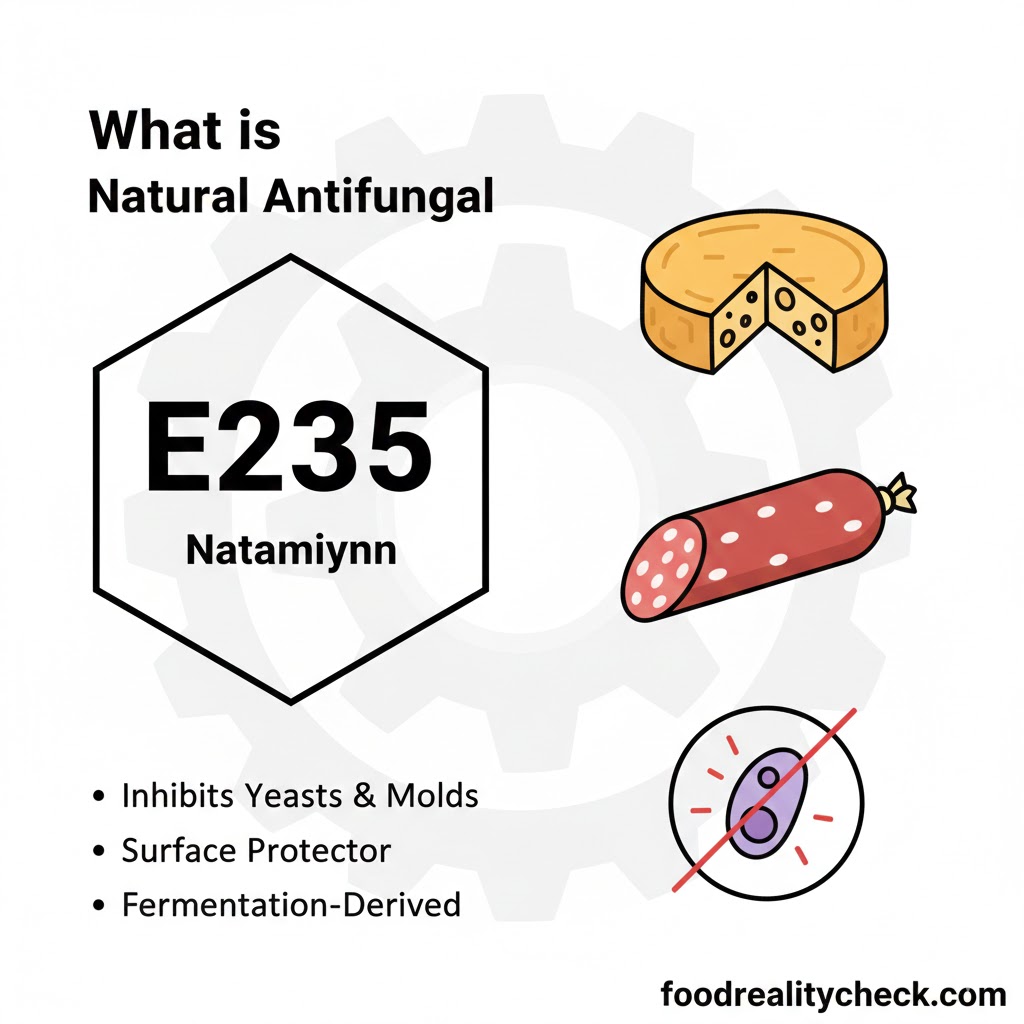
What is E235?
Complete guide to understanding E235 (Natamycin) in your food
The Quick Answer
E235 is natamycin (also called pimaricin), a natural antifungal antibiotic produced through bacterial fermentation that prevents mold and yeast growth on foods—making it an effective, natural, and safe preservative with an excellent regulatory history.
It’s a polyene macrolide antibiotic naturally produced by the bacteria Streptomyces natalensis, used primarily on cheese rinds and sausage casings to extend shelf life while preventing mold spoilage.
Most people consuming cheese, yogurt, cured meats, and some other fermented products occasionally encounter E235 residues, though it remains largely invisible to consumers—functioning as a natural surface preservative with no documented safety concerns and genuine toxin-prevention benefits.
📌 Quick Facts
- Category: Natural Antifungal Antibiotic, Polyene Macrolide, Bacteriocin-like Preservative
- Source: 100% natural—produced through fermentation by Streptomyces natalensis bacteria
- Found in: Cheese (rinds), sausages (casings), yogurt, baked goods, beverages, processed fruits
- Safety: FDA GRAS approved; EFSA approved (2009 evaluation); JECFA approved; ADI 0.3 mg/kg bw
- Natural or Synthetic: 100% natural—fermentation-derived antibiotic
- Vegan/Vegetarian: Yes
- Key Advantage: Natural antifungal; does not affect bacteria; prevents mycotoxin production; minimal absorption; excellent safety record
- Chemical Formula: C₃₃H₄₇NO₁₃; polyene macrolide structure
What Exactly Is It?
E235 is natamycin (pimaricin), a polyene macrolide antibiotic with the molecular formula C₃₃H₄₇NO₁₃ and molecular weight of 665.7 g/mol. It is a naturally occurring compound produced by the bacterium Streptomyces natalensis, discovered in 1957.
Natamycin belongs to the polyene antibiotic family—compounds containing multiple conjugated double bonds. The structure consists of a large macrocyclic lactone ring (21-membered) with a conjugated diene system and an attached mycosamine sugar. This unique structure is critical to its selective antifungal mechanism.
Physically, E235 appears as a colorless to light yellow crystalline powder, practically insoluble in water but soluble in methanol and other organic solvents. Commercial preparations typically contain 50% natamycin mixed with carriers like lactose, glucose, or salt to improve handling. The compound is heat-stable and maintains antifungal activity across wide pH ranges (pH 3-9).
Chemically, natamycin functions through a unique mechanism: it binds to ergosterol (the primary sterol in fungal cell membranes) and disrupts membrane function by interfering with amino acid and glucose transport proteins. Critically, it does NOT directly permeabilize membranes—distinguishing it from other polyene antifungals. This mechanism makes it highly selective for fungi (which contain ergosterol) while having no effect on bacteria (which lack sterols).
Where You’ll Find It
E235 natamycin appears on food surfaces and in various foods:
• Cheese rinds (primary application—hard, semi-hard, semi-soft cheeses)
• Sausage casings (dry cured sausages)
• Yogurt surfaces
• Baked goods
• Processed fruits and vegetables
• Juices and beverages
• Wine surfaces
• Ready-to-drink tea and energy beverages
• Fruit waxing formulations (on berries, stone fruits)
• Processed meats
• Food packaging (controlled-release applications)
E235 is applied directly to food surfaces where molds and yeasts are most likely to grow—particularly on cheese rinds and sausage casings. Its low water solubility makes it ideal for surface treatment, where it stays concentrated where needed rather than penetrating into the food.
Why Do Food Companies Use It?
E235 natamycin performs one critical function with exceptional benefits:
Natural prevention of mold and yeast spoilage while inhibiting toxin production: E235 prevents growth of fungi (both yeasts and molds) that cause food spoilage and product damage. Critically, it also prevents mycotoxin production—dangerous compounds produced by molds (particularly Aspergillus and Penicillium species) that are carcinogenic and toxic. By preventing fungal growth, E235 prevents both spoilage and potential mycotoxin contamination.
Why it’s increasingly preferred: E235 is natural (fermentation-derived), has selective antifungal mechanism (no effect on beneficial bacteria in fermented foods), demonstrates excellent safety history, prevents dangerous mycotoxins, is less controversial than synthetic fungicides (E230-E233), and aligns with clean-label consumer preferences. Many manufacturers are actively shifting to E235 as replacement for controversial synthetic fungicides.
Is It Safe?
E235 natamycin has an excellent safety record with full regulatory approval and no documented adverse health effects at food-use levels.
Regulatory Status—Strong and Consistent Approval:
• FDA (USA): Generally Recognized As Safe (GRAS); approved for cheese at 20 mg/kg; for beverages at 0.5 mg/kg
• EFSA (Europe): Approved (2009 evaluation); safe for surface treatment of cheese and sausages at approved levels
• JECFA (WHO/FAO): Approved; ADI 0.3 mg/kg body weight (established 1976; maintained)
• Australia/New Zealand: Approved (designated E235 like EU)
Documented safety findings:
• No genotoxicity: Testing shows zero genotoxic effects (contrasting with E230, E231, E233)
• No carcinogenicity: No indication of carcinogenic potential
• No reproductive toxicity: Safe for pregnant women
• No developmental toxicity: Safe for infants and children
• No allergenicity: Exceptionally low allergy potential; hypersensitivity extremely rare
• No gastrointestinal effects: Minimal absorption; no GI disturbance
• No systemic toxicity: Minimal systemic exposure due to poor absorption
• No antimicrobial resistance risk: Due to unique mechanism targeting ergosterol; resistance development unlikely
• Minimal interaction with beneficial bacteria: Selective for fungi; does not inhibit beneficial bacteria in fermented products
Unique Benefit—Mycotoxin Prevention
A critical distinction of E235 is that it prevents production of mycotoxins by dangerous fungi:
By inhibiting fungal growth, particularly Aspergillus and Penicillium species, E235 prevents production of aflatoxins and other mycotoxins—dangerous compounds responsible for liver damage, cancer risk, and serious health effects. This positions E235 not merely as a spoilage prevention agent but as a genuine food safety protectant against serious fungal toxins.
Selective Antifungal Properties—No Effect on Bacteria
A unique advantage of E235 is selective antifungal activity without antibacterial effects:
E235 targets ergosterol in fungal cell membranes—bacteria lack sterols entirely, so they are unaffected. This selectivity means E235 can be used on fermented foods (cheese, yogurt, cured meats) without inhibiting beneficial fermentation bacteria. The fermentation process is preserved while pathogenic fungi are eliminated—an ideal combination not possible with broad-spectrum antimicrobials.
Production Method
E235 natamycin is produced entirely through natural fermentation:
1. Streptomyces natalensis bacteria (food-grade non-GMO strain) are cultured in fermentation tanks containing nutrient media (typically carbohydrate and protein-based media)
2. Fermentation occurs over several days under controlled aerobic conditions
3. The fermentation broth contains natamycin produced by the bacteria as a natural secondary metabolite
4. Natamycin is recovered through extraction (broth extraction or mycelium extraction)
5. Purification through precipitation, crystallization, and chromatography removes impurities
6. The purified natamycin is standardized for potency (natamycin units per mg), mixed with carriers (lactose, glucose, salt), and formulated into commercial preparations
7. Final products standardized to meet food-grade purity specifications
The entire production is fermentation-based—no chemical synthesis. The product is as natural as fermented yogurt or cheese production.
Natural vs Synthetic Version
E235 natamycin is 100% natural—there is no synthetic version.
Natamycin must be produced through bacterial fermentation. It cannot be chemically synthesized—it is produced only by living Streptomyces bacteria. All food-grade E235 is fermentation-derived from natural bacterial production.
Comparison with Alternatives—Why E235 Stands Out
E235 natamycin occupies a unique position as the preferred natural antifungal:
• E230 (Biphenyl): Synthetic; genotoxic; increasingly phased out
• E231 (Orthophenylphenol): Synthetic; neurotoxic; phasing out
• E232 (Sodium orthophenylphenol): Synthetic; toxic; phasing out
• E233 (Thiabendazole): Synthetic; genotoxic (2025 research); regulatory split; concerns emerging
• E234 (Nisin): Natural bacteriocin; antibacterial, not antifungal; excellent safety
• E235 (Natamycin): Natural antibiotic; antifungal; prevents mycotoxins; selective for fungi; excellent safety history; increasingly preferred
• Sorbic acid/Potassium sorbate: Synthetic; water-soluble (disadvantage for surface treatment—penetrates food); broader spectrum
• Benzoic acid/Sodium benzoate: Synthetic; water-soluble; broader spectrum
E235 stands out as the natural antifungal gold standard—selective, effective, safe, with regulatory approval across major markets.
Kraft’s Clean-Label Shift to E235
A significant market indicator—Kraft reformulated Kraft Singles American Cheese Slices to replace sorbic acid with natamycin (E235):
In 2014, Kraft removed sorbic acid (a synthetic preservative) from cheese slices and replaced it with E235 natamycin. The updated packaging now displays “no artificial preservatives” with natamycin listed as the natural antifungal. This major brand transition signals industry-wide movement toward E235 as the preferred replacement for controversial synthetic fungicides—a market-driven validation of E235’s safety profile and clean-label appeal.
Environmental and Sustainability
E235 natamycin production through fermentation is highly sustainable—uses renewable agricultural media, generates minimal environmental impact, and is biodegradable. Environmental footprint is negligible and significantly lower than synthetic alternatives. The fermentation production aligns with circular economy principles—using agricultural processing byproducts as fermentation substrates.
Natural Alternatives and Comparison
E235 natamycin IS ITSELF the natural antifungal alternative to synthetic fungicides (E230-E233). Comparing with other antifungal preservatives:
• E235 (Natamycin): Natural fermentation-derived; antifungal; prevents mycotoxins; selective for fungi; excellent safety
• E234 (Nisin): Natural fermentation-derived; antibacterial (not antifungal); excellent safety; pathogenic inhibition
• Sorbic acid: Natural (or synthetic); broad-spectrum; water-soluble; penetrates foods
• Benzoic acid: Natural (or synthetic); broad-spectrum; water-soluble
• Essential oils: Natural; variable efficacy; sensory impact
• Citral: Natural; antifungal; variable efficacy
E235 natamycin represents the optimal natural antifungal—most selective, most effective against molds/yeasts, prevents mycotoxins, and has best regulatory history among natural options.
Consumer Actions to Maximize E235 Benefits
For consumers seeking safe, natural antifungal preservation:
• Choose products with E235 natamycin listed as preservative (natural antifungal)
• Select cheese and yogurt products with surface natamycin treatment (indicates natural preservation)
• Look for “naturally preserved” or “no artificial preservatives” claims indicating E235 use
• Know that E235 is minimally absorbed—remains largely in intestine unabsorbed
• Understand E235 prevents mycotoxin production—a genuine food safety benefit
• Appreciate E235 as selective for fungi—does not inhibit beneficial fermentation bacteria
• Support manufacturers shifting from synthetic fungicides to E235 natamycin
The Bottom Line
E235 (natamycin/pimaricin) is a 100% natural antifungal antibiotic produced through bacterial fermentation, approved by FDA, EFSA, and JECFA, with an excellent safety record spanning decades of use in multiple countries, zero documented adverse health effects at food-use levels, selective antifungal mechanism without antibacterial effects, and demonstrated benefit of preventing mycotoxin production by dangerous fungi.
E235 natamycin is a polyene macrolide antibiotic naturally produced by Streptomyces natalensis bacteria. It functions by binding to ergosterol in fungal cell membranes, disrupting nutrient transport and causing fungal death. The compound is heat-stable, effective across wide pH ranges, and remains on food surfaces where needed rather than penetrating into the product.
The critical distinction of E235 is its exceptional safety profile combined with genuine food safety benefits: it prevents mold and yeast growth (extending shelf life) while preventing production of dangerous mycotoxins by Aspergillus and Penicillium species. This dual benefit—spoilage prevention plus toxin prevention—distinguishes natamycin from most other preservatives.
E235 is increasingly preferred by manufacturers as the natural replacement for controversial synthetic fungicides (E230-E233), all of which face documented toxicity concerns. Kraft’s 2014 reformulation of Kraft Singles American Cheese to replace sorbic acid with E235 natamycin signals industry-wide recognition of natamycin’s superior clean-label positioning.
The selective antifungal mechanism (affecting only fungi, not bacteria) allows use on fermented foods without inhibiting beneficial fermentation bacteria—a unique advantage for cheese, yogurt, and fermented meat production.
For consumers, E235 natamycin represents one of the clearest examples of a genuinely beneficial natural preservative—effective at preventing spoilage and dangerous mycotoxins, with minimal absorption in the GI tract, no documented adverse effects, exceptional regulatory approval, and increasing industry adoption. Products containing E235 represent optimal natural preservation choice from both safety and efficacy perspectives.