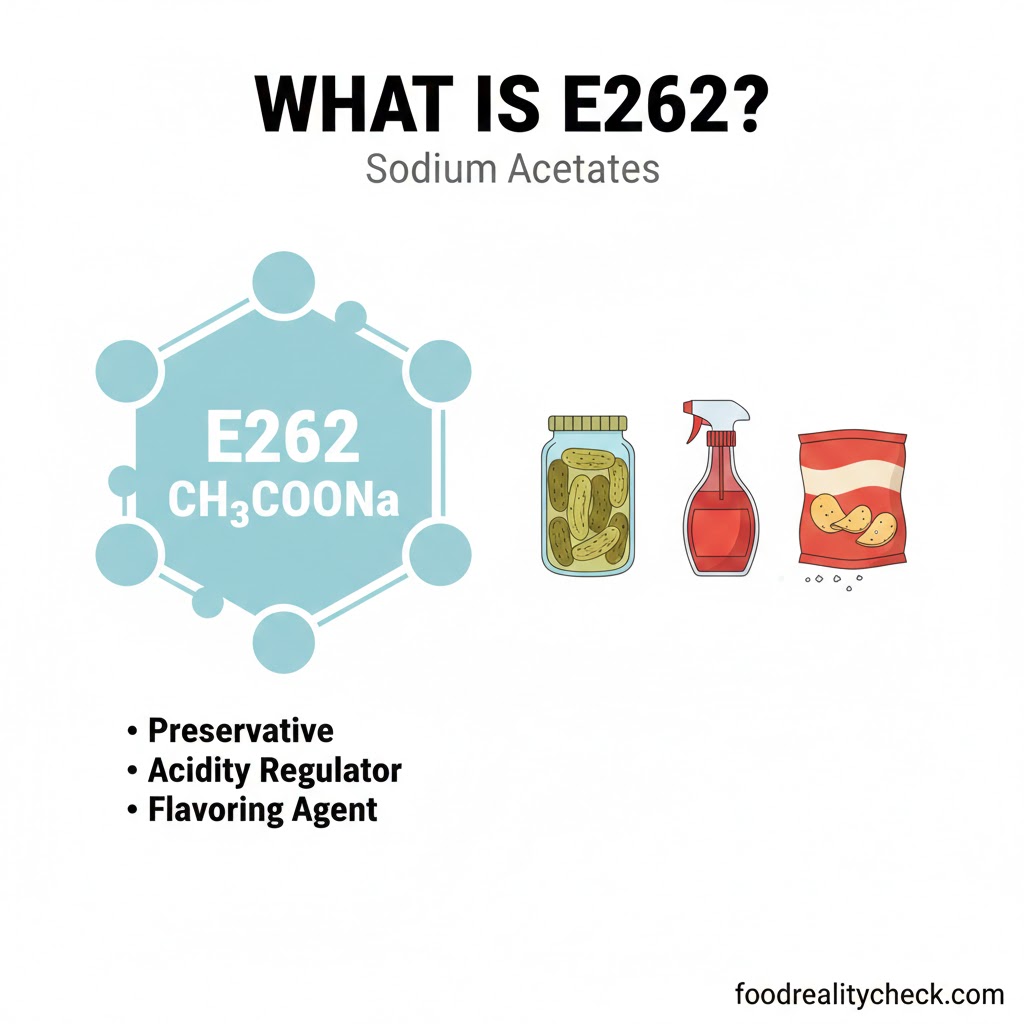
What is E262 (Sodium Acetate)?
Complete guide to this versatile preservative with excellent safety profile and multiple functional benefits
The Quick Answer
E262 is sodium acetate—the sodium salt of acetic acid (the main component of vinegar), available in two chemical forms: sodium acetate (E262(i)) and sodium diacetate (E262(ii)). It’s used as a preservative, acidity regulator, pH buffer, and flavor enhancer in thousands of foods.
Unlike controversial additives, sodium acetate is a safe, well-studied ingredient with no known adverse effects at food levels. It works by preventing bacterial growth, maintaining pH stability, and enhancing the tangy/savory taste of foods—particularly popular in snacks like salt-and-vinegar chips.
It’s approved by all major food authorities with an ADI of “Not Limited,” indicating excellent safety even at high intakes, and has no documented health concerns beyond the sodium content consideration applicable to all sodium-containing additives.
📌 Quick Facts
- Category: Preservative, acidity regulator, pH buffer, flavor enhancer, dough conditioner
- Source: Sodium salt of acetic acid (vinegar component); created by neutralizing acetic acid with sodium compounds
- Found in: Salad dressings, potato chips, sauces, baked goods, processed meats, condiments, pickles, bread
- Safety Status: FDA approved, EFSA approved, ADI “Not Limited” (highest safety rating)
- Chemical Forms: E262(i) Sodium acetate (anhydrous/trihydrate); E262(ii) Sodium diacetate
- Controversy Level: NONE—universally considered safe; no known adverse effects documented
- Taste Profile: Imparts salty, tangy, vinegar-like flavor
- Main Consideration: Sodium content (like all sodium-containing additives)
What Exactly Is Sodium Acetate?
Sodium acetate is the sodium salt of acetic acid—created by neutralizing acetic acid with sodium compounds such as sodium hydroxide, sodium carbonate, or sodium bicarbonate. The result is a white crystalline powder with a mildly salty, vinegar-like taste.
Chemical composition: Sodium acetate exists in multiple chemical forms:
• E262(i) – Sodium acetate anhydrous: Chemical formula CH₃COONa; contains no water molecules
• E262(i) – Sodium acetate trihydrate: Chemical formula CH₃COONa·3H₂O; contains three water molecules (more common in food)
• E262(ii) – Sodium diacetate: Chemical formula NaH(C₂H₃O₂)₂; a 1:1 molar mixture of sodium acetate and acetic acid (more commonly used for flavor enhancement)
In simple terms: It’s essentially vinegar’s salty cousin. While vinegar is acetic acid, sodium acetate is the buffered version. Adding it to food neutralizes excess acidity, prevents bacterial growth, and adds a vinegary or salty flavor.
Key properties:
• Highly soluble: Dissolves readily in water, making it ideal for liquid foods
• Alkaline pH: Creates a pH of 8.5-9.0 in solution, making it basic
• Antimicrobial: Inhibits growth of bacteria, fungi, and spoilage organisms
• Mild taste: Imparts subtle salty and tangy (vinegar-like) notes
• pH buffering: Resists pH changes when acids or bases are added
• Hygroscopic: Absorbs moisture from air; why it comes as hydrated crystals
Where You’ll Find E262
Sodium acetate appears in a diverse range of foods:
• Salad dressings and vinaigrettes
• Potato chips (particularly salt-and-vinegar flavored)
• Savory snacks and seasonings
• Sauces and gravies
• Pickles and pickled vegetables
• Processed and cured meats (sausages, deli meats)
• Bread and baked goods
• Condiments (ketchup, mustard, mayonnaise)
• Sauerkraut and fermented vegetables
• Canned and jarred vegetables
• Butter and dairy products
• Fish and seafood products
• Dumpling and dumpling wrappers
• Steamed fish paste
• Rice cakes
How Is Sodium Acetate Produced?
Sodium acetate production is a straightforward chemical synthesis process:
Step 1: Starting Material
High-purity acetic acid is obtained, typically from fermentation of glucose or sucrose by Aspergillus niger fungus (the same source as citric acid), or from synthetic chemical synthesis.
Step 2: Neutralization
The acetic acid is neutralized with one of three sodium compounds depending on the desired form:
• Sodium hydroxide (NaOH) + Acetic acid → Sodium acetate + Water
• Sodium carbonate (Na₂CO₃) + Acetic acid → Sodium acetate + Water + CO₂
• Sodium bicarbonate (NaHCO₃) + Acetic acid → Sodium acetate + Water + CO₂
Step 3: For E262(ii) Sodium Diacetate
A controlled stoichiometric ratio is maintained to create a 1:1 mixture of sodium acetate and acetic acid. This is done by carefully controlling the neutralization process to not fully neutralize the acid.
Step 4: Crystallization or Hydration
For sodium acetate trihydrate (the most common food-grade form), water is added to crystallize the product with three water molecules per sodium acetate molecule.
Step 5: Separation & Purification
The crystallized product is separated and purified to remove impurities and unreacted starting materials.
Step 6: Drying & Milling
The product is dried to the desired moisture content and milled to achieve the appropriate particle size for food use.
Step 7: Quality Control
Tested for purity, acidity, sodium content, microbiological safety, and contaminants before approval for food use.
Functions of E262 in Food
Sodium acetate serves multiple critical functions in food manufacturing:
As a preservative: Inhibits growth of bacteria, fungi, and mold by creating an acidic environment inhospitable to spoilage organisms. Particularly effective against Clostridium botulinum (botulism risk) and other pathogens.
As an acidity regulator: Lowers pH (increases acidity) in foods that need preservation or specific taste profiles. Used in pickles, dressings, and sauces to achieve desired tang.
As a pH buffer: Resists pH changes when foods are mixed or stored, maintaining consistency in flavor and preservation effectiveness.
As a flavor enhancer: The combination of sodium (salty) and acetate (vinegary) creates the distinctive salt-and-vinegar taste popular in snacks like potato chips. Sodium diacetate (E262(ii)) is particularly valued for this function.
As a dough conditioner: In baking, improves dough texture, elasticity, and gluten development, resulting in softer, more uniform baked goods.
As an antimicrobial agent: Works through multiple mechanisms: lowers pH, disrupts bacterial cell membranes, and inhibits enzyme function in microorganisms.
Is E262 Safe?
Yes. Sodium acetate is one of the safest food additives, with universal approval and no documented adverse health effects at food levels.
Regulatory Approvals:
• FDA: Approved as a food additive for use as a preservative and flavor agent
• EFSA (European Food Safety Authority): Approved as E262. Classified in “Group I” permitted food additives with maximum use level “quantum satis” (as much as is technologically necessary)
• JECFA (Joint FAO/WHO Committee): Assigned an ADI of “Not Limited”—the highest possible safety rating, indicating no safety concerns even at high intake levels
Why is the safety so outstanding?
1. Natural source: Derived from acetic acid, which occurs naturally in vinegar, fermented foods, and is produced by human metabolism
2. Complete metabolism: Completely broken down by the body into acetyl-CoA and enters normal metabolic pathways
3. Decades of use: Used for food preservation for over a century with no documented health problems
4. Extensive safety testing: Animal and human studies show no toxic effects, no carcinogenicity, no genotoxicity, no reproductive toxicity
5. Low exposure: Food levels are minimal; total acetate intake from additives is far lower than from vinegar consumption
6. High safety margin: LD50 (lethal dose) in animals is very high (3,500+ mg/kg), meaning acute toxicity is extremely unlikely even at high doses
Health Effects & Side Effects
At food levels, sodium acetate has no documented adverse effects. The compound has “no known adverse effects” according to multiple safety assessments.
Potential effects only from extremely high doses (well above food levels):
• Nausea and vomiting (from ingesting large quantities as a salt)
• Abdominal pain or cramps
• Diarrhea
• Irritation of gastrointestinal mucosa
• From inhalation exposure (occupational): coughing, respiratory irritation (not relevant to food consumption)
At typical food consumption levels: Zero adverse effects are documented. Studies specifically testing sodium acetate show no cytotoxicity, no genotoxicity, and no DNA damage at concentrations relevant to food use.
Sodium Content Consideration
The main health consideration is sodium content: Like all sodium-containing additives, sodium acetate contributes to dietary sodium intake. Each form contains different amounts of sodium:
• Sodium acetate: Approximately 13-15% sodium by weight
• Sodium diacetate: Approximately 11% sodium by weight
However, food-level contributions are modest: A typical serving of potato chips might contain 300-500mg of sodium acetate, contributing only 40-75mg of sodium—minimal compared to the direct salt (sodium chloride) added to the same product.
For people with hypertension, heart disease, or kidney disease on sodium-restricted diets: Monitor total sodium intake as with all processed foods, but E262 is typically a minor contributor compared to salt itself.
E262(i) vs E262(ii): Forms Compared
| Form | Chemical Formula | Sodium Content | Primary Function | Taste/Effect |
|---|---|---|---|---|
| E262(i) – Sodium Acetate Anhydrous | CH₃COONa | ~23.6% sodium | Preservation, pH regulation, buffering | Salty, slightly acidic |
| E262(i) – Sodium Acetate Trihydrate | CH₃COONa·3H₂O | ~13.6% sodium | Preservation, flavor enhancement (more common) | Milder salty taste |
| E262(ii) – Sodium Diacetate | NaH(C₂H₃O₂)₂ | ~11% sodium | Flavor enhancement, preservation (preferred for taste) | Stronger vinegar/salt taste |
Sodium Acetate vs Acetic Acid (E260): Key Differences
| Property | E260 (Acetic Acid) | E262 (Sodium Acetate) |
|---|---|---|
| Chemical Type | Weak organic acid | Sodium salt of acetic acid |
| pH Effect | Acidic (pH 2-3) | Alkaline (pH 8.5-9.0) |
| Taste | Sour, sharp vinegar taste | Salty, mild vinegar taste |
| Sodium Content | No sodium | 13-24% sodium (depending on form) |
| Primary Use | Flavor enhancer, acidulant | Preservative, flavor enhancer, pH buffer |
| Often Used Together? | Yes—sodium diacetate (E262(ii)) is a 1:1 mixture of acetic acid and sodium acetate | |
Who Should Limit E262 Intake?
Most people can consume E262-containing foods without concerns. However, consider limiting if you have:
• Hypertension (high blood pressure): Monitor total sodium intake, though E262 is typically a modest contributor
• Congestive heart failure: Sodium-restricted diet; limit processed foods in general
• Chronic kidney disease: Reduced sodium clearance; consult healthcare provider
• Edema or fluid retention conditions: Sodium restriction may be recommended
For these populations: The sodium content of E262 is a minor consideration compared to direct salt addition and should be managed as part of overall sodium reduction in processed food consumption.
The Bottom Line
E262 (sodium acetate) is one of the safest and most well-studied food additives, with universal regulatory approval and no documented health concerns at food levels.
Key takeaways:
• Outstanding safety: ADI “Not Limited”—the highest possible safety rating; no adverse effects documented at food levels
• Natural origin: Derived from acetic acid (vinegar), which occurs naturally in foods and human metabolism
• Multiple beneficial functions: Preservative, pH buffer, flavor enhancer, dough conditioner—truly multifunctional
• Decades of safe use: Used for food preservation for over 100 years with excellent safety record
• Well-studied: Extensive animal and human studies show no toxicity, carcinogenicity, or genotoxicity
• No known adverse effects: Unlike controversial additives, sodium acetate has zero documented health problems from food consumption
• Minimal side effects: Only effects occur from extremely high doses far exceeding food levels
• Sodium consideration: Main health factor is sodium content (applicable to all sodium additives), typically contributing modestly to total dietary sodium
Practical recommendation: Sodium acetate (E262) is one of the safest and most beneficial food additives available. It serves genuine preservation and flavor functions while maintaining an excellent safety profile. There are no health concerns with consuming it in typical food amounts. If managing sodium intake due to hypertension or kidney disease, focus on reducing direct salt intake rather than worrying about sodium acetate in processed foods, as the latter is a minor contributor.