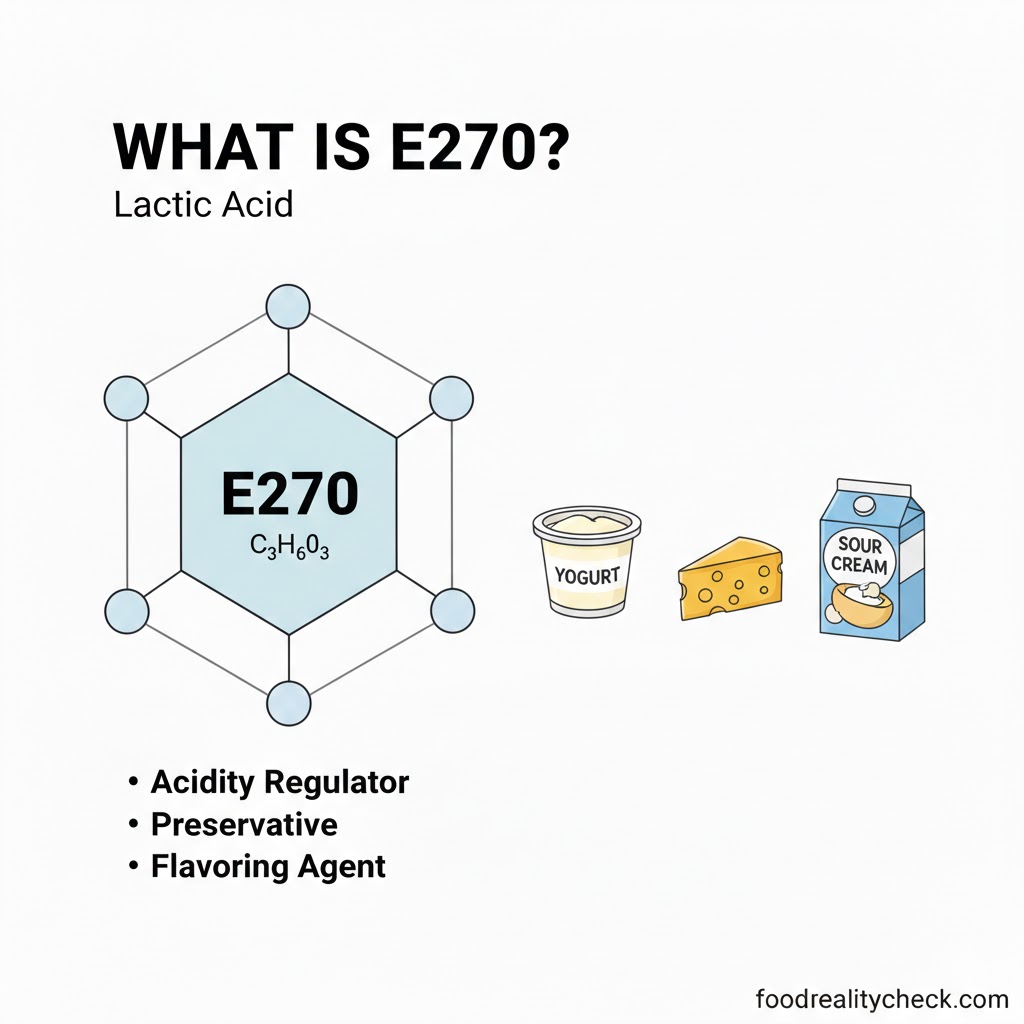
What is E270?
Complete guide to understanding E270 (Lactic Acid) in your food
The Quick Answer
E270 is a natural organic acid produced by fermentation of carbohydrates.
It’s used in foods to regulate acidity, preserve freshness, and add a mild sour flavor.
It’s one of the safest food additives available, with an excellent safety record and no documented adverse health effects at approved levels.
📌 Quick Facts
- Category: Natural organic acid (acidity regulator, preservative)
- Chemical Name: 2-hydroxypropanoic acid
- Chemical Formula: C₃H₆O₃
- Source: Naturally produced by lactic acid bacteria fermentation; also synthetically from acetaldehyde
- Found in: Yogurt, pickles, sauerkraut, kimchi, sourdough bread, dairy products, beverages, processed meats
- Safety: FDA GRAS status; EFSA approved with no numerical ADI limit needed (Green classification)
- Health Impact: Essential metabolite; your body produces lactic acid during exercise and fermentation
What Exactly Is It?
E270 is a natural organic acid naturally present in many foods and produced by your own body.
Its chemical formula is C₃H₆O₃ (2-hydroxypropanoic acid).
Lactic acid is produced by lactic acid bacteria when they ferment carbohydrates (glucose, sucrose, galactose) under anaerobic (oxygen-free) conditions. This fermentation process is ancient—used for millennia in creating yogurt, cheese, sauerkraut, kimchi, and fermented breads.
Commercially, E270 is produced in two main ways: fermentation (70–90% of industrial production) using lactic acid bacteria, or chemical synthesis from acetaldehyde.
It appears as a colorless to slightly yellowish liquid with a characteristic sour milk smell, highly soluble in water and alcohol.
Lactic acid naturally occurs in high concentrations in yogurt, kefir, pickled vegetables, sourdough bread, and all fermented foods.
Where You’ll Find It
E270 appears in many common foods:
• Yogurt and dairy products
• Cheese and cheese spreads
• Pickles and pickled vegetables
• Sauerkraut and fermented vegetables
• Kimchi
• Sourdough and fermented breads
• Fruit juices and beverages
• Sports drinks and electrolyte beverages
• Salad dressings and marinades
• Canned vegetables and fruits
• Processed and cured meats (deli meats, sausages)
• Confectionery and candies
• Beer and fermented alcoholic beverages
• Infant formula and baby food
Lactic acid is one of the most widely used and well-tolerated food additives globally, with minimal regulatory restrictions.
Why Do Food Companies Use It?
E270 serves multiple critical functions:
Acidity regulation (pH control): Lactic acid lowers pH, creating an acidic environment that inhibits harmful bacteria like Listeria and E. coli while preserving flavor and food safety.
Mild preservative effect: The acidic environment inhibits microbial growth, extending shelf-life without synthetic preservatives.
Flavor enhancement: Adds a mild sour, tangy taste that enhances other flavors without overwhelming (probiotic effect). This is why yogurt, pickles, and fermented foods taste complex and appealing.
Texture improvement: In cheese making, lactic acid causes casein (milk protein) to coagulate, creating the desired curd texture.
Food safety: Particularly important in meat processing, where lactic acid surface treatment reduces pathogens and extends shelf-life of deli meats and cured products.
Natural image: Consumer preference for “fermented” and “probiotic” products makes lactic acid an attractive natural preservation alternative to synthetic additives.
Is It Safe?
Yes, E270 is considered one of the safest food additives available, with no documented adverse health effects at approved use levels.
The FDA classifies lactic acid as GRAS (Generally Recognized as Safe) under 21 CFR §184.1061.
The EFSA re-evaluated lactic acid and concluded there are “no safety concerns” when used as requested in foods within existing specifications.
JECFA and WHO both approve lactic acid without numerical ADI (Acceptable Daily Intake) limit—a designation reserved for substances with exceptionally low toxicological concern.
What Are The Health Concerns?
E270 has essentially no documented health concerns at approved food use levels.
Natural metabolite: Lactic acid is not a foreign substance. Your body produces it naturally: during anaerobic exercise (muscle fatigue during intense workouts), during bacterial fermentation in your gut, and in your blood as a normal metabolic intermediate.
No toxicity: Extensive testing shows no genotoxic, carcinogenic, or reproductive/developmental toxicity effects at any approved food use level.
Beneficial effects: Fermented foods containing lactic acid support healthy gut microbiota (probiotics), improve digestive enzyme activity, increase mineral bioavailability (particularly calcium, iron, magnesium), and boost immune function.
Concentrated solutions (occupational hazard only): Concentrated lactic acid (>10%) is corrosive and can irritate skin and eyes in occupational settings. However, food-grade lactic acid is properly diluted and poses no such risk for consumers.
Rare consideration – D-isomer in infants: Some studies theoretically suggest extremely high intakes of D-lactic acid (a stereoisomer) could be undesirable for infants or individuals with impaired metabolism. However, typical dietary exposure is low, and this is not a practical concern for food consumption.
Cavity formation (dental concern): Lactic acid bacteria in the mouth produce lactic acid as a byproduct, which can contribute to tooth decay. However, this is a dental hygiene issue, not a food safety issue—and has nothing to do with consuming lactic acid in food.
Natural vs Synthetic Version
E270 exists in both forms:
Naturally fermented (70–90% of production): Produced by bacterial fermentation of carbohydrates (glucose from corn, beets, molasses). This is the preferred form and is identical chemically to naturally occurring lactic acid in yogurt and pickles.
Synthetically manufactured: Produced from acetaldehyde through chemical synthesis. Also safe, chemically identical to fermented lactic acid, and equally approved.
Stereoisomers: Fermentation typically produces L-lactic acid (left-handed molecular form), which is the naturally occurring form in your body. Chemical synthesis can produce racemic lactic acid (equal mixture of L and D forms, both safe).
Natural Alternatives
E270 IS already the natural alternative to synthetic preservatives.
If you want to avoid processed lactic acid and prefer whole foods, options include:
• Yogurt and kefir – live lactic acid from natural fermentation
• Sauerkraut and kimchi – fermented vegetables with natural lactic acid
• Sourdough bread – naturally leavened with lactic acid bacteria
• Pickled vegetables – vinegar-based or naturally fermented
• Cheese – naturally fermented with lactic acid
• Other fermented foods – kombucha, tempeh, miso (all contain lactic acid from fermentation)
The Bottom Line
E270 (Lactic Acid) is a naturally occurring organic acid produced by fermentation that is one of the safest food additives available, with an exceptional safety record and documented health benefits.
Safety Profile: FDA GRAS, EFSA approved with no safety concerns, JECFA approval with no numerical ADI limit. No genotoxicity, carcinogenicity, reproductive/developmental toxicity documented.
Health Benefits: Lactic acid supports healthy gut microbiota (probiotics), improves digestive enzyme activity, increases mineral bioavailability, and boosts immune function. Your body naturally produces lactic acid and depends on it.
Why It’s Different: Unlike synthetic dyes (Yellow 5/6) or preservatives (sodium benzoate E211) with documented concerns, lactic acid has no credible health risks and actually supports health. It’s not an additive you should try to avoid—it’s one you want in your food.
Best Use: E270 is particularly valuable in fermented foods where it provides both preservation and probiotic benefits. Choose fermented and probiotic-rich foods (yogurt, kefir, sauerkraut, kimchi) which naturally contain lactic acid along with beneficial bacteria.
Regulatory Consistency: This is one of the rare food additives where FDA, EFSA, JECFA, and scientific literature are in complete consensus: lactic acid is safe and beneficial.