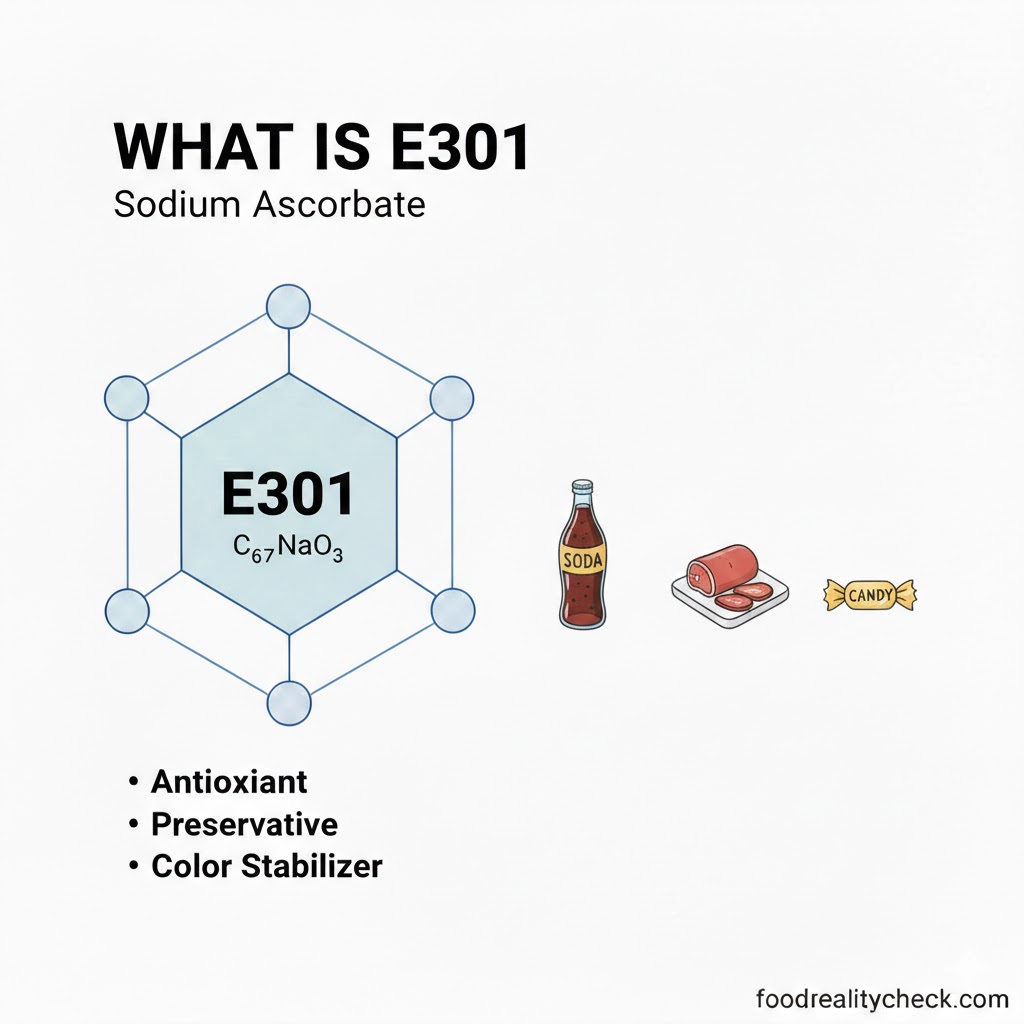
What is E301?
Complete guide to understanding E301 (Sodium Ascorbate) in your food
The Quick Answer
E301 is the sodium salt of vitamin C (ascorbic acid)—an essential nutrient that functions as an antioxidant and preservative to prevent fats, oils, and foods from becoming rancid.
It’s used in processed meats, cured meats, juices, baked goods, canned foods, and virtually every food category where oxidation protection is needed.
It is one of the safest food additives available, with no documented adverse health effects at food-use levels. EFSA’s comprehensive re-evaluation concluded there is no need for a numerical ADI, indicating that E301 (along with E300 and E302) is fundamentally safe.
📌 Quick Facts
- Category: Natural antioxidant, preservative, vitamin (sodium salt of vitamin C)
- Chemical Name: Sodium ascorbate or sodium L-ascorbate
- Chemical Formula: C₆H₇NaO₆
- Source: Produced by neutralizing ascorbic acid (vitamin C) with sodium hydroxide or sodium bicarbonate
- Sodium Content: 1 g of E301 contains approximately 111 mg sodium and 889 mg ascorbic acid
- Found in: Processed meats, cured meats, sausages, fruit juices, baked goods, canned foods, beverages, dairy products
- Safety Status: FDA GRAS; EFSA approved; NO numerical ADI required (safest rating); JECFA approved
- Key Advantage Over E300: Higher water solubility; less acidic; better tolerated by sensitive digestive systems
What Exactly Is It?
E301 is sodium ascorbate—the sodium salt of vitamin C (ascorbic acid)—produced by neutralizing ascorbic acid with sodium hydroxide or sodium bicarbonate.
Its chemical formula is C₆H₇NaO₆.
Composition: Each 1 gram of sodium ascorbate contains approximately 889 mg ascorbic acid (vitamin C) and 111 mg sodium.
Production: Food-grade E301 is manufactured by dissolving ascorbic acid (E300) in water and adding an equimolar amount of sodium hydroxide (NaOH) or sodium bicarbonate (NaHCO₃). After the chemical reaction is complete (indicated by cessation of effervescence), the sodium ascorbate is precipitated by adding isopropanol, then filtered, washed, and dried to produce a white to light-yellow crystalline powder.
E301 is chemically identical whether the ascorbic acid starting material came from natural fruit extraction or industrial synthesis—the final product is the same sodium salt of vitamin C.
Key functional advantage: E301 has much higher water solubility than pure ascorbic acid (E300), making it easier to dissolve in aqueous solutions (beverages, cured meats, sauces). It is also less acidic, making it gentler on teeth enamel and more suitable for people with acid-sensitive digestive systems.
Where You’ll Find It
E301 appears in many foods, particularly those requiring oxidation prevention and acidic adjustment:
• Processed and cured meats (sausages, ham, bacon, deli meats)
• Fruit juices and nectars (citrus, apple, pineapple)
• Baked goods (bread, pastries, cakes)
• Canned fruits and vegetables
• Beverages (soft drinks, sports drinks, energy drinks)
• Dairy products (milk, yogurt, cheese)
• Oils and fats (particularly in meat products)
• Beer and wine
• Instant foods and powders
• Ice cream and frozen desserts
• Confectionery and sweets
• Flavored drinks
• Cosmetics and personal care products
• Pharmaceuticals
E301 is particularly valued in cured meat products where it prevents formation of carcinogenic nitrosamines from curing salts while simultaneously providing vitamin C nutrition.
Why Do Food Companies Use It?
E301 serves multiple critical functions, particularly in processed foods:
Prevents oxidative rancidity: Fats and oils naturally oxidize, producing rancid off-flavors and potentially toxic byproducts. E301 prevents this, extending shelf-life months or years.
Prevents nitrosamine formation: In cured meats, E301 inhibits formation of carcinogenic N-nitroso compounds from nitrite curing salts—a critical safety function.
Better water solubility than E300: The sodium salt dissolves readily in water and aqueous food systems, enabling uniform distribution and effectiveness across beverages, sauces, and cured products.
Less acidic than E300: Gentler on tooth enamel and sensitive digestive systems; preferable to ascorbic acid in products targeting sensitive consumers.
Color and flavor preservation: Prevents browning, color loss, and off-flavor development in fruits, vegetables, and processed foods.
Metal chelation: Binds copper and iron, preventing their oxidation-catalyzing effects.
Dual benefit—preservation and nutrition: E301 simultaneously provides vitamin C nutrition while preserving food—a dual benefit few additives offer.
Regulatory approval and consumer confidence: “Sodium ascorbate” and “vitamin C” are recognized as safe and beneficial, aiding marketing of health-conscious products.
Is It Safe?
Yes—E301 is one of the safest food additives available. EFSA’s comprehensive re-evaluation concluded there is no need for a numerical ADI limit because sodium ascorbate is fundamentally safe, with no documented adverse health effects at food-use levels.
The FDA classifies sodium ascorbate as GRAS (Generally Recognized as Safe).
The EFSA’s 2015 comprehensive re-evaluation of ascorbic acid (E300), sodium ascorbate (E301), and calcium ascorbate (E302) concluded: “There is no safety concern for the use of ascorbic acid (E 300), sodium ascorbate (E 301) and calcium ascorbate (E 302) as food additives at the reported uses and use levels and there is no need for a numerical ADI for ascorbic acid and its salts.”
The JECFA (WHO Expert Committee) also confirmed safety with no numerical ADI limit.
✓ GREEN SAFETY RATING – SAFEST CATEGORY: E301 has:
• No genotoxicity (DNA damage) at any tested dose
• No carcinogenicity; no chronic toxicity or cancer risk documented
• No reproductive or developmental toxicity
• No organ toxicity at food-use levels
• Very low acute toxicity
• Essential nutrient component (vitamin C); humans require it for survival
• Regulatory consensus: NO numerical ADI needed (highest safety confidence)
• Similar safety profile to E300 (ascorbic acid) but with improved solubility and reduced acidity
This is one of the highest regulatory safety ratings possible for a food additive—indicating E301 is fundamentally safe and beneficial.
What Are The Health Concerns?
E301 has no documented health concerns at food-use levels. However, some considerations exist at extremely high supplement doses (well beyond typical food consumption):
No health concerns at food-use levels: EFSA, FDA, and JECFA all concluded no adverse effects at approved food use levels. Extensive human consumption history globally supports safety.
Sodium content (minimal concern): Each gram of E301 contains ~111 mg sodium. However, typical food use levels are small (0.1–0.5% by weight), translating to minimal sodium contribution compared to table salt and other sodium sources in diet.
Minor gastrointestinal effects (extreme supplement doses only): At very high supplemental doses (2,000+ mg/day from supplements), some people report diarrhea, nausea, or stomach cramps. Food-use levels pose no such risk.
Kidney stone risk (supplement use, not food): Extremely high supplemental vitamin C intake (3,000+ mg/day) may increase kidney stone risk in susceptible individuals. Food consumption poses no such risk.
Less acidic than E300 (advantage): E301 is gentler on tooth enamel and digestive systems than pure ascorbic acid, making it preferable for acid-sensitive individuals.
Cytotoxic effects in cancer cells (potential benefit, not harm): In vitro studies show sodium ascorbate produces cytotoxic effects in malignant cell lines (melanoma particularly susceptible), suggesting potential therapeutic anticancer properties rather than toxicity to normal cells.
No concerns for any population group: E301 is safe for children, pregnant women, elderly, immunocompromised—all populations.
Natural vs Synthetic Version
E301 is chemically identical whether the ascorbic acid starting material came from natural fruit extraction or industrial fermentation synthesis.
All E301 has the same chemical formula (C₆H₇NaO₆) and biological activity. The human body cannot distinguish between sodium ascorbate derived from citrus extract and sodium ascorbate synthesized from glucose fermentation.
Most food-grade E301 is produced by synthesizing ascorbic acid from glucose via bacterial fermentation, then neutralizing with sodium hydroxide. However, E301 derived from natural ascorbic acid extract is also available and produces identical chemical compounds.
Natural Alternatives
E301 IS already a natural ingredient (sodium salt of vitamin C).
Other antioxidant preservatives include:
• Ascorbic acid (E300) – pure vitamin C (same antioxidant power but more acidic)
• Calcium ascorbate (E302) – calcium salt of vitamin C (less sodium, more calcium)
• Vitamin E/Tocopherols (E306) – natural fat-soluble antioxidant
• Rosemary extract – natural antioxidant
• Green tea extract – natural antioxidant
• Citric acid (E330) – chelates metals; synergistic with antioxidants
• Fresh foods with shorter shelf-life – accept reduced shelf-life, higher cost
The Bottom Line
E301 (Sodium Ascorbate) is the sodium salt of vitamin C—one of the safest food additives available, with no documented adverse health effects at food-use levels. EFSA’s determination that no numerical ADI is needed reflects the highest possible regulatory confidence, identical to E300 (ascorbic acid).
Regulatory Consensus: FDA GRAS, EFSA approved (no ADI needed), JECFA approved—unanimous agreement from all major food authorities.
Essential Nutrient Component: E301 contains vitamin C, an essential nutrient humans cannot synthesize and must obtain from diet. Unlike most food additives (non-essential chemicals), E301 provides actual nutritional benefit.
Advantages Over E300 (Ascorbic Acid): E301 has superior water solubility (dissolves more easily in aqueous foods), is less acidic (gentler on teeth and sensitive digestive systems), and is better tolerated by sensitive individuals.
Minimal Sodium Concern: While E301 contains sodium (111 mg per gram), typical food-use levels are low (0.1–0.5%), translating to minimal sodium contribution compared to table salt and other dietary sodium sources.
Critical Nitrosamine Prevention Function: In processed meats, E301 prevents formation of carcinogenic nitrosamines from curing salts—a protective health function.
Dual Benefit: E301 simultaneously provides food preservation (extending shelf-life) AND nutritional benefit (vitamin C fortification). Few food additives combine these advantages.
Safe for All Populations: E301 is approved for all consumer groups, including infants, children, pregnant women, elderly, and immunocompromised individuals.
No Documented Human Adverse Effects: Extensive global consumption history combined with comprehensive regulatory testing shows no genotoxicity, carcinogenicity, or chronic toxicity.
Recommendation: E301 is safe and beneficial. Like E300, it is one of the few food additives you should NOT try to avoid. Ensuring adequate vitamin C intake (from both natural sources and E301-fortified foods) is health-promoting rather than concerning. For individuals preferring lower sodium intake, E302 (calcium ascorbate) is an alternative, but E301 remains an excellent, safe choice.