What is E306?
Complete guide to understanding E306 (Tocopherols) in your food
The Quick Answer
E306 is a natural antioxidant derived from vitamin E.
It’s used in food to prevent fats and oils from spoiling, extending shelf-life and freshness.
It’s actually a nutrient that your body needs, making it one of the safest food additives available.
📌 Quick Facts
- Category: Natural antioxidant (Vitamin E compound)
- Also Known As: Tocopherol-rich extract, mixed tocopherols, vitamin E
- Source: Vegetable oils (soybean, sunflower, corn, wheat germ)
- Found in: Oils, margarines, baked goods, snacks, cereals, meat products, dairy
- Safety: Generally Recognized as Safe (GRAS); nutritional benefit
- ADI (EFSA): 2 mg/kg body weight per day
What Exactly Is It?
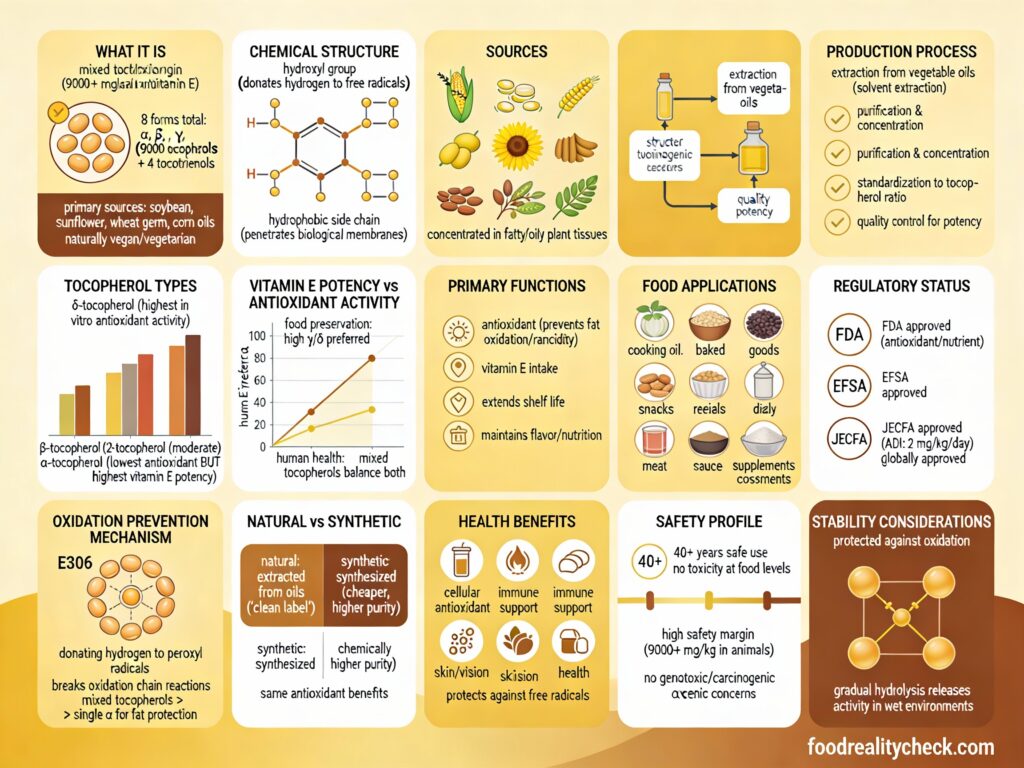
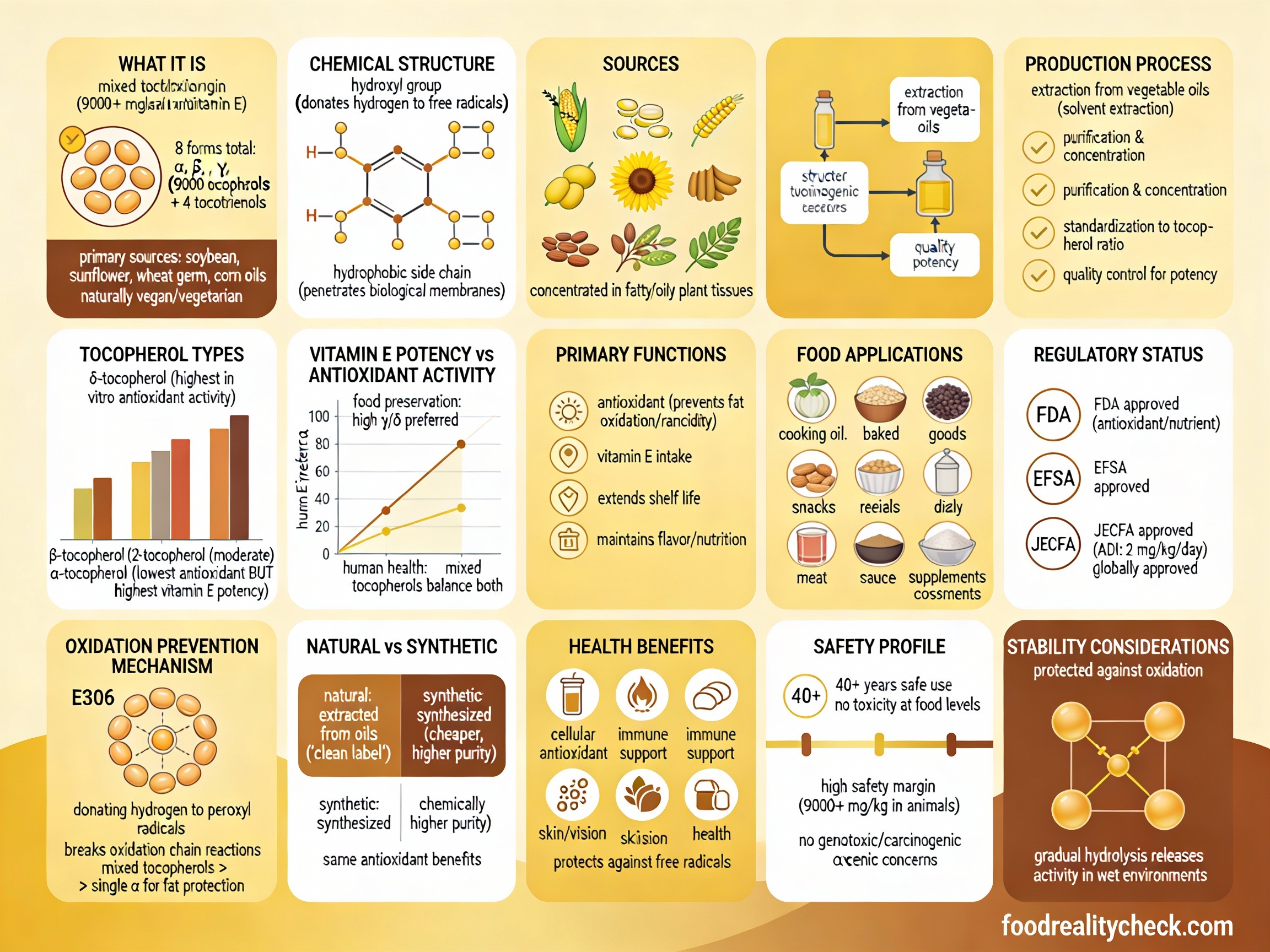
E306 is a mixture of natural tocopherols and tocotrienols extracted from vegetable oils.
These compounds are forms of vitamin E—a fat-soluble vitamin your body requires for health.
Tocopherols exist in eight different chemical forms: alpha, beta, gamma, and delta tocopherols, plus four corresponding tocotrienols.
E306 is extracted from oil-rich seeds and plants through pressing or solvent extraction, producing a concentrated source of vitamin E compounds.
It appears as a pale yellow oily liquid with a faint vegetable odor.
Where You’ll Find It
E306 appears in many common foods:
• Cooking oils and margarines
• Bread, cakes, and bakery products
• Cereals and grain-based products
• Snacks and fried foods (chips, nuts)
• Processed meats and sausages
• Dairy products and cheese
• Sauces and condiments
• Chocolate and confectionery
• Powdered milk and dairy replacers
• Nuts and nut butters
• Nuts and seeds
• Pet food and animal feed
Wherever there’s fat in processed food, E306 is likely protecting it from oxidation.
Why Do Food Companies Use It?
E306 serves one essential function: prevent fat and oil rancidity.
When fats and oils are exposed to oxygen, heat, or light, they undergo oxidation—a chemical reaction that produces off-flavors, off-odors, and harmful compounds like peroxides.
E306 acts as an antioxidant by donating a hydrogen atom to free radicals and peroxides, neutralizing them before they can damage the food.
This keeps products fresh, flavorful, and nutritious for longer, extending shelf-life and reducing food waste.
Because E306 is a natural source of vitamin E—a nutrient consumers recognize and trust—manufacturers prefer it over synthetic antioxidants (BHA, BHT) for products marketed as “natural.”
Is It Safe?
Yes, E306 is considered extremely safe.
The FDA classifies it as “Generally Recognized as Safe” (GRAS).
The European Food Safety Authority (EFSA) has established an ADI of 2 mg/kg body weight per day.
To exceed this limit, you would need to consume approximately 140 grams of pure E306 daily—far beyond any realistic food consumption.
E306 is actually beneficial: tocopherols are essential nutrients that support immune function, cell protection, and cardiovascular health.
What Are The Health Concerns?
E306 has virtually no documented health concerns.
Nutrient, not toxin: E306 is a form of vitamin E, an essential nutrient required for optimal health. You need it; your body doesn’t store excess amounts permanently.
Soy allergen concern: E306 is often derived from soybean oil. While most processing removes allergens, people with severe soy allergies should check labels or contact manufacturers to confirm the source.
No toxicity concerns: No studies show genotoxic, carcinogenic, or reproductive toxicity effects at normal exposure levels.
Vitamin E supplementation distinction: Some concerns about high-dose vitamin E supplements (pills, extracts) causing thinning of blood apply to supplement megadoses, not the tiny food additive amounts. E306 in food poses no bleeding risk.
Environmental consideration: E306 from soybean or palm oil sources raises environmental concerns about deforestation—not a health risk, but an ethical one.
E306 is genuinely one of the safest food additives available.
Natural vs Synthetic Version
E306 is naturally derived—extracted directly from vegetable oils.
However, related additives E307 (alpha-tocopherol), E308 (gamma-tocopherol), and E309 (delta-tocopherol) are synthetically manufactured in laboratories.
E306 specifically is a natural extract, making it preferred by manufacturers seeking “clean label” products with natural antioxidants.
Both natural and synthetic tocopherols have identical chemical structures and identical antioxidant effects in the body.
Natural Alternatives
E306 already IS the natural alternative.
For manufacturers seeking natural antioxidants, alternatives include:
• Rosemary extract (E392) – natural antioxidant from herbs
• Ascorbic acid/vitamin C (E300) – natural antioxidant
• Tea extract polyphenols – natural antioxidants from tea
• Reduced processing – fresh foods without added antioxidants
But E306 remains the most effective, most versatile, and most nutrient-dense natural antioxidant available, which is why it’s so widely used.
The Bottom Line
E306 is a natural, vitamin E-derived antioxidant that prevents fats and oils from spoiling while providing genuine nutritional benefit.
It’s one of the few food additives that is genuinely beneficial—a nutrient your body needs, not a synthetic chemical to avoid.
Regulatory bodies worldwide consider it safe with virtually no documented health concerns.
If you’re trying to avoid synthetic food additives, E306 is an excellent choice that actually improves product quality without trade-offs.
For anyone seeking products with natural ingredients, E306 (and vitamin E in general) is exactly what you want to see on ingredient labels.