What is E320?
Complete guide to understanding E320 (Butylated Hydroxyanisole) in your food
The Quick Answer
E320 is a synthetic antioxidant used to prevent fats and oils from becoming rancid.
It’s used in oils, shortenings, butter, cereals, baked goods, and processed meats.
It is classified as “possibly carcinogenic to humans” (IARC Group 2B) and is a documented endocrine disruptor that interferes with reproductive and developmental health, with documented effects on fertility, sperm quality, and hormone levels—making it one of the most controversial food additives.
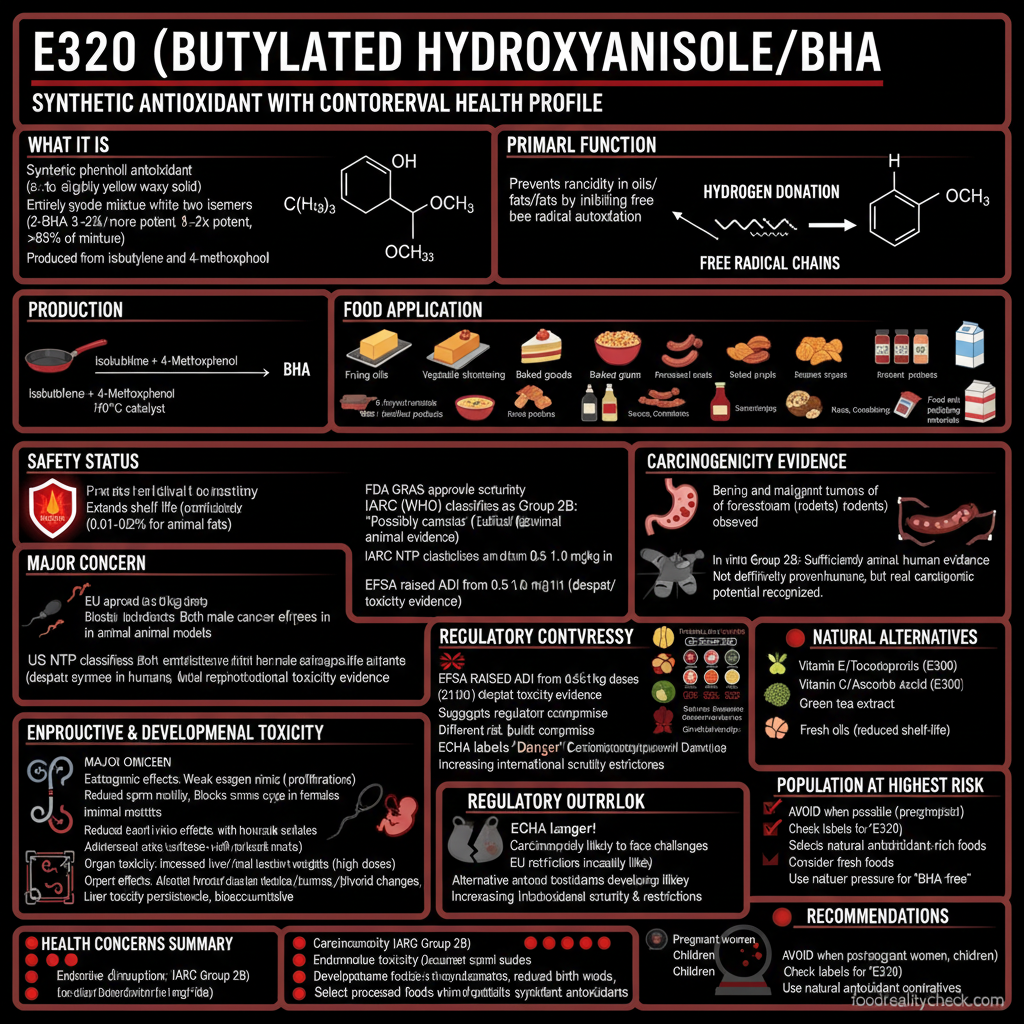
📌 Quick Facts
- Category: Synthetic phenolic antioxidant and preservative
- Full Name: Butylated Hydroxyanisole (2-tert-butyl-4-methoxyphenol)
- Chemical Formula: C₁₁H₁₆O₂
- Source: Entirely synthetic, produced from isobutylene and 4-methoxyphenol
- Found in: Oils, shortenings, cereals, baked goods, dehydrated potatoes, processed meats, margarine, chewing gum
- Safety Status: FDA GRAS approval; EU approved (but controversial); IARC classifies as “possibly carcinogenic” (Group 2B)
- ADI (EFSA): 1.0 mg/kg body weight per day (raised from 0.5 mg/kg in 2011)
- Critical Concerns: Carcinogenicity, endocrine disruption, reproductive/developmental toxicity
What Exactly Is It?
E320 is a synthetic phenolic antioxidant chemically produced from isobutylene and 4-methoxyphenol.
Its full chemical name is 2-tert-butyl-4-methoxyphenol or butylated hydroxyanisole.
It appears as a white to slightly yellow waxy solid with a faint characteristic odor.
Food-grade E320 is a mixture of two isomers: 2-BHA (less active) and 3-BHA (1.5–2 times more potent), with 3-BHA comprising at least 85% of the mixture.
E320 works by inhibiting free radical autoxidation—the chemical process that makes fats and oils rancid. It donates hydrogen atoms to break the free radical chain reaction.
E320 is entirely synthetic—there is no natural form.
Where You’ll Find It
E320 appears in many processed foods:
• Frying oils and cooking oils
• Shortenings and vegetable shortening
• Butter and margarine
• Cereals and breakfast products
• Baked goods (cakes, cookies, pastries)
• Chewing gum
• Dehydrated potatoes and potato products
• Processed and cured meats (sausages, deli meats)
• Instant soups and broths
• Sauces and condiments
• Spices and seasonings
• Powdered milk and infant formula (in some jurisdictions)
• Nuts and nut products
• Food packaging materials (migrates into food)
E320 can also be found in cosmetics, pharmaceuticals (isotretinoin, lovastatin, simvastatin), rubber, and petroleum products.
Why Do Food Companies Use It?
E320 serves a critical preservation function:
Prevents rancidity: Fats and oils naturally undergo oxidation when exposed to air, producing rancid off-flavors and potentially toxic oxidation products. E320 prevents this oxidation, extending shelf-life by months or years.
Highly effective: Works at very low concentrations (0.01–0.02% for animal fats).
Cost-effective: Far cheaper than most natural antioxidants.
Heat stable: Resists degradation at high temperatures used in food processing.
Regulatory approval: Approved by major regulators (FDA, EU) despite controversy.
Synergy with other additives: Works well in combination with other antioxidants and preservatives.
Is It Safe?
No—E320 is officially approved but highly controversial due to documented carcinogenicity (IARC Group 2B), endocrine disruption, and reproductive/developmental toxicity with confirmed effects on fertility, sperm quality, and hormone balance.
The FDA classifies E320 as GRAS (Generally Recognized as Safe).
The EFSA approved E320 with an ADI of 1.0 mg/kg body weight per day (raised from 0.5 mg/kg in 2011).
However, these approvals are increasingly controversial given documented health effects.
⚠️ CRITICAL HEALTH CONCERNS – Why E320 Is One Of The Most Controversial Food Additives:
1. CARCINOGENICITY (PROVEN IN ANIMALS): Carcinogenicity studies show that BHA causes benign and malignant tumors of the forestomach (a pre-stomach chamber in rodents) and increases incidence of several cancer types. IARC classified as “possibly carcinogenic to humans” (Group 2B). The US National Toxicology Program (NTP) classified BHA as “reasonably anticipated to be a human carcinogen.”
2. ENDOCRINE DISRUPTION (EXTENSIVELY DOCUMENTED): BHA acts as both an estrogen mimic (weak estrogenic activity) and androgen antagonist (blocks male hormones). Multiple in vitro and in vivo studies confirm:
• Estrogenic effects in breast cancer cell proliferation assays
• Androgenic antagonism in androgen receptor assays
• Dual properties: estrogenic + anti-androgenic
• Additive/synergistic effects when combined with natural estrogens
3. REPRODUCTIVE & DEVELOPMENTAL TOXICITY (CONFIRMED): Animal studies at 100–500 mg/kg (within realistic dietary exposure range) show:
• Delayed sexual maturation in offspring (delayed vaginal opening, delayed preputial separation)
• Reduced sperm motility and smaller sperm size
• Shortened estrous (menstrual) cycle in females
• Reduced reproductive organ weights (vagina, testes, ventral prostate)
• Reduced serum testosterone in males
• Altered thyroid hormone levels
• Lower mating rates and reduced fertility
4. ORGAN TOXICITY: Long-term studies show:
• Increased liver and adrenal gland weights
• Stomach forestomach hyperplasia and tumor formation
• Kidney and thyroid changes
5. REGULATORY CONTROVERSY: The EFSA RAISED the ADI from 0.5 to 1.0 mg/kg in 2011 despite evidence of reproductive and developmental toxicity—suggesting regulatory compromise rather than genuine safety confidence.
What Are The Health Concerns?
E320 has multiple severe documented health concerns:
Carcinogenicity: IARC Group 2B (“possibly carcinogenic to humans”); NTP “reasonably anticipated to be a human carcinogen.” Sufficient animal evidence but limited human studies.
Endocrine disruption: Acts as weak estrogen mimic and androgen antagonist. Multiple receptor binding and gene expression studies confirm hormone-like effects. Additive/synergistic with natural hormones.
Reproductive toxicity: Delays sexual maturation, reduces fertility, impairs sperm quality and motility, shortens estrous cycle, reduces reproductive organ development.
Developmental toxicity: Fetal exposure to BHA causes altered organ development, reduced birth weights, delayed maturation in offspring.
Thyroid effects: Alters thyroid hormone levels and thyroid gland morphology at high doses.
Allergic reactions: Documented cases of contact dermatitis (skin irritation) and allergic sensitization, particularly in cosmetics and topical applications.
Liver toxicity: Long-term consumption increases liver weight and can cause hepatotoxicity at high doses.
Environmental persistence: Not readily biodegradable; accumulates in aquatic organisms with high bioaccumulation potential and toxicity.
Natural vs Synthetic Version
E320 is entirely synthetic—there is no natural form.
It’s manufactured from isobutylene and 4-methoxyphenol through chemical synthesis.
Natural Alternatives
Want to avoid E320?
Natural antioxidants include:
• Vitamin E/Tocopherols (E306) – natural antioxidant
• Vitamin C/Ascorbic Acid (E300) – natural antioxidant
• Rosemary extract – natural antioxidant (carnosic acid)
• Green tea extract – natural antioxidant (catechins)
• Oregano extract – natural antioxidant
• Citric acid (E330) – synergistic with antioxidants
• Fresh oils with shorter shelf-life – accept reduced shelf-life vs. chemical preservation
Natural alternatives are less potent and have shorter effective shelf-life but avoid documented reproductive, endocrine, and carcinogenic concerns.
The Bottom Line
E320 (Butylated Hydroxyanisole) is a synthetic antioxidant that is officially approved by the FDA and EU but is classified as “possibly carcinogenic to humans” (IARC Group 2B), acts as an endocrine disruptor, and causes documented reproductive and developmental toxicity—making it one of the most controversial food additives despite continued regulatory approval.
Regulatory Red Flag: The EFSA RAISED the ADI from 0.5 to 1.0 mg/kg in 2011 despite animal evidence of reproductive and developmental toxicity—suggesting regulatory compromise rather than genuine confidence in safety.
Carcinogenicity Status: IARC Group 2B means sufficient animal evidence of carcinogenicity but limited human evidence. This is not “safe”—it’s a precautionary classification acknowledging real carcinogenic potential.
Endocrine Disruption: Extensively documented in vitro and in vivo evidence that BHA mimics estrogen and blocks androgens, with additive effects when combined with natural hormones. This is a serious concern for reproductive health, particularly in fetuses and developing children.
Reproductive Impacts: Confirmed animal studies show delayed sexual maturation, reduced fertility, impaired sperm quality, shortened reproductive cycles—effects consistent with endocrine disruption.
If You Want to Minimize Exposure: Avoid processed foods containing E320 (check labels for “BHA” or “E320”), particularly for pregnant women and children. Choose fresh oils and fats without synthetic antioxidants. Use natural antioxidant-rich foods (olive oil, seeds, nuts).
For Pregnant Women & Children Particularly: Given documented endocrine disruption and developmental toxicity, avoiding E320 during pregnancy and in children’s diets is prudent.
Regulatory Outlook: Given increasing scrutiny of endocrine disruptors globally, E320’s continued approval is likely to face challenges. EU restrictions are increasingly likely as endocrine disruption research accelerates.