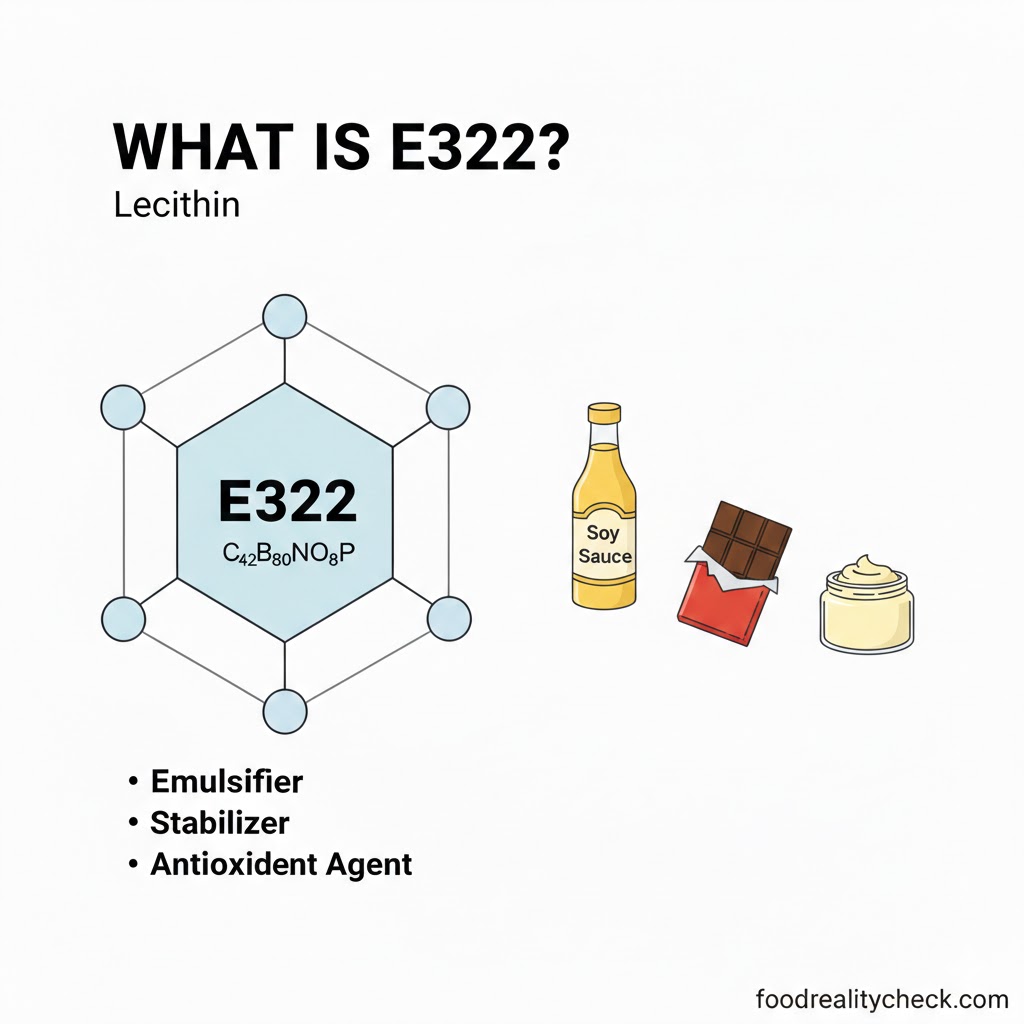
What is E322?
Complete guide to understanding E322 (Lecithin) in your food
The Quick Answer
E322 is a natural emulsifier derived from soybeans.
It’s used in food to mix oil and water together, creating smooth, creamy textures.
It’s one of the most common and safest food additives, with virtually no documented health risks.
📌 Quick Facts
- Category: Natural emulsifier and stabilizer (phospholipid)
- Source: Soybeans (byproduct of soy oil refining)
- Also Known As: Lecithin, soy lecithin, phosphatidylcholine
- Found in: Chocolate, baked goods, ice cream, salad dressings, margarines, bread
- Safety: Generally Recognized as Safe (GRAS); no numerical ADI limit needed
- Approval: FDA, EFSA, and worldwide regulatory approval
What Exactly Is It?
E322 is a mixture of phospholipids extracted from soybeans.
The main component is phosphatidylcholine (lecithin), a lipid naturally found in animal and plant cell membranes.
It’s produced as a byproduct of soybean oil refining: when soybean oil is extracted and refined, lecithin separates as a natural byproduct through a process called degumming, which uses water or steam to separate the lecithin from the oil.
E322 typically contains 29–43% phosphatidylcholine, plus other phospholipids like phosphatidylethanolamine and phosphatidyl inositol.
It appears as a viscous brown liquid or brown powder with a characteristic soy odor.
Where You’ll Find It
E322 appears in many common foods:
• Chocolate and cocoa products
• Baked goods and bread
• Ice cream and frozen desserts
• Salad dressings and mayonnaise
• Margarines and spreads
• Pastries and confectionery
• Pasta and pasta products
• Dairy products and milk replacers
• Cakes, cookies, and biscuits
• Chewing gum
• Powdered drinks and nutritional supplements
• Some sausages and processed meats
It’s one of the most widely used food additives globally, appearing in dozens of everyday products.
Why Do Food Companies Use It?
E322 serves multiple essential functions in food processing:
Emulsification: E322 is a natural emulsifier that helps mix oil and water—two normally incompatible liquids. In mayonnaise, salad dressings, and chocolate, it prevents the oil from separating and creating a greasy, unstable product.
Texture improvement: In chocolate, lecithin is added during “conching” (mixing at 45–70°C) to reduce viscosity, making the chocolate smoother and creamier.
Bread and bakery improvement: Lecithin reduces gluten elasticity, increases water absorption, and helps retain gas bubbles (CO₂), resulting in lighter, airier bread with better texture and volume.
Stabilization: E322 prevents emulsions from breaking down, extending shelf-life and preventing separation in products like ice cream, margarine, and sauces.
Anti-sticking properties: In pasta production, it prevents stickiness and improves the strength of the finished product.
Nutrient delivery: Lecithin contains choline, which aids fat transport and digestion, providing a minor nutritional benefit.
Is It Safe?
Yes, E322 is considered extremely safe by all major regulatory bodies.
The FDA classifies it as “Generally Recognized as Safe” (GRAS).
The European Food Safety Authority (EFSA) re-evaluated E322 in 2017 and concluded that no numerical ADI (Acceptable Daily Intake) limit is needed—a designation reserved only for substances with extremely low toxicological concern.
The EFSA also evaluated safety for infants (12 weeks to 11 months) and infants consuming special medical foods and found no safety concerns even at maximum permitted levels.
Lecithin is a natural constituent of all cell membranes in animals and plants—your body produces and uses lecithin every day.
What Are The Health Concerns?
E322 has virtually no documented health concerns, though some claims circulate online:
Soy allergy: People with severe soy allergies should avoid soy-derived E322. The refining process removes most allergenic proteins, but traces may remain. Always check labels or contact manufacturers if you have a severe soy allergy.
GMO concern: Most soybeans are genetically modified (GMO). If you prefer non-GMO ingredients, look for products specifically labeled “non-GMO lecithin.”
Phytoestrogen myth: Online claims suggest soy lecithin contains dangerous phytoestrogens that increase cancer or hormonal imbalance risk. However, the amount of phytoestrogens in lecithin is negligible (refined during processing), and current scientific evidence does not support these claims.
Digestive complaints (rare): A very small minority of people report diarrhea, nausea, or appetite changes from large quantities of lecithin, but this is extremely rare at food-additive levels.
No toxicity, carcinogenicity, or genetic damage: Extensive scientific studies show no evidence of these concerns.
The safety of E322 is exceptionally well-established; concerns are primarily based on internet myths rather than scientific evidence.
Natural vs Synthetic Version
E322 is naturally derived—extracted directly from soybeans as a byproduct of oil refining.
There is no synthetic version of lecithin; all E322 is plant-based extraction.
Some lecithin is extracted using chemical solvents (like hexane), while others are extracted mechanically or enzymatically. Non-GMO and organic versions are available for consumers preferring these options.
Natural Alternatives
E322 already IS a natural alternative to synthetic emulsifiers.
If you want to avoid soy lecithin specifically, natural alternatives include:
• Sunflower lecithin – from sunflower seeds instead of soy
• Egg lecithin – from egg yolks (traditional emulsifier)
• Rapeseed lecithin – from canola/rapeseed oil
• Guar gum or xanthan gum – plant-derived thickeners and stabilizers
• Gelatin or pectin – natural gelling agents
• Minimal processing – products without added emulsifiers
However, these alternatives are more expensive and less effective, so E322 remains the industry standard.
The Bottom Line
E322 is a naturally derived, plant-based emulsifier with an exceptional safety profile and zero documented health concerns at approved use levels.
The EFSA’s decision that no numerical ADI limit is needed reflects one of the highest safety endorsements available for food additives.
Lecithin is a natural component of all cells in your body—you’re not consuming a foreign chemical.
If you have a soy allergy, avoid it; if you prefer non-GMO ingredients, choose non-GMO lecithin. Otherwise, E322 is one of the safest and most beneficial food additives you’ll encounter.
Online fears about phytoestrogens and cancer are not supported by scientific evidence and can be disregarded.