The Quick Answer
E330 is citric acid—a weak organic acid naturally found in citrus fruits like lemons, limes, and oranges. It’s also called “lemon salt” and is one of the most widely used food additives worldwide.
Unlike many controversial additives, citric acid is universally recognized as safe by all major food authorities. It serves multiple functions: it adds sour taste, preserves food, prevents oxidation, and stabilizes products.
In fact, citric acid may offer genuine health benefits including improved mineral absorption, antioxidant effects, and kidney stone prevention.
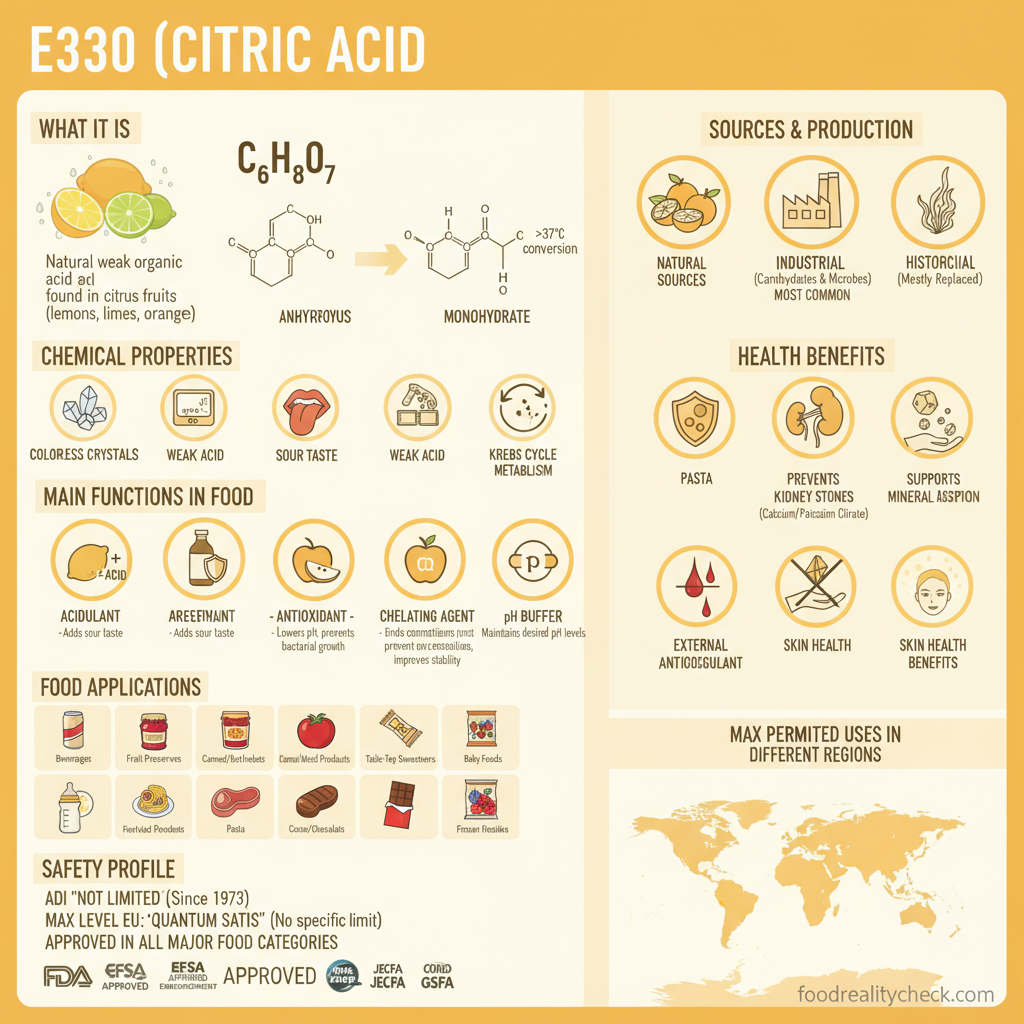
📌 Quick Facts
- Category: Acidity regulator, preservative, antioxidant, chelating agent, flavor enhancer
- Source: Naturally found in citrus fruits; commercially produced by fermentation of glucose or sucrose
- Found in: Soft drinks, candies, jams, processed meats, dairy products, juices, energy drinks, sauces
- Safety Status: FDA GRAS approved, EFSA approved, ADI “Not Limited” (JECFA)
- Dietary Status: Vegan, vegetarian, gluten-free, kosher, halal
- Controversy Level: NONE—universally considered safe
- Health Potential: May provide antioxidant, anti-inflammatory, and bone-health benefits
What Exactly Is Citric Acid?
Citric acid is a tricarboxylic acid (C₆H₈O₇)—an organic compound with three carboxylic acid groups. It’s a colorless, crystalline powder with a sour taste and no smell.
Chemical structure: Citric acid consists of a central carbon backbone with three carboxylic acid (-COOH) groups, making it a weak acid. It’s a key intermediate in cellular metabolism, appearing naturally in almost all living organisms.
In simple terms: It’s the compound that makes lemons, limes, and oranges taste sour. When you consume citric acid in food, your body metabolizes it through the Krebs cycle (cellular respiration), where it’s completely broken down and used for energy.
Key properties:
• Natural and ubiquitous: Found in virtually all foods containing carbohydrates
• Metabolized completely: Your body breaks it down and excretes it—no accumulation risk
• Multi-functional: Acts simultaneously as acidulant, preservative, antioxidant, and chelating agent
• Taste-neutral at low doses: At proper levels, provides tartness without overpowering flavor
• Biodegradable: Breaks down naturally in the environment
Where You’ll Find E330
Citric acid appears in thousands of foods:
• Soft drinks and energy drinks
• Fruit juices and juice concentrates
• Candies and sour sweets
• Jams, marmalades, and fruit preserves
• Cheese and dairy products
• Yogurt and cultured milk products
• Ice cream and frozen desserts
• Processed meats (sausages, ham, cured meats)
• Canned fruits and vegetables
• Sauces and condiments (ketchup, mayonnaise)
• Baked goods
• Beverages (beer, wine, cider)
• Nutritional supplements and vitamin powders
• Powdered drink mixes
• Cosmetics and personal care products
• Cleaning products and detergents
If a processed food needs to stay fresh, taste balanced, or maintain texture, it almost certainly contains citric acid. It’s one of the top 10 most commonly used food additives globally.
How Is Citric Acid Made?
Commercial citric acid is produced through fermentation, not extraction:
Step 1: Raw Material Selection
Glucose (from corn, beet sugar, or molasses) or sucrose is chosen as the fermentation substrate. In organic production, these come from certified organic sources.
Step 2: Fungal Fermentation
The substrate is inoculated with Aspergillus niger, a food-safe fungus. The fermentation occurs in large tanks at controlled temperature and pH. The fungus metabolizes the sugar and produces citric acid as a byproduct.
Step 3: Acid Extraction
After fermentation (usually 7-14 days), the broth contains dissolved citric acid. Lime (calcium hydroxide) is added to precipitate calcium citrate, which is then separated by filtration.
Step 4: Conversion to Citric Acid
The calcium citrate is treated with sulfuric acid, converting it back to citric acid while producing gypsum (calcium sulfate) as a byproduct.
Step 5: Purification & Crystallization
The solution is filtered, concentrated, and cooled to crystallize pure citric acid. The crystals are separated, washed, and dried.
Step 6: Final Processing
Citric acid is milled to the desired particle size and packaged. Some is supplied as monohydrate (with one water molecule), others as anhydrous (water-free).
Note: China is the world’s largest producer of citric acid, producing and exporting approximately 1 million tons annually. The fermentation process uses no synthetic chemicals or animal products, making it vegan and suitable for most dietary restrictions.
Functions of E330 in Food
Citric acid serves multiple roles in food production:
As an acidulant (flavor enhancer): Adds sour taste and enhances flavor perception. Common in candies (sour gummies), soft drinks, juices, and energy drinks. Creates the “tart” sensation that balances sweetness and makes beverages refreshing.
As a preservative: Creates an acidic environment (lowers pH) that inhibits bacterial growth and food spoilage. Bacteria struggle to survive in acidic conditions below pH 4.0. Used in jams, canned foods, salad dressings, and sauces to extend shelf life.
As an antioxidant: Prevents oxidation—the process where foods turn brown, develop off-flavors, or lose nutrients. Citric acid works synergistically with synthetic antioxidants like BHA (E320) and BHT (E321) to prevent rancidity in oils and fats.
As a chelating agent (sequestrant): Binds metal ions (copper, iron, magnesium) that would otherwise catalyze food spoilage and discoloration. Prevents browning in canned fruits and vegetables. Also stabilizes flavor in beverages by binding metals that affect taste.
As a pH buffer: Maintains stable acidity levels in foods. In cheese production, citric acid helps adjust pH to achieve proper texture and consistency. In beverages, it balances the pH to prevent spoilage.
As an emulsifier: In ice cream and frozen desserts, citric acid helps prevent fat from separating from the aqueous phase, maintaining smooth, uniform texture.
As a crystal inhibitor: In candies and caramel, citric acid prevents sucrose crystallization on surfaces, maintaining smooth texture and appearance.
Is E330 Safe?
Yes. Citric acid is one of the safest food additives available, with unanimous regulatory approval and no scientific controversy.
Regulatory Approvals:
• FDA: Generally Recognized As Safe (GRAS). Can be used in food with no numerical limits, only adherence to good manufacturing practices.
• EFSA (European Food Safety Authority): Approved as E330. Listed as “Additives other than colours and sweeteners” with “Quantum satis” (no specific limit)—meaning it’s approved at any level needed for its functional purpose.
• JECFA (Joint FAO/WHO Committee): Assigned an ADI of “Not Limited”—meaning it’s safe at any level typically found in food. This rating has been in place since 1973.
Why is the safety so strong?
1. Natural occurrence: Citric acid naturally exists in virtually all foods. Your body is evolutionarily adapted to metabolizing it.
2. Complete metabolism: Unlike some additives that the body struggles to break down, citric acid is completely metabolized through the Krebs cycle and excreted.
3. No bioaccumulation: Citric acid doesn’t accumulate in tissues. Once processed, it’s eliminated.
4. Centuries of safe use: Humans have consumed citrus fruits (and thus citric acid) for thousands of years.
5. Extensive testing: Decades of regulatory testing and real-world consumption data show no toxicity.
Health Benefits of Citric Acid
🌟 Potential Health Benefits
- Improves mineral absorption: Research shows citric acid enhances calcium absorption in the gut, supporting bone health and density
- Prevents kidney stones: Multiple studies confirm that citric acid (and its salts like calcium citrate and potassium citrate) reduce kidney stone formation and can dissolve small stones. Particularly beneficial for people with hypocitraturia
- Antioxidant effects: Citric acid has been shown to reduce free radical damage and lipid peroxidation in cells, with potential neuroprotective effects
- Anti-inflammatory properties: Research indicates citric acid can reduce inflammation markers and downregulate inflammatory pathways
- Supports bone health: Through improved mineral absorption and direct effects on bone metabolism and regeneration
- Alkalizing effect: Despite being acidic, citric acid has an alkalizing effect on urine, which is actually beneficial for kidney stone prevention and overall acid-base balance
- Skin health improvement: As an alpha-hydroxy acid (AHA), it may improve acne and support skin healing through gentle exfoliation
- May prevent cancer: Some research suggests citric acid inhibits esophageal cancer cell growth and that citrate can suppress tumor growth
- Promotes wound healing: Emerging research suggests citric acid ointments support healing of infected wounds like diabetic ulcers
Important note: While these benefits are supported by research, most require either higher intakes than typical food levels or specific forms (like calcium citrate supplements). The amount in a soft drink won’t dramatically change your health, but it’s reassuring that this additive may have positive effects when consumed regularly.
Side Effects & Safety Concerns
Citric acid is very well tolerated by most people, but some effects can occur with excessive intake or individual sensitivity:
Digestive symptoms (mild, from excessive intake):
• Stomach cramps or pain
• Nausea
• Diarrhea
• Vomiting
• Heartburn or acid reflux (in people with GERD)
Dental erosion (with frequent acidic exposure):
Citric acid is acidic and can erode tooth enamel with chronic exposure, especially from acidic beverages and sour candies. A 2015 study found that acidic juices containing citric acid (apple, orange juice) are about 5 times more erosive than Coca-Cola light. Solutions: rinse mouth with water after consuming acidic foods, wait 30 minutes before brushing teeth (brushing immediately can damage weakened enamel), use a straw for acidic beverages.
Skin and eye irritation (from pure powder/concentrated form):
Pure citric acid powder can irritate skin and eyes if directly exposed. Workers handling bulk citric acid should wear protective gloves and goggles. However, food-grade citric acid in normal food amounts poses no skin risk.
Respiratory irritation (from dust inhalation):
Inhaling citric acid dust can cause coughing, sore throat, or respiratory irritation. This is a workplace concern, not a food consumption concern.
Citric acid intolerance (rare):
Some people report sensitivity to citric acid with symptoms including:
• Joint pain
• Respiratory symptoms
• Muscle pain or weakness
• IBS symptoms (in sensitive individuals)
This is distinct from true allergy and is believed to be related to individual digestive sensitivity, not toxicity.
Serious side effects (from excessive supplemental doses, not food):
Taking very large amounts of citric acid supplements can cause numbness, muscle twitching, confusion, severe diarrhea, or other serious effects. However, you would never consume these amounts through normal food.
Citric Acid Monohydrate vs Anhydrous
Two forms are available commercially:
| Form | Composition | Appearance | Best Use |
|---|---|---|---|
| Monohydrate | Citric acid + 1 water molecule (C₆H₈O₇·H₂O) | White crystalline powder | Most common in food; more stable in humid storage |
| Anhydrous | Pure citric acid (C₆H₈O₇) | Colorless crystals | Requires dry storage; slightly stronger acidifying effect per gram |
Both forms are approved (E330) and chemically equivalent once consumed. The monohydrate is more common in commercial food production because it’s more stable during shipping and storage.
Who Should Avoid or Limit Citric Acid?
For most people, citric acid is completely safe. However, be cautious if you have:
• Severe GERD or acid reflux: Citric acid may trigger symptoms; consult your doctor
• Sensitive teeth or existing enamel erosion: Limit frequent consumption of acidic beverages and foods
• Citric acid intolerance: Some people report digestive or joint symptoms with high intake
• Taking citrate-based medications: Supplemental citric acid might interact; consult your pharmacist
• Severe kidney disease: While citric acid is usually beneficial, people with kidney failure should consult their nephrologist about their specific situation
Citric Acid vs Other Acidulants
| Acidulant | Source | Safety | Flavor Profile | Main Use |
|---|---|---|---|---|
| Citric Acid (E330) | Fermented glucose/sucrose | ✓ Excellent—ADI “Not Limited” | Clean, bright, lemon-like tartness | Most versatile—drinks, candies, preserves, sauces |
| Malic Acid (E296) | Natural in apples; fermented | ✓ Safe—ADI “Not Limited” | Apple-like, slightly fruity | Beverages, candies, bakery |
| Tartaric Acid (E334) | Grapes and wine byproducts | ✓ Safe—ADI “Not Limited” | Wine-like, complex tartness | Wine, beverages, specialty foods |
| Phosphoric Acid (E338) | Synthetic mineral acid | ? Controversial—linked to bone/kidney concerns | Sharp, bitter, metallic | Colas and dark sodas |
| Acetic Acid (E260) | Vinegar fermentation | ✓ Safe—ADI “Not Limited” | Vinegar-like, pungent | Pickles, condiments, preserves |
Bottom line on acidulants: Citric acid is the safest and most versatile natural option. Malic and tartaric acids are also excellent. Phosphoric acid is more controversial and should be limited. Acetic acid is safe but imparts a vinegar flavor.
The Bottom Line
E330 (citric acid) is one of the safest, most natural, and most beneficial food additives available. It has unanimous regulatory approval, excellent safety data spanning decades, and emerging evidence of health benefits.
Key takeaways:
• Universally safe: FDA GRAS, EFSA approved, ADI “Not Limited”—the strongest safety rating possible
• Natural and metabolic: Your body produces and metabolizes it as part of normal cellular function
• No controversy: Unlike many additives, there is zero scientific debate about safety
• Potential benefits: May improve mineral absorption, prevent kidney stones, provide antioxidant effects
• Minimal side effects: Only rare individual sensitivity or dental erosion from excessive acidic beverage consumption
• Vegan and clean: Plant-based, fermented, no animal products involved
Practical recommendation: If you’re concerned about food additives, E330 (citric acid) should be among the last things on your worry list. It’s genuinely one of the safest compounds in processed foods. Your focus should be on reducing ultra-processed food consumption in general, not avoiding this particular additive.