What is E341?
Complete guide to understanding E341 (Calcium Phosphates) in your food
The Quick Answer
E341 is a group of mineral salts (calcium phosphates) used as leavening agents and anti-caking agents.
It’s used in baked goods to make them rise, and in powdered foods to prevent clumping.
It’s a natural mineral salt found in bones and teeth, making it generally safe but with emerging concerns about nanoscale particles.
📌 Quick Facts
- Category: Leavening agent, anti-caking agent, mineral salt (three types)
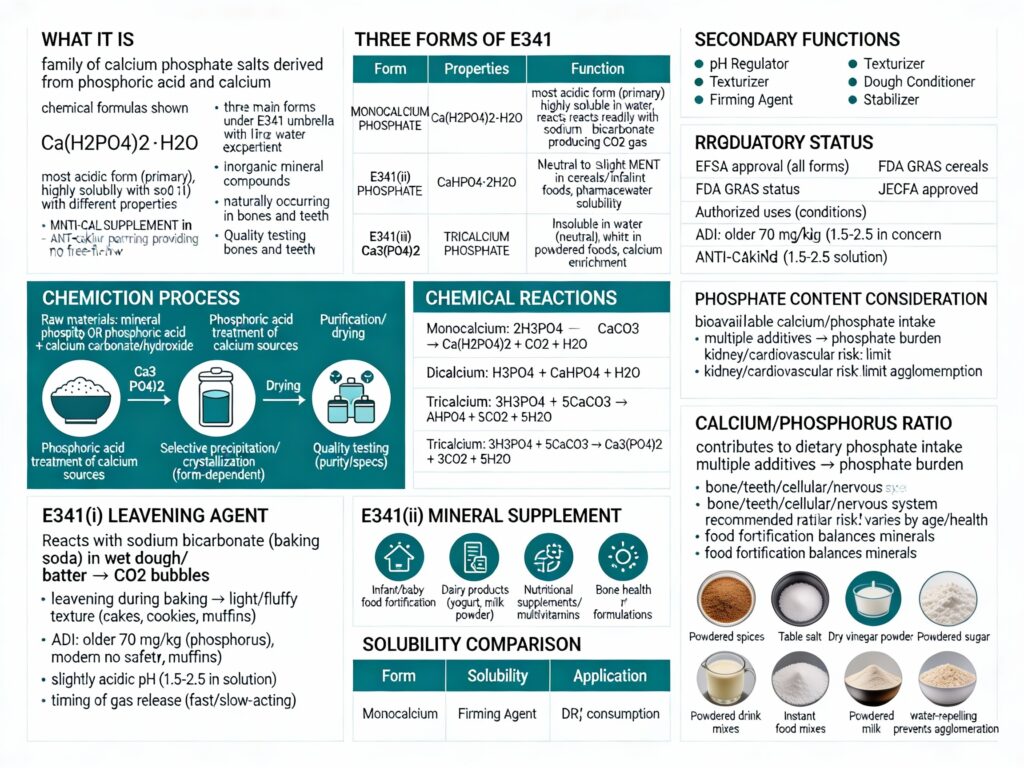
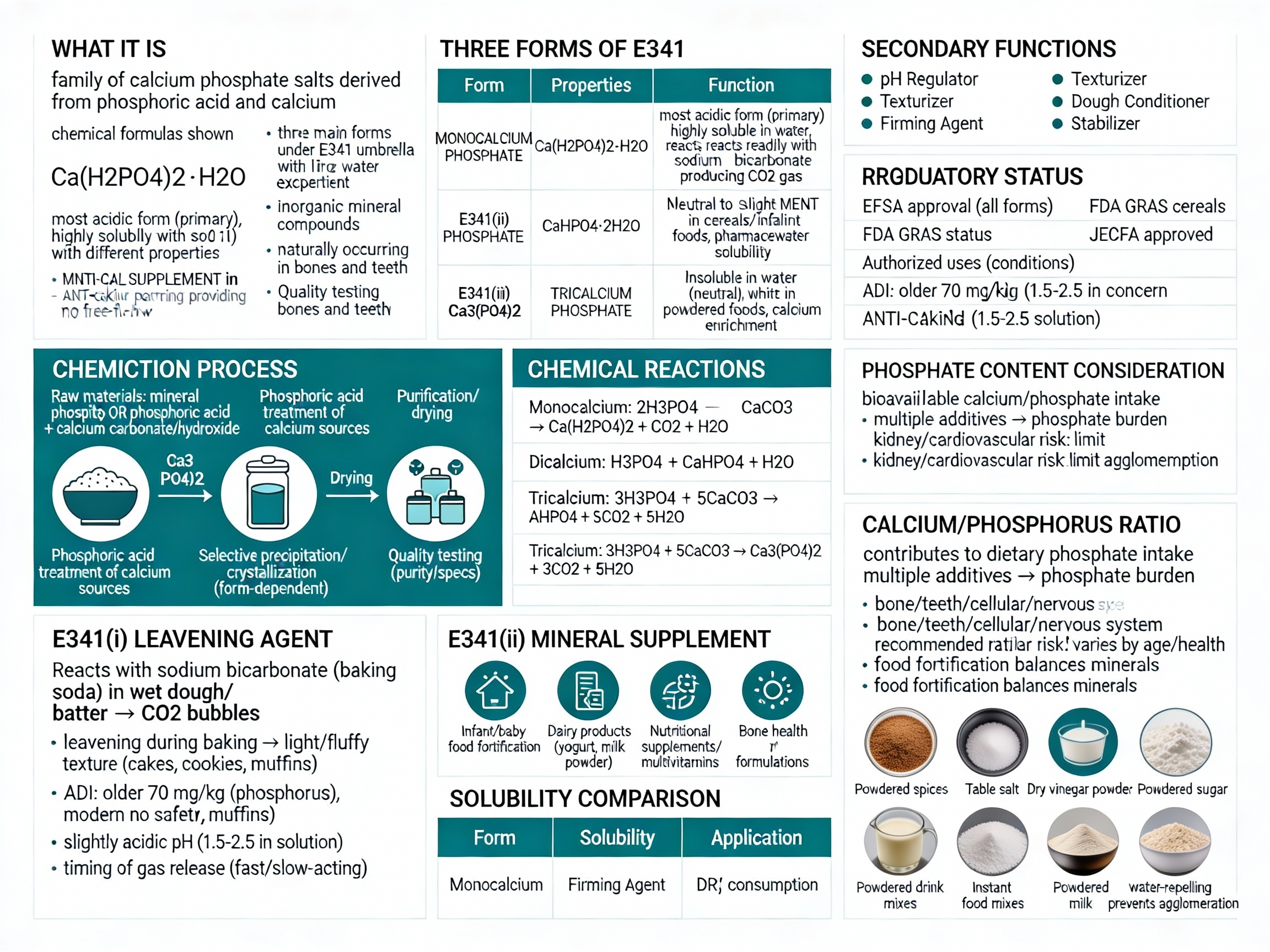
- Three Types: E341(i) monocalcium phosphate, E341(ii) dicalcium phosphate, E341(iii) tricalcium phosphate
- Source: Phosphoric acid combined with calcium salts or minerals
- Found in: Baked goods, cereals, powdered foods, baby formula, canned vegetables
- Safety: Generally Recognized as Safe (GRAS); emerging nanotoxicity concerns
- ADI (JECFA): 70 mg/kg body weight per day (as phosphorus)
What Exactly Is It?
E341 refers to three different calcium phosphate salts—all derived from phosphoric acid combined with calcium:
E341(i) – Monocalcium phosphate: Ca(H₂PO₄)₂, the acidic form used primarily as a leavening agent in baking powder.
E341(ii) – Dicalcium phosphate: CaHPO₄, a more neutral form used as a mineral supplement and anti-caking agent.
E341(iii) – Tricalcium phosphate (TCP): Ca₃(PO₄)₂, the most basic form used mainly as an anti-caking agent in powdered foods and as a calcium/phosphorus supplement in baby formula and cereals.
All are produced by reacting phosphoric acid (from mined phosphate minerals) with calcium carbonates or calcium hydroxides.
Calcium phosphates are natural minerals—the main inorganic component of bones and teeth in mammals.
Where You’ll Find It
E341 appears in many common foods:
• Baked goods (cakes, biscuits, cookies, bread)
• Baking powders and self-rising flour
• Instant puddings and no-bake cheesecakes
• Powdered foods and drink mixes
• Cereals and grain products
• Infant formula and baby foods
• Canned and frozen vegetables
• Canned fruits and fish
• Table salt (anti-caking)
• Powdered milk and cream replacers
• Pastry mixes and cake mixes
• Confectionery and candy
It’s particularly common in baked goods (where it helps dough rise) and baby foods (where it provides calcium and phosphorus nutrition).
Why Do Food Companies Use It?
E341 serves multiple essential functions in food:
Leavening in baked goods: E341(i) monocalcium phosphate is the acid component of baking powder. When heated in dough, it reacts with baking soda to produce CO₂ gas bubbles, making baked goods rise and creating a light, airy texture.
Anti-caking in powders: E341(iii) tricalcium phosphate is insoluble in water and hygroscopic (non-moisture-absorbing), making it ideal for preventing clumping in table salt, powdered milk, and drink mixes.
Nutritional supplementation: All three forms provide bioavailable calcium and phosphorus, minerals essential for bone and tooth development. This is particularly important in infant formula and fortified cereals.
Acidity regulation: E341 regulates pH in various products, affecting texture and shelf-life.
Texture stabilization: In canned vegetables and fruits, it helps maintain firmness and prevents mushiness during storage.
Protein coagulation: In instant puddings, E341 helps thicken and stabilize products through protein interactions.
Is It Safe?
E341 is generally recognized as safe, but emerging research on nanoscale particles raises new concerns.
The FDA classifies all calcium phosphates as “Generally Recognized as Safe” (GRAS).
The WHO Expert Committee (JECFA) established an ADI of 70 mg/kg body weight per day, expressed as phosphorus.
Calcium phosphates are natural constituents of the human body—your bones and teeth are approximately 70% calcium phosphate compounds.
What Are The Health Concerns?
E341 has relatively few documented concerns at traditional particle sizes, but emerging research identifies new risks:
Traditional safety: No genotoxicity, carcinogenicity, or reproductive toxicity at approved use levels in food.
Nanoscale particle concern (emerging): Recent research reveals that food-grade E341(iii) contains nanoscale particles. In laboratory studies, when these nanoparticles were co-exposed with silica (E551) to human mesenchymal stem cells, they caused: oxidative stress from ROS generation, mitochondrial membrane potential depletion, reduced cell viability, and upregulation of genes associated with oxidative stress and cell death (MDM3, TNFSF10, POR). However, these are in vitro findings at high doses; human safety remains unclear.
Phosphate accumulation concern: Like other phosphate additives (E452), excessive dietary phosphate from multiple sources may raise cardiovascular risk in people with kidney disease, though E341 is less problematic than other phosphate additives because it’s less soluble.
Bone resorption in excess: Extreme phosphate oversupply (well beyond food additive levels) can interfere with calcium absorption, though this is unlikely with food-approved quantities.
Regulatory response: Most authorities still classify E341 as safe. However, the emerging nanotoxicology findings suggest that manufacturers should disclose nanoscale particle content, and more human studies are needed.
Natural vs Synthetic Version
E341 is mineral-derived but processed.
While calcium phosphates occur naturally in nature (bones, teeth, mineral deposits), the food additive E341 is synthetically manufactured by reacting phosphoric acid with calcium minerals.
It is not “extracted” from nature like natural additives, but rather synthesized from mined phosphate minerals.
Natural Alternatives
Want to avoid E341?
Food companies sometimes use natural alternatives:
• Yeast and natural fermentation – biological leavening instead of chemical
• Baking soda + acid (lemon, vinegar) – chemical leavening from traditional ingredients
• Unbleached flour and no leavening – dense baked goods without rising agents
• Arrowroot powder or cornstarch – natural anti-caking agents in minimal processing
• Calcium carbonate or calcium citrate – alternative mineral supplements
However, these alternatives are less effective (particularly for leavening) and more expensive, so E341 remains the industry standard.
The Bottom Line
E341 is a mineral salt widely approved as safe for traditional use, but emerging nanotoxicology research raises concerns about nanoscale particles that warrant further investigation.
For most consumers, E341 in foods at approved levels is likely safe, particularly since your body naturally contains and requires calcium phosphate.
However, the recent discovery of nanoscale particles in food-grade E341(iii) is concerning and suggests regulatory agencies should require manufacturers to disclose particle size and conduct more human safety studies.
If you’re concerned about emerging nanotoxicology risks, minimizing consumption of powdered foods (which concentrate E341(iii)) and choosing fresh or minimally processed baked goods is a prudent approach.
For infants and young children eating lots of baby formula and fortified cereals, the risk-benefit analysis slightly favors the nutritional benefit, but parents should be aware of the emerging particle-size concerns.