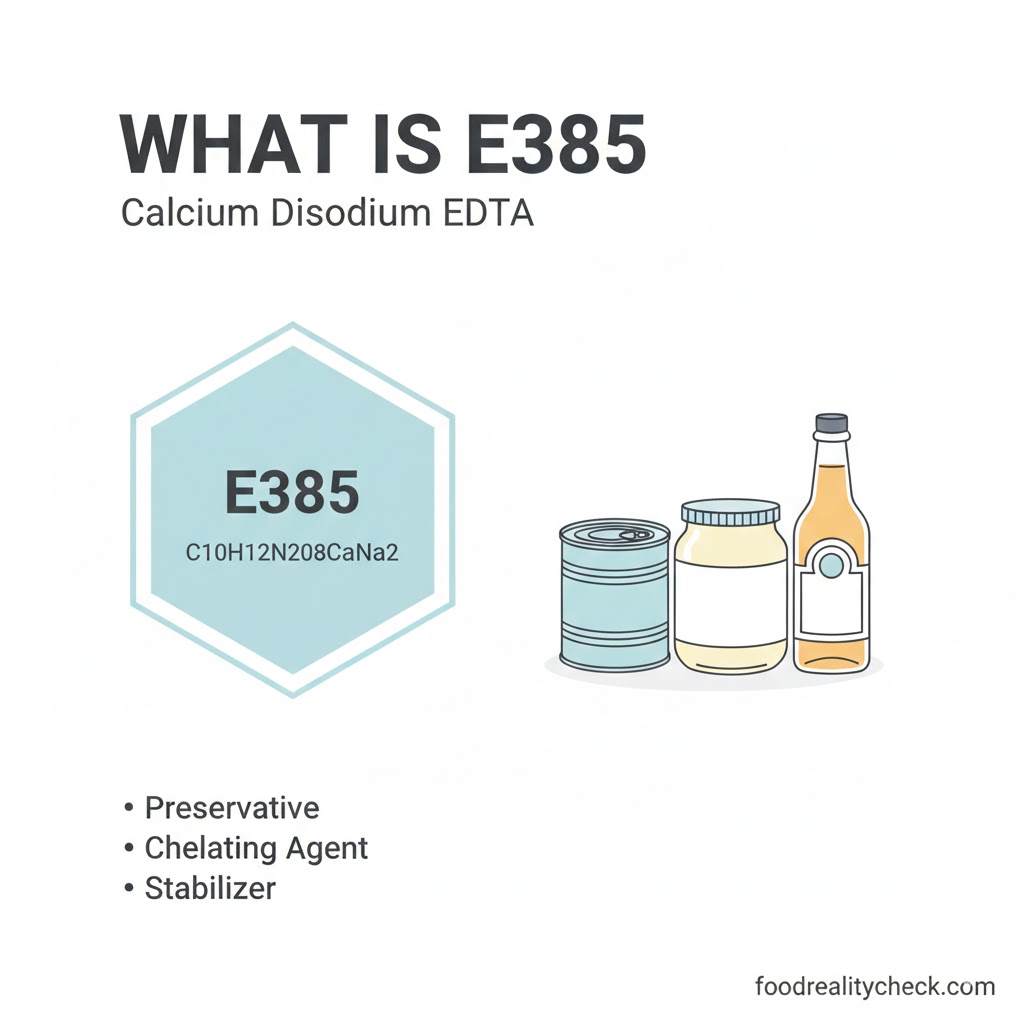
What is E385?
Complete guide to understanding E385 (Calcium Disodium EDTA) in your food
The Quick Answer
E385 is a synthetic chelating agent that binds to metals in food, preventing spoilage and color degradation.
It’s used in soft drinks, canned foods, mayonnaise, salad dressings, and other processed products.
It was historically considered safe, but recent 2021 research reveals it aggravates inflammatory bowel disease, increases colorectal cancer risk, and damages intestinal barrier function at doses comparable to human food exposure—prompting calls for re-evaluation and highlighting a previously unrecognized gut toxicity concern.
📌 Quick Facts
- Category: Synthetic chelating agent (preservative, sequestrant)
- Full Name: Calcium disodium ethylenediaminetetraacetate
- Chemical Formula: C₁₀H₁₂O₈CaN₂Na₂·2H₂O
- Source: Entirely synthetic chemical compound
- Found in: Soft drinks, canned foods, mayonnaise, salad dressings, pickled foods, beverages
- Safety Status: FDA/EFSA approved; ADI 2.5 mg/kg; currently re-evaluation underway due to 2021 intestinal toxicity research
- Primary Concern: Aggravates inflammatory bowel disease, increases colorectal cancer, damages gut barrier function
What Exactly Is It?
E385 is a synthetic chemical chelating agent that binds (sequesters) metal ions, preventing them from reacting with food.
Its full chemical name is calcium disodium ethylenediaminetetraacetate.
It appears as a white, odorless crystalline powder with a faint salty taste.
E385 is entirely synthetically manufactured—there is no natural form. It’s produced by synthesizing disodium EDTA (ethylenediaminetetraacetic acid) with calcium carbonate or calcium chloride.
The mechanism: E385 binds to metal ions (zinc, iron, copper, manganese, magnesium) through four carboxylate groups and two amine groups, forming extremely stable chelate complexes. This prevents the metals from participating in oxidation reactions that cause discoloration, flavor loss, or texture degradation.
Where You’ll Find It
E385 appears in many processed foods:
• Soft drinks and carbonated beverages
• Canned foods (vegetables, fruits, fish, meats)
• Mayonnaise and salad dressings
• Sandwich spreads
• Pickled vegetables and fruits
• Canned seafood
• Vitamin-fortified beverages
• Beer and ales
• Jams and jellies
• Sauces and condiments
• Canned soups
• Dried fruits
• Cosmetics and personal care products
Important: E385 is NOT allowed in foods for infants and young children, suggesting regulatory recognition of potential concerns in vulnerable populations.
Why Do Food Companies Use It?
E385 serves critical preservation functions:
Prevents metal-catalyzed oxidation: Free metal ions naturally present in food (from water, ingredients, or mineral content) catalyze oxidation reactions that degrade colors, flavors, and nutrients. E385 sequesters these metals, preventing oxidation.
Color retention: Prevents discoloration caused by metal ions reacting with food pigments.
Flavor preservation: Prevents “off-flavor” development caused by metal-catalyzed chemical reactions.
Texture preservation: Prevents precipitation and texture degradation.
Shelf-life extension: Particularly valuable in canned foods where thermal processing creates conditions favoring oxidation.
Cost-effective: More effective than many natural preservatives at lower use levels (25–800 mg/kg).
Is It Safe?
E385 is FDA and EFSA approved, but recent 2021 research reveals it aggravates inflammatory bowel disease, increases colorectal cancer risk, and damages intestinal barrier function at doses comparable to human consumption—challenging traditional safety assessments and prompting regulatory re-evaluation.
The FDA approves E385 with maximum levels of 25–800 mg/kg depending on food category.
The EFSA sets an ADI of 2.5 mg/kg body weight per day.
The JECFA (WHO Expert Committee) set an ADI of 1.9 mg/kg.
However, traditional safety assessments were conducted in healthy animals. New research (2021) reveals previously unrecognized intestinal toxicity in animals with inflammatory bowel disease.
⚠️ CRITICAL 2021 RESEARCH – Intestinal Toxicity in IBD Models:
The Study (Nature Scientific Reports, 2021): Researchers found that EDTA (the active component of E385), when administered at doses comparable to human food exposure, caused:
• Massive intestinal inflammation in animals with inflammatory bowel disease (IBD)
• Significantly increased colorectal cancer risk and carcinogenic lesions
• Disruption of epithelial barrier function (the intestinal lining)
• Multiple animal and cell culture models confirmed the effect
Critical Implication: While traditional safety studies showed no toxicity in healthy animals, this research reveals that EDTA IS toxic to the intestine in the context of pre-existing inflammation. Given that ~3% of the population has inflammatory bowel disease (Crohn’s disease or ulcerative colitis) and ~15–20% have irritable bowel syndrome (IBS) or other chronic intestinal inflammation conditions, a significant portion of the population may be at risk.
Mechanism Proposed: EDTA disrupts epithelial barrier function—the tight junctions that form the intestinal lining’s protective barrier. When this barrier is compromised, bacterial lipopolysaccharides (LPS) and other harmful compounds can cross into the bloodstream, triggering systemic inflammation and increasing carcinogenic pathways.
EFSA Response: The European Food Safety Authority acknowledged that E385 requires a full re-evaluation and recommended additional toxicological data to address shortcomings in the available database (as of 2018, before the 2021 Nature study). The 2021 Nature paper appears to have prompted deeper review.
What Are The Health Concerns?
E385 has multiple documented health concerns, both established and emerging:
Intestinal barrier damage and increased inflammation (NEW 2021 CONCERN): EDTA disrupts epithelial tight junctions in the intestine, damaging the protective barrier. In animals with inflammatory bowel disease, this causes massive inflammation and increased colorectal carcinogenesis at doses comparable to human food exposure. This is a previously unrecognized toxicity not revealed by traditional safety testing in healthy animals.
Mineral depletion and imbalance: Because E385 binds to metal ions, excessive consumption can reduce bioavailability of essential minerals (zinc, iron, calcium, magnesium, manganese) and cause mineral deficiencies. This is particularly concerning in vulnerable populations (children, elderly, pregnant women) requiring adequate mineral intake.
Muscle cramps and pain: Mineral depletion can cause muscle cramps and myalgia (muscle pain).
Kidney damage (at high doses): Animal studies at extremely high doses showed kidney toxicity. While approved levels are far below this, chronic exposure at approved levels in susceptible individuals (those with IBD or IBS) raises concerns.
Increased heavy metal uptake: Paradoxically, while E385 is used medically for lead poisoning treatment, in food settings it can increase absorption of harmful heavy metals from food (lead, mercury, cadmium) by forming soluble chelate complexes that facilitate absorption rather than excretion.
Chromosome damage (genotoxicity – disputed): Some studies report genotoxic effects; others dispute these findings. Evidence is conflicting.
Liver and reproductive effects (uncertain): Animal studies show potential but inconsistent effects on liver and reproduction at very high doses.
Bioaccumulation and environmental persistence: EDTA compounds are extremely stable and accumulate in the environment, including detectable amounts in drinking water and food supplies.
Natural vs Synthetic Version
E385 is entirely synthetic—there is no natural form.
It’s manufactured through chemical synthesis of ethylenediaminetetraacetic acid (EDTA) with calcium salts.
Natural Alternatives
Want to avoid E385?
Alternative preservation methods include:
• Ascorbic acid (Vitamin C, E300) – natural antioxidant
• Tocopherols (Vitamin E, E306) – natural antioxidant
• Citric acid (E330) – natural organic acid
• Rosemary extract – natural antioxidant
• Fresh/refrigerated products – minimal processing, no metal chelation needed
• Glass or stainless steel packaging – reduces metal ion leaching from containers
The Bottom Line
E385 (Calcium Disodium EDTA) is a synthetic chelating agent that was historically considered safe but recent 2021 research reveals it aggravates inflammatory bowel disease, increases colorectal cancer risk, and damages intestinal barrier function at doses comparable to human food exposure—fundamentally challenging its safety profile and prompting EFSA re-evaluation.
Regulatory Red Flag: The EU’s prohibition of E385 in baby foods suggests regulatory recognition of potential developmental/intestinal concerns in vulnerable populations.
Critical Research Gap: Traditional safety testing in healthy animals missed E385’s intestinal toxicity in diseased (inflamed) intestines. This reveals a fundamental limitation in food safety assessment: testing only in healthy populations may miss risks to vulnerable subpopulations (those with IBD, IBS, celiac disease, etc.).
At-Risk Populations: Individuals with inflammatory bowel disease (~3% of population), irritable bowel syndrome (~15–20%), celiac disease, or other chronic intestinal inflammation may be at elevated risk of EDTA-induced barrier disruption and increased carcinogenic pathways.
Mineral Depletion Concern: E385’s metal-chelating properties, beneficial for preservation, become problematic if consumed chronically at high levels—potentially reducing bioavailability of essential minerals.
If You Have IBD or IBS: Consider minimizing consumption of E385-containing foods (canned foods, soft drinks, processed condiments). Fresh, unprocessed foods are preferable.
For Healthy Individuals: Occasional consumption at approved use levels is unlikely to cause harm. However, given the emerging intestinal toxicity research and EFSA re-evaluation, consumers should be aware of potential risks, particularly with chronic high consumption.
Future Outlook: EFSA re-evaluation will likely result in tighter restrictions, possible reduction in approved use levels, or expanded prohibition in vulnerable populations (pregnant women, infants, children, immunocompromised individuals).