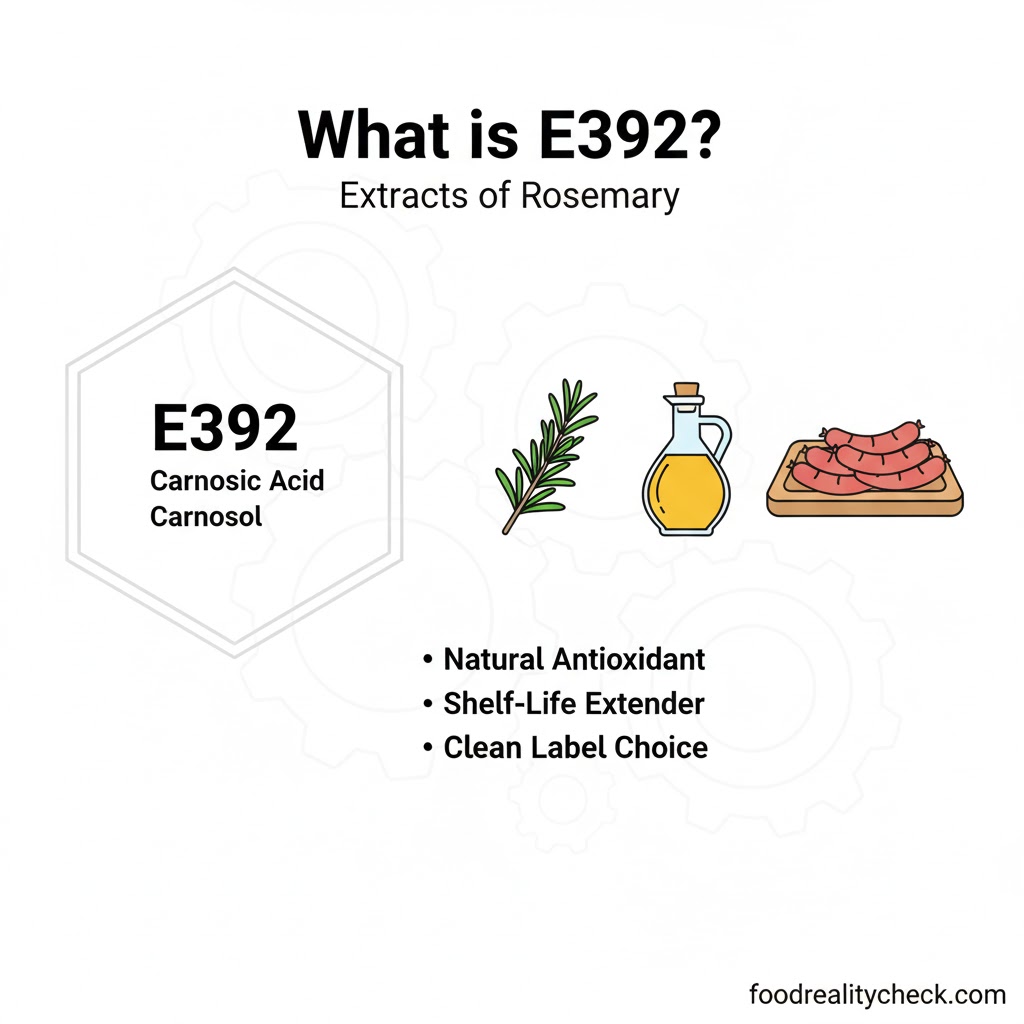
What is E392?
Complete guide to understanding E392 (Rosemary Extract) in your food
The Quick Answer
E392 is rosemary extract, a natural antioxidant derived from the leaves of Rosmarinus officinalis (rosemary) used to preserve food and prevent oxidative spoilage while extending shelf life.
It’s used to protect oils, fats, and fatty foods from oxidation—preventing rancidity and color degradation—while providing clean-label appeal due to its natural origin.
Most people consuming processed meats, oils, spreads, sauces, and snacks regularly encounter E392, though its presence is often unnoticed because it’s perceived as a natural spice ingredient rather than an “additive.”
📌 Quick Facts
- Category: Natural Antioxidant, Preservative, Stabilizer, Clean-Label Ingredient
- Source: 100% natural—extracted from rosemary leaves (Rosmarinus officinalis L.)
- Found in: Meat products, oils, spreads, dressings, sauces, baked goods, snacks, beverages, frozen foods
- Safety: FDA approved; EFSA approved; JECFA temporary ADI 0-0.3 mg/kg body weight (2016)
- Natural or Synthetic: 100% natural—extracted, not chemically synthesized
- Vegan/Vegetarian: Yes
- Key Advantage: Natural origin; documented antioxidant, anti-inflammatory, and antimicrobial properties
- Active Compounds: Carnosic acid and carnosol (≥90% of phenolic diterpenes); also flavonoids and triterpenes
What Exactly Is It?
E392 is rosemary extract, a natural extract from the leaves of Rosmarinus officinalis L., a Mediterranean shrub belonging to the mint family (Lamiaceae). The extract is a complex mixture of plant compounds, with antioxidant activity derived primarily from phenolic compounds including carnosic acid, carnosol, and various flavonoids and triterpenes.
The key antioxidant compounds are carnosic acid and carnosol—phenolic diterpenes that constitute at least 90% of the total phenolic diterpenes in food-grade rosemary extract. Additionally, rosemary extract contains volatile compounds including borneol, bornyl acetate, camphor, 1,8-cineol, and verbenone, which contribute minor flavor and aroma properties.
Physically, rosemary extract appears as a brown to dark brown powder or liquid (depending on extraction method and formulation). It is water-insoluble, restricting its use to fat-based and oily food systems where it naturally disperses. The extract density is greater than 0.25 g/ml, and moisture content is typically less than 5%.
Rosemary extract is produced through multiple extraction methods, each producing slightly different composition profiles: acetone extraction, supercritical CO₂ extraction, ethanol extraction, and decolorized/deodorized forms produced through sequential extraction with hexane and ethanol. Different forms have different minimum carnosic acid and carnosol content specifications (ranging from 5-13% w/w depending on production method).
Where You’ll Find It
E392 appears in an extremely wide range of foods, particularly those containing fats and oils:
• Processed meat products (sausages, pâté, cured meats)
• Non-heat-treated processed meat (particularly dried sausages)
• Heat-treated processed meat (especially dehydrated meat products)
• Oils and oil-based products (cooking oils, essential oils)
• Fat-based spreads (margarine, butter substitutes)
• Salad dressings and mayonnaise
• Sauces and condiments
• Soups and broths
• Snacks (nuts, chips, cereal-based snacks)
• Fine bakery wares
• Fish and shellfish products (particularly canned and processed)
• Processed eggs and egg products
• Desserts and confectionery
• Cereals and breakfast products
• Beverage flavorings and sports drinks
• Processed herbs and spice mixes
• Mustard and condiments
• Dietary and weight-control foods
• Cosmetic and pharmaceutical products
E392’s presence in foods is often unnoticed because rosemary is perceived as a culinary herb rather than an “additive,” making it one of the least recognized natural preservatives despite widespread use.
Why Do Food Companies Use It?
E392 performs three critical functions:
1. Antioxidant preservation of fats and oils: Rosemary extract’s potent antioxidant activity prevents oxidative degradation of fats and oils—the process that creates rancidity, off-flavors, and color degradation. By neutralizing free radicals and oxygen-dependent spoilage mechanisms, E392 extends shelf life significantly, reducing need for synthetic antioxidants (BHA, BHT, TBHQ).
2. Clean-label appeal and natural positioning: Unlike synthetic antioxidants (BHA, BHT, TBHQ) which are controversial and increasingly restricted, rosemary extract is 100% natural, has a Mediterranean culinary heritage, and allows marketing as “naturally preserved” or “antioxidant-rich.” This functionality is crucial for premium and health-focused brands seeking clean-label positions.
3. Synergistic preservation effects: Rosemary extract provides not only antioxidant activity (preventing lipid oxidation) but also documented antimicrobial properties, offering multi-functional preservation benefits in a single ingredient—a significant advantage in formulation simplification.
Why it’s selected: E392 enables manufacturers to eliminate synthetic preservatives and antioxidants while achieving equivalent shelf life—a critical advantage in the modern food market where consumer demand for “natural” and “clean label” ingredients drives formulation innovation.
Is It Safe?
E392 rosemary extract is considered extremely safe with exceptional regulatory approval and documented health benefits.
Regulatory Status:
• FDA (USA): Generally Recognized As Safe (GRAS); approved for food use
• EFSA (Europe): Approved as direct food additive (E392); 2008 and 2015 re-evaluations concluded “no safety concern for general population”
• JECFA (WHO/FAO): 2016 evaluation established temporary ADI of 0-0.3 mg/kg body weight per day (conservative due to limited chronic toxicity data, not safety concerns)
Documented health benefits (unusual for a food preservative):
• Antioxidant activity: Potent free radical scavenging; prevents lipid peroxidation and prevents oxidative degradation of vitamins and nutrients
• Anti-inflammatory effects: Documented in research to reduce inflammatory markers and support cardiovascular health
• Antimicrobial properties: Inhibits growth of food-spoilage bacteria and potentially pathogenic organisms—dual preservation mechanism
• Cognitive support: Traditional use for memory and concentration enhancement; modern research supports carnosic acid’s neuroprotective properties
• Cardiovascular benefits: Anti-inflammatory and antioxidant effects support heart health
• Hepatoprotective effects: Supports liver function and protects against oxidative liver damage
Documented side effects and safety considerations:
• At food-use levels (50-200 mg/kg in most foods): No adverse effects documented; well-tolerated
• Allergic reactions: Extremely rare; only documented in individuals with known rosemary allergies or severe allergies to plants in the mint family
• At therapeutic/supplemental doses (far exceeding food levels): Rare cases of gastrointestinal upset, interaction with medications, or allergic reactions reported, but these reflect medicinal use rather than food additive levels
• Pregnancy/lactation: Some sources suggest caution at very high doses due to potential uterine stimulation; food levels present no concern
• Heavy metal content: Arsenic (≤3 mg/kg), Lead (≤2 mg/kg) are specified limits, ensuring safety from contamination
Production Methods
E392 rosemary extract is produced through four primary extraction methods, each creating slightly different products:
1. Acetone Extraction: Dried rosemary leaves are treated with acetone, filtered, purified, and solvent evaporated. Final product contains ≥10% w/w carnosic acid + carnosol; residual acetone ≤500 mg/kg. Produces concentrated extract used in most food applications.
2. Supercritical CO₂ Extraction: Dried rosemary leaves are extracted using supercritical carbon dioxide with ethanol as entrainer. Creates extract with ≥13% w/w carnosic acid + carnosol; residual ethanol ≤2%. Produces premium extracts with minimal solvent residues—preferred for high-quality food products.
3. Ethanol Extraction with Deodorization: Dried rosemary is extracted with ethanol, deodorized (removing volatile flavor compounds), then purified. Final product ≥5% w/w carnosic acid + carnosol; can be spray-dried or suspended in carriers. Produces deodorized form minimizing rosemary flavor impact.
4. Sequential Extraction (Hexane + Ethanol): Dried rosemary undergoes hexane extraction (removing oils, creating decolorization), followed by ethanol extraction. Product ≥5% w/w carnosic acid + carnosol; residual hexane ≤25 mg/kg, ethanol ≤500 mg/kg. Produces decolorized, deodorized form for neutral flavor/color applications.
All methods involve natural solvents and extraction processes—no chemical synthesis. The entire process is mechanical extraction and separation of naturally occurring plant compounds.
Natural vs Synthetic Version
E392 is entirely natural—there is no synthetic version.
Rosemary extract exists only as a naturally derived plant extract. There is no laboratory-created or chemically synthesized equivalent. All E392 is extracted, purified, and possibly deodorized or decolorized from rosemary leaves through natural processes. Different extraction methods produce different forms, but all originate directly from the rosemary plant.
Comparison with Synthetic Antioxidants
E392 rosemary extract represents a natural alternative to synthetic preservatives, with significant advantages:
• BHA (Butylated Hydroxyanisole): Synthetic; potentially carcinogenic (proposed); banned in EU; allowed in USA with restrictions
• BHT (Butylated Hydroxytoluene): Synthetic; potentially carcinogenic (proposed); banned in EU; allowed in USA with restrictions
• TBHQ (Tertiary Butylhydroquinone): Synthetic; banned in EU; concerns about neurotoxicity at high doses; allowed in USA
• E320/E321 (BHA/BHT): Controversial synthetic antioxidants; increasingly restricted
• E392 (Rosemary Extract): Natural; documented health benefits; no safety concerns; increasingly preferred choice
The shift toward E392 reflects regulatory and consumer preference for natural alternatives to synthetic antioxidants with historical or theoretical carcinogenic concerns. Rosemary extract provides equivalent preservation without controversy.
Historical Use and Traditional Medicine
Rosemary has an extensive history of human use and traditional applications:
• Mediterranean cuisine: Rosemary leaves are traditional culinary herb in Mediterranean cooking for thousands of years
• Traditional medicine: Used historically for cognitive support, circulation improvement, and inflammation reduction
• Preservation history: Traditionally used to preserve meats and oils in Mediterranean food cultures
• Cosmetic and fragrance use: Rosemary oil has been used in perfumery and skincare for centuries; Cologne traditionally contains rosemary oil
• Global culinary use: Now used in cuisines worldwide for flavor and preservation properties
This millennia-long history of culinary and medicinal use provides additional safety evidence beyond formal regulatory testing.
Environmental and Sustainability
Rosemary is a hardy Mediterranean shrub that grows sustainably in arid climates without requiring intensive cultivation inputs. Global production is well-established, with primary sources including Spain, Italy, Portugal, Greece, and other Mediterranean regions. Extraction using supercritical CO₂ or ethanol represents sustainable methods with minimal environmental impact. The crop is increasingly cultivated using organic methods. Overall sustainability is excellent—renewable resource, low-input cultivation, natural extraction processes.
Natural Alternatives
Want to avoid E392? Food companies sometimes use these alternatives:
• E320 (BHA): Synthetic antioxidant; controversial safety profile; not recommended
• E321 (BHT): Synthetic antioxidant; controversial safety profile; not recommended
• E100 (Curcumin): Natural antioxidant from turmeric; similar benefits; different color/flavor profile
• Tea extract (polyphenols): Natural antioxidant; similar functionality; alternative for some applications
• Vitamin C (E300) and derivatives: Natural antioxidant; different mechanism; useful for some applications
• Vitamin E (E306-E309): Natural antioxidant from oils; similar functionality
• Sodium/potassium ascorbate: Mineral forms of vitamin C; natural alternatives
• None (no added antioxidant): Shorter shelf life but avoiding all additives
Among alternatives, other natural antioxidants (vitamin E, tea polyphenols, vitamin C) provide similar functionality. E392 remains popular due to its potency, broad preservation utility, and clean-label appeal.
The Bottom Line
E392 (rosemary extract) is a natural food antioxidant and preservative derived from rosemary leaves that is FDA GRAS approved, EFSA approved, and JECFA approved with exceptional safety profile and documented health benefits.
Rosemary extract functions as a potent antioxidant preventing lipid oxidation and shelf-life degradation, while providing documented anti-inflammatory, antimicrobial, and cognitive-support properties. It is 100% natural, vegan, vegetarian, and enables manufacturers to eliminate synthetic antioxidants (BHA, BHT, TBHQ) while maintaining preservation efficacy.
The safety profile is exceptional: no genotoxicity, carcinogenicity, or reproductive toxicity documented. The JECFA temporary ADI reflects conservative caution reflecting limited chronic toxicity data rather than identified safety concerns. Actual human exposure is well below established ADI, with substantial safety margins. The 2008, 2015, and 2018 EFSA evaluations all concluded “no safety concern” or “it is unlikely that there is a safety concern.”
E392 appears widely in processed meats, oils, spreads, sauces, and snacks—often unnoticed because rosemary is perceived as a culinary herb rather than an “additive.” Rosemary extract represents the optimal balance between food preservation necessity and consumer demand for natural ingredients, clean labels, and health-supporting additives. For consumers seeking natural alternatives to synthetic preservatives, E392 rosemary extract represents one of the safest, most effective, and most beneficial food additives available.