What is E405?
Complete guide to understanding E405 (Propylene Glycol Alginate) in your food
The Quick Answer
E405 is propylene glycol alginate (PGA), a modified food additive derived from brown seaweed and chemically altered for enhanced stability and performance.
It’s used in food as a thickener, stabilizer, and emulsifier—particularly in acidic products where regular alginates would fail.
Most people consume it multiple times per week in salad dressings, ice cream, soft drinks, beers, and other processed foods.
📌 Quick Facts
- Category: Thickener, Stabilizer, Emulsifier, Defoaming Agent
- Source: Brown seaweed (kelp, Laminaria, Macrocystis) chemically modified with propylene glycol
- Found in: Salad dressings, ice cream, acidic beverages, beer, sauces, baked goods, dairy products
- Safety: Approved safe by FDA, EFSA, JECFA with ADI of 55-70 mg/kg body weight per day
- Natural or Synthetic: Semi-synthetic (natural base with chemical modification)
- Key Advantage: Stable in acidic environments where regular alginates would precipitate
- Vegan/Vegetarian: Yes (no animal products involved)
What Exactly Is It?
E405 is propylene glycol alginate (PGA), also known as propane-1,2-diol alginate. It has the chemical formula (C₉H₁₄O₇)ₙ with a molecular weight ranging from 10,000 to 600,000 depending on the degree of esterification.
E405 is not a naturally occurring compound like the other alginates (E401-E404). Instead, it’s a semi-synthetic chemical created by chemically modifying alginic acid—a naturally occurring polysaccharide from brown seaweed—with propylene glycol (E1520).
The process works like this: alginic acid is extracted from brown seaweed (Macrocystis pyrifera, Laminaria species, Ascophyllum nodosum), and then some of the carboxyl groups (-COOH) on the alginate polymer chain are esterified (chemically bonded) with propylene glycol using propylene oxide as the reagent. The result is a hybrid molecule with both hydrophobic (fat-loving) propylene glycol groups and hydrophilic (water-loving) carboxyl groups, giving it unique properties.
The FDA requires that PGA have a minimum esterification degree of 85% for food use. E405 appears as a white to yellowish-brown fibrous, granular, or powdery solid with no taste or odor. It’s cold-water soluble—unlike calcium alginate (E404) which is insoluble in water.
Where You’ll Find It
E405 appears in a wide range of processed foods, particularly acidic products:
• Salad dressings and vinaigrettes
• Ice cream and frozen desserts
• Acidic beverages and sports drinks
• Fruit juices and fruit drinks
• Soft drinks and carbonated beverages
• Beer and malt beverages
• Cider and perry
• Gravies and sweet sauces
• Sauces and condiments
• Frozen fruits and water ices
• Jams and jellies
• Baked goods and bread
• Cheeses and dairy products
• Emulsified liqueurs
• Decorations, coatings, and fillings
• Sugar confectionery
• Chewing gum
• Seasonal and dietary special foods (including special medical purpose foods and infant formulae)
If you consume salad dressing, acidic beverages, or ice cream regularly, you’ve likely consumed E405 multiple times this week.
Why Do Food Companies Use It?
E405 performs five critical functions that regular alginates cannot:
1. Acid-stable thickening: This is E405’s defining advantage. While sodium alginate (E401) and other natural alginates precipitate and lose viscosity in acidic conditions (pH below 5), E405 remains soluble and functional. The propylene glycol modification protects the molecule from acid-induced precipitation. This makes it ideal for acidic dressings (vinegar-based), fruit juices, soft drinks, and lactic acid beverages where standard alginates would fail.
2. Stabilization and emulsion maintenance: E405 prevents oil and water from separating in emulsified products. The propylene glycol groups are lipophilic (fat-attracting) while the carboxyl groups are hydrophilic (water-attracting), making PGA an excellent amphiphilic molecule—it can bridge both phases and prevent coalescence of oil droplets.
3. Thermal stability: Unlike some thickeners that break down with heat, E405 maintains its thickening properties at high temperatures. This makes it suitable for products that undergo high-temperature processing or that may be served warm.
4. Flavor stabilization: E405 can bind and stabilize flavor compounds, preventing flavor loss during storage and processing. This function is particularly valuable in beverages and acidic drinks where volatile flavors might otherwise dissipate.
5. Texture improvement and mouthfeel: It creates smooth, desirable textures that improve consumer perception of quality and creaminess without adding fat or calories.
Without E405, acidic salad dressings would separate, acidic beverages would develop undesirable precipitation, and many low-fat products would feel thin and unsatisfying rather than creamy and pleasant.
Is It Safe?
E405 is considered safe by all major regulatory authorities, though with specific ADI limits.
The FDA, EFSA, and the Joint FAO/WHO Expert Committee on Food Additives (JECFA) have all approved propylene glycol alginate for food use. Unlike the natural alginates (E401-E404) which have no ADI limits, E405 has a defined acceptable daily intake.
EFSA (2018 re-evaluation): ADI of 55 mg/kg of body weight per day, based on the safety of propylene glycol (E1520) component.
JECFA (1993): Group ADI of 70 mg/kg of body weight per day.
FDA: Approved as GRAS (Generally Recognized As Safe) with maximum usage levels established for specific food categories (ranging from 0.4% in jams to 1.7% in seasonings and flavors).
Potential considerations: At very high intake levels far exceeding food-use concentrations, theoretical concerns include mild gastrointestinal effects (diarrhea, bloating), possible interference with calcium and iron absorption, and rare allergic reactions in individuals sensitive to seaweed or alginates. However, these effects require consumption vastly exceeding typical food exposure. Individuals with documented seaweed allergies should exercise caution.
Propylene Glycol Confusion: Many consumers worry about “propylene glycol” because it’s used in antifreeze. However, propylene glycol (E1520) is a safe, FDA-approved food additive unrelated to the antifreeze function. The confusion stems from propylene glycol being used as a solvent in various industrial and consumer applications—it’s the propylene glycol alginate compound that matters for food, not the historical use of propylene glycol itself.
How E405 Differs from Other Alginates
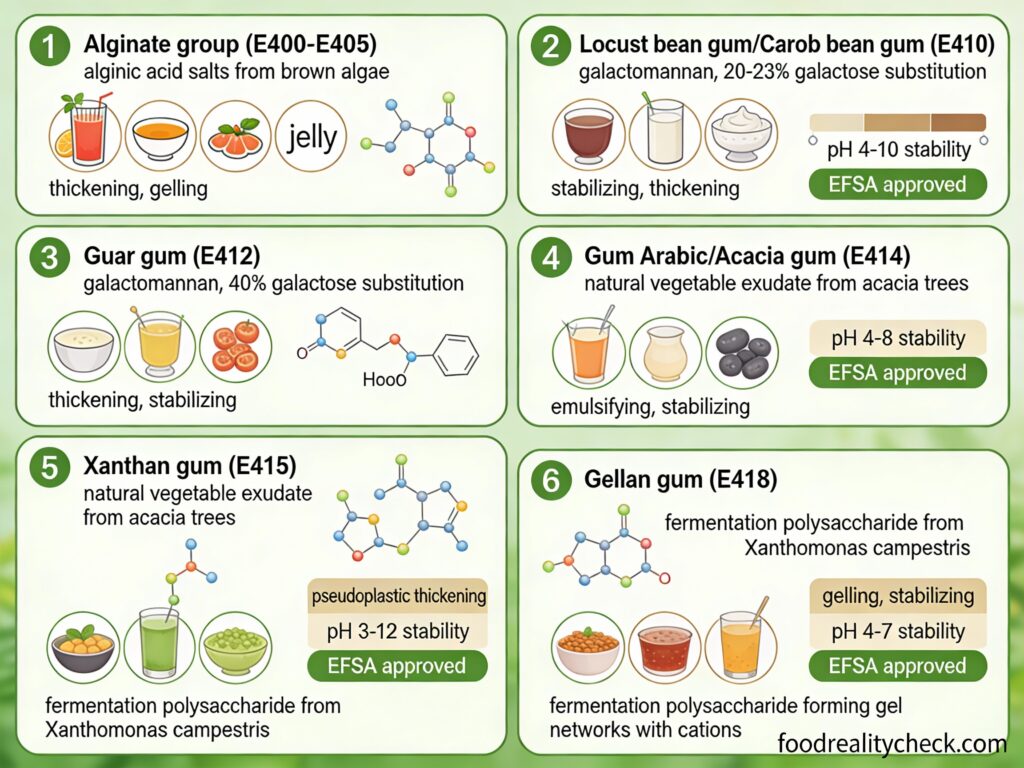
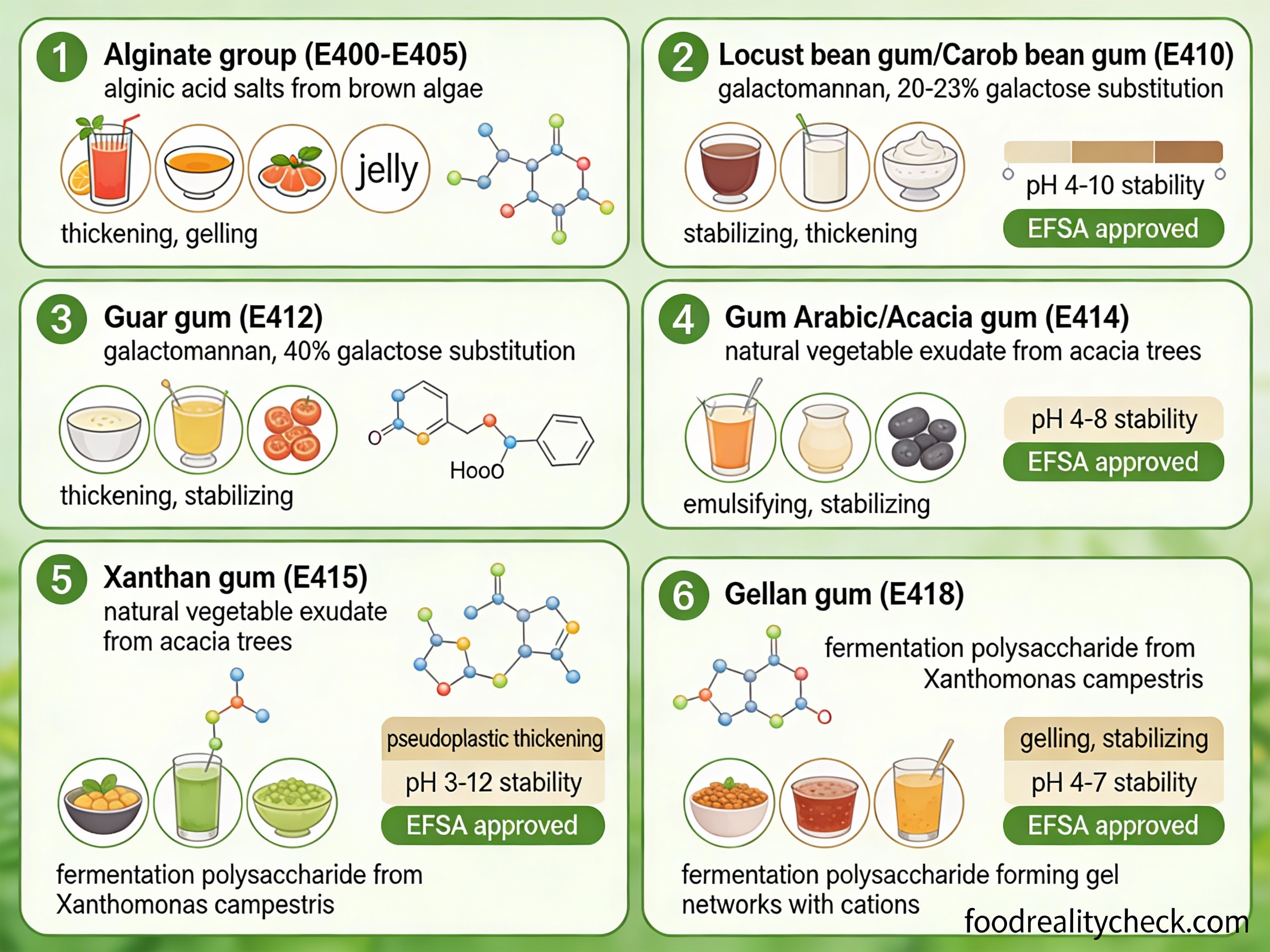
All alginates (E401-E405) come from brown seaweed, but they have dramatically different properties:
E401 (Sodium alginate): Water-soluble. Fails in acidic pH. General-purpose thickener.
E402 (Potassium alginate): Water-soluble. For low-sodium products. Not acid-stable.
E403 (Ammonium alginate): Water-soluble. Heat and acid resistant. Restricted from infant foods.
E404 (Calcium alginate): Water-insoluble. Forms heat-stable gels. Prevents ice crystallization.
E405 (Propylene glycol alginate): Water-soluble. Acid-stable. Semi-synthetic modification. Ideal for acidic products.
E405 uniquely solves the acid-stability problem that makes E401-E403 unsuitable for acidic foods and beverages.
Natural vs Synthetic Version
E405 is semi-synthetic—it starts natural but is chemically modified.
The production process begins naturally: brown seaweed is harvested, alginic acid is extracted through alkaline treatment, and the alginic acid is isolated through acid precipitation. However, unlike E401-E404 which stop at this stage, E405 undergoes an additional chemical synthesis step:
The alginic acid is reacted with propylene oxide at approximately 70°C under pressure with a chemical catalyst. This esterification reaction bonds propylene glycol groups to the carboxyl groups on the alginate polymer chain. The result is a chemically modified polysaccharide that doesn’t exist in nature—making it synthetic despite its seaweed origin.
There is no natural version of E405. It only exists through chemical synthesis, distinguishing it from the other alginates which are natural extractions with minimal chemical processing.
Common Food Applications
Salad Dressings: E405’s acid-stability makes it the default choice. Vinegar-based dressings would cause regular alginates to precipitate, but E405 maintains viscosity throughout the shelf life of the product.
Acidic Beverages: Fruit juices, lactic acid drinks, sports drinks, and soft drinks all rely on E405 because the acidic environment (pH 3-5) would disable other thickeners.
Beer and Beverages: Used to improve mouthfeel, maintain foam stability, and prevent haze formation during storage.
Ice Cream: Combined with other additives, it prevents ice crystal formation and maintains smooth texture during freeze-thaw cycles.
Environmental and Sustainability
Brown seaweed is a renewable resource harvested globally (major producers: China, Japan, France, USA, UK, Chile, Norway). The environmental impact of alginate extraction is considered minimal—it doesn’t deplete fish stocks or significantly harm marine ecosystems. However, E405 involves chemical synthesis using propylene oxide, which adds an environmental footprint compared to simple alginate extraction. The final product is biodegradable.
Natural Alternatives
Want to avoid E405? Food companies sometimes use these alternatives for acidic products:
• Xanthan gum (E415): Acid-stable natural polysaccharide from fermentation, though with different texture properties
• Modified starch: Temperature and acid-stable, but different mouthfeel
• Pectin: Plant-based thickener, requires specific pH range
• Citrus fiber: Natural alternative, though less effective as an emulsifier
• E401 (Sodium alginate) with pH buffering: Some manufacturers adjust pH to prevent precipitation
These alternatives have different functional profiles. For acidic salad dressings and beverages specifically, E405 remains the industry standard because its combination of acid-stability, emulsifying power, and cost-effectiveness is difficult to match.
The Bottom Line
E405 (propylene glycol alginate) is a semi-synthetic food additive derived from brown seaweed that has been chemically modified for enhanced stability.
It’s the essential ingredient in most salad dressings and acidic beverages because it’s the only alginate that remains stable and functional in acidic environments. Approved by the FDA, EFSA, and JECFA with established safety limits, E405 has demonstrated an excellent safety profile through extensive testing. It passes through the digestive system without absorption, is vegan and suitable for most dietary restrictions, and poses no identified health risk at approved food-use levels.
The semi-synthetic nature of E405—combining a natural seaweed base with propylene glycol chemical modification—makes it a hybrid additive that solves specific functional problems that natural alginates cannot address. While consumers might prefer fully natural alternatives, E405 enables the creation of shelf-stable salad dressings and acidic beverages that would be impossible with unmodified alginate compounds. For the general population, E405 is considered one of the safer food additives available, with regulatory approval justified by thorough safety testing.
I’ve been surfing online more than 3 hours today, yet I never found any interesting article like this one. It’s pretty worth enough for me.