What is E418?
Complete guide to understanding gellan gum in your food
The Quick Answer
E418 is gellan gum, a thickener, gelling agent, and stabilizer produced by bacterial fermentation, used to create gels, thicken beverages, and stabilize products like non-dairy milk alternatives.
It’s a naturally produced polysaccharide (complex carbohydrate) created when the bacterium Sphingomonas elodea ferments starch and sugars. Unlike gelatin (which is animal-derived), gellan gum is plant-based and vegan-friendly, making it an ideal substitute for creating gel textures in vegan candies and plant-based products.
Most people eating jam, jellies, non-dairy beverages, or vegan candies regularly consume small amounts of E418.
📌 Quick Facts
- Category: Thickener, Gelling Agent & Stabilizer
- Found in: Jam, jellies, non-dairy beverages, vegan candies, sauces, desserts
- Safety: FDA-approved, EFSA-approved, no numerical ADI needed
- Approved by: FDA, EFSA, JECFA
- Key Fact: Plant-based; produced by bacterial fermentation; vegan-friendly gelatin alternative
What Exactly Is E418?
E418 is gellan gum, a polysaccharide hydrocolloid (complex carbohydrate) produced by the fermentation of starch and sugars using the bacterium Sphingomonas elodea.
More specifically, the bacterium converts starch or sugars into a soluble polymer through fermentation. The resulting gellan gum is then purified and processed for use as a food additive. The result is a plant-based, naturally produced hydrocolloid that functions as both a gel and a stabilizer.
E418 comes in two main forms: high acyl and low acyl, each with different gelling properties. High acyl gellan gum forms thick, elastic gels requiring heating (70-80°C) to gel. Low acyl gellan gum forms firm, brittle gels at lower temperatures (10-60°C).
In technical terms, E418 is a nonionic hydrocolloid that forms gels only in the presence of calcium ions. It’s a soluble dietary fiber that passes through the digestive system largely unchanged.
Where You’ll Find E418
E418 appears in numerous food and beverage products requiring gelling, thickening, or stabilizing:
– Jam, jellies, and marmalades
– Fruit and vegetable spreads
– Non-dairy beverages (soy milk, almond milk, coconut milk)
– Fruit juices and drinks
– Vegan gum candies and wine gums
– Desserts and puddings
– Sauces and salad dressings
– Ice cream and frozen products
– Table-top sweeteners
– Snacks and breading
– Food enzyme preparations (as carrier)
If you eat jam, consume non-dairy beverages, or eat vegan candies, you’ve likely consumed E418. It’s especially common in plant-based and vegan products as a gelatin alternative.
💡 Pro Tip: Look for “Gellan gum” or “E418” on ingredient lists. It’s especially common in non-dairy beverages (soy milk, almond milk) where it suspends particles and prevents separation. Also appears in vegan gum candies as a gelatin substitute.
How E418 Works in Food
E418’s primary functions depend on which type (high acyl or low acyl) is used.
As a gelling agent: E418 creates gels with specific texture properties. High acyl gellan gum requires heating to form thick, elastic gels—useful in applications where heat is applied during manufacturing. Low acyl gellan gum forms firm, brittle gels at lower temperatures, suitable for cold applications. Both require calcium ions to form proper gels.
As a thickener: E418 increases viscosity in beverages and sauces, creating desired consistency without changing flavor. It has a strong thickening effect at relatively low concentrations.
As a stabilizer: E418 prevents syneresis (the unwanted separation of water from gels), maintains texture stability during storage, and extends shelf life. In non-dairy beverages, it keeps proteins suspended uniformly throughout the product.
As an emulsifier: E418 helps keep oil and water components mixed, preventing separation in complex food systems.
Thermoreversible properties: E418 forms gels when cooled and returns to a liquid state when heated, allowing manufacturers to mold products and then set them into final shapes.
Why Do Food Companies Use E418?
E418 provides multiple benefits manufacturers value: effective gelling at low use levels, vegan-friendly alternative to gelatin, excellent stabilizing properties, and thermoreversible characteristics.
Gellan gum requires significantly lower use levels than agar (the traditional gelling agent), making it more economical. For vegan and plant-based product manufacturers, it’s an ideal gelatin substitute that creates comparable gel textures. In non-dairy beverages, it keeps plant proteins suspended and prevents separation during storage—a critical function for product stability.
Is It Safe?
Regulatory authorities worldwide confirm E418 is exceptionally safe for food use—so safe that no numerical Acceptable Daily Intake (ADI) limit is needed.
The FDA approved gellan gum for use as a stabilizer and thickener. The EFSA conducted a comprehensive re-evaluation in 2018 and concluded there is no safety concern at reported uses and use levels. JECFA (the international FAO/WHO expert committee) also approved it.
The fact that no numerical ADI was established indicates exceptional safety—this is rare and indicates the regulatory margin of safety is so large that no upper limit needs to be set.
✓ Safety Confirmed – Exceptional Level: The EFSA’s 2018 re-evaluation concluded there is NO NEED FOR A NUMERICAL ADI for E418. This is extremely rare and indicates exceptional safety. No safety concern exists at approved food use levels. The compound is neither absorbed nor fermented in the human digestive system.
The EFSA’s 2018 Comprehensive Safety Re-evaluation
The European Food Safety Authority’s 2018 re-evaluation examined extensive data and concluded gellan gum is exceptionally safe.
Key findings:
– No numerical ADI needed – Indicating exceptional safety margin
– No safety concern at reported uses and use levels
– Unlikely to be absorbed intact – Passes through digestive system unchanged
– Would not be fermented by human intestinal microbiota
– No carcinogenicity concern – Not cancer-causing
– No genotoxicity concern – Does not damage genes
– Chronic toxicity: No adverse effects in mice at 3,627 mg/kg bw/day or in rats at 1,460 mg/kg bw/day (highest doses tested)
– Human study: Intake of 200 mg/kg bw/day for 3 weeks produced no adverse effects
– No allergenic reactions – No indication of allergic reactions
– Maximum estimated exposure: 72.4 mg/kg bw per day in toddlers (95th percentile)
Potential Side Effects
At approved food use levels, no adverse effects are documented.
E418 is well-tolerated at food consumption levels. Human studies show that people consumed 30 times typical food levels of gellan gum for 3 weeks without experiencing adverse effects.
At very high concentrations (far exceeding typical use): E418 might cause flatulence and bloating due to fermentation by intestinal bacteria (similar to consuming excessive dietary fiber). It has mild laxative properties like other dietary fibers.
Important note: One animal study linked chronic intake of very high doses to abnormalities in gut lining, but other studies found no harmful effects. This isolated finding has not been confirmed.
How E418 Is Made
E418 is produced through a biological fermentation process, not chemical synthesis.
Manufacturing process:
1. Bacterial growth: The bacterium Sphingomonas elodea is cultured in fermentation vessels
2. Substrate addition: Starch or sugars are provided as nutrient source
3. Fermentation: The bacterium metabolizes the starch/sugars and produces gellan gum polymer
4. Purification: Gellan gum is separated from the fermentation broth
5. Processing: The purified product is concentrated and dried into powder or liquid form
6. Result: Plant-based polysaccharide suitable for food use
E418 is a naturally produced compound—created through biological processes, not chemical synthesis—making it fundamentally different from purely synthetic additives.
Types of Gellan Gum
E418 comes in different forms with varying properties:
High acyl gellan gum: Higher acyl content (>50%), high molecular weight (1-2 × 10⁶), high viscosity, requires heating (70-80°C) to form thick, elastic gels. Used when strong gel texture is desired.
Low acyl gellan gum: Lower acyl content (≤50%), lower molecular weight (2-3 × 10⁵), lower viscosity, forms firm, brittle gels at lower temperatures (10-60°C). Used for applications requiring cold setting.
Deacylated form: Minimal acyl content, specialized properties for specific applications.
The choice between forms depends on the desired gel texture and the manufacturing process requirements.
Vegan and Dietary Status
E418 is exceptionally suitable for plant-based diets:
– Vegan-friendly ✓ – Produced by bacterial fermentation, not animal-derived
– Gelatin alternative ✓ – Specifically used in vegan gum candies to replace animal-derived gelatin
– Vegetarian ✓
– Plant-based ✓
– Organic-approved ✓ – High-acyl form approved by USDA National Organic Program (2010)
– Kosher – Potentially, depending on certification
– Halal ✓ – Halal certification available
– Gluten-free ✓
– Natural ✓ – Produced through biological fermentation, not chemical synthesis
E418 is particularly valued in vegan and vegetarian products because it’s a plant-based alternative to gelatin (which is derived from animal collagen).
Dietary Fiber Properties
E418 functions as a soluble dietary fiber:
E418 is unlikely to be absorbed intact in the digestive system and would not be fermented by human intestinal microbiota. It passes through largely unchanged, providing dietary fiber benefits without digestive side effects typical of other polysaccharides.
At very high concentrations (far exceeding typical food use), it might cause mild flatulence or bloating—the same response to excessive dietary fiber consumption.
Comparison with Other Gelling Agents
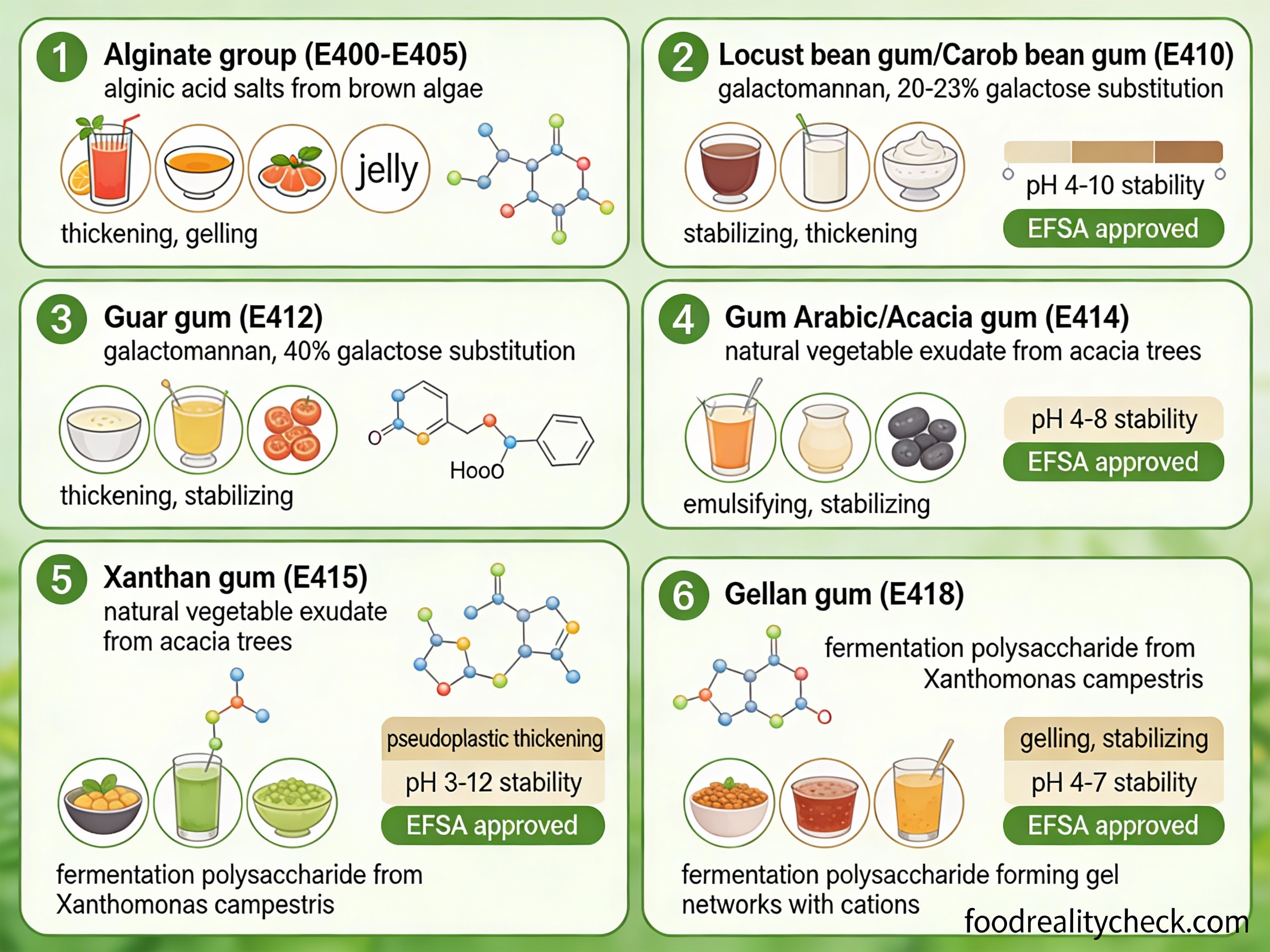
E418 is one of several gelling agents available to food manufacturers:
– Agar (E406): Traditional gelling agent; requires higher use levels
– Gelatin: Animal-derived (from collagen); not vegan/vegetarian
– Xanthan gum: Similar stabilizing/thickening properties
– Locust bean gum: Similar texture control functions
E418 is distinguished by its lower effective use level, plant-based origin, fermentation production method, and vegan credentials.
Approved Use Levels
E418 is approved for use in numerous food categories:
– 4 specific food categories: Defined maximum permitted levels set by regulation
– 67 food categories: Quantum satis basis (“as much as needed”) without numerical limits
Examples of specific approvals: jam, jellies, marmalades, fruit spreads, table-top sweeteners, and as a carrier in food enzyme preparations.
Regulatory Approval Across Regions
E418 is approved by virtually all major regulatory authorities:
– United States (FDA): Approved
– European Union (EFSA): Authorized per Regulation (EC) No 1333/2008
– International (JECFA/FAO/WHO): Approved
– Japan: First approval (1988)
– Canada: Approved
– Korea: Approved
– China: Approved
– Australia/New Zealand: Approved (code 418)
– USDA Organic: High-acyl form approved for organic foods (2010)
This near-universal approval reflects confidence in its safety across different regulatory systems.
Historical Information
E418 has a long history of safe regulatory approval:
– Discovery: Initially identified as a substitute for agar in bacterial culture media
– First approval: Japan (1988)
– Global rollout: FDA, Canada, EU, Korea, China followed
– Organic approval: High-acyl form added to USDA National List (2010)
– Established use: Over 35 years of regulatory safety approval
Notable Uses
E418 has appeared in some well-known food products:
– Orbitz soft drink: The now-discontinued beverage was famous for its unusual floating gel spheres created with gellan gum
– Non-dairy milk alternatives: A key ingredient in soy milk, almond milk, and coconut milk to keep plant proteins suspended
– Vegan candies: Used instead of gelatin to create gel textures in plant-based gum candies
The Bottom Line
E418 (gellan gum) is a naturally produced polysaccharide created through bacterial fermentation, used as a thickener, gelling agent, and stabilizer in food and beverages.
It’s produced by fermenting starch or sugars using the bacterium Sphingomonas elodea—making it a biologically created, plant-based compound.
Regulatory authorities worldwide classify E418 as exceptionally safe. The EFSA’s 2018 re-evaluation concluded there is NO NEED FOR A NUMERICAL ADI—an extremely rare designation indicating exceptional safety.
E418 is neither absorbed nor fermented in the human digestive system, passing through largely unchanged like dietary fiber.
Animal studies found no adverse effects even at very high doses (3,627 mg/kg bw/day in mice, 1,460 mg/kg bw/day in rats). Human studies showed no effects at 200 mg/kg bw/day for 3 weeks, and even at 30 times typical food levels.
E418 is vegan-friendly, making it an ideal gelatin alternative for plant-based products. The high-acyl form is USDA Organic-approved.
Most people eating jam, consuming non-dairy beverages, or eating vegan candies regularly consume E418 without any documented health concerns.
As always, food labels must declare E418 when used, enabling informed consumer choice.