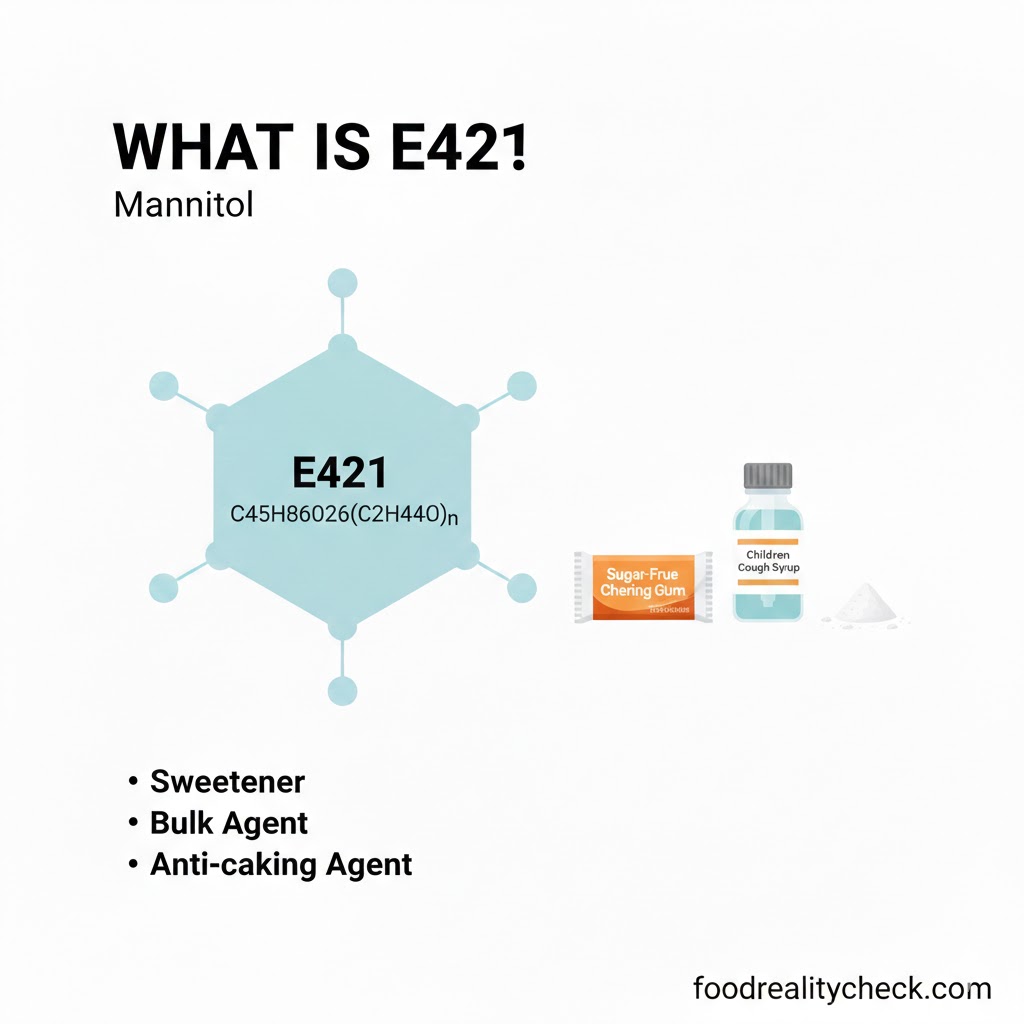
What is E421?
Complete guide to understanding E421 (Mannitol) in your food
The Quick Answer
E421 is a sugar alcohol sweetener derived from glucose or fructose that is approximately 50-60% as sweet as sugar with about 40% fewer calories (2.4 kcal/g vs 4 kcal/g), used in sugar-free and reduced-calorie products.
It’s used in chewing gum, candy, baked goods, and confectionery products.
It is considered safe by regulatory authorities (FDA GRAS, EFSA approved, JECFA approved). The primary considerations are: (1) its strong laxative effect at relatively low doses (>20g daily or single doses can trigger diarrhea), which is more pronounced than sorbitol; (2) EFSA’s ongoing re-evaluation suggests potential regulatory changes are being evaluated; (3) some sources indicate GI distress, nausea, and vomiting as documented side effects. Mannitol is less hygroscopic and has lower osmotic activity than sorbitol, but carries higher laxative risk at normal consumption levels.
📌 Quick Facts
- Category: Natural sugar alcohol (polyol) sweetener; anti-caking agent
- Chemical Name: D-mannitol or manna sugar
- Chemical Formula: C₆H₁₄O₆
- Sweetness: 50-60% as sweet as sugar; produces cooling sensation
- Calories: 2.4 kcal/gram (vs 4 kcal/gram for sugar); 40% fewer calories
- Glycemic Index: Low; minimal blood glucose impact; suitable for diabetics
- Found in: Chewing gum, candy, confectionery, baked goods, pressed mints
- Safety Status: FDA GRAS; EFSA approved; EFSA re-evaluation currently ongoing; JECFA approved
- Key Considerations: Strong laxative effect (>20g daily); lower solubility than sorbitol; medical use as diuretic/osmotic laxative
What Exactly Is It?
E421 is D-mannitol—a six-carbon sugar alcohol produced by catalytic hydrogenation of glucose or fructose syrups, or extracted from seaweed and manna (tree resin from Fraxinus ornus).
Chemical formula: C₆H₁₄O₆; molecular weight 182.17; also known as manna sugar or mannite.
E421 appears as white, odorless crystalline powder or granules. It is sparingly soluble in water (5.4 g/100 ml at 20°C)—much less soluble than sorbitol (91 g/100 ml). This low solubility is a defining characteristic and is why mannitol is preferred in certain applications like gum coating and preventing caking.
Production: E421 is produced industrially via catalytic hydrogenation of glucose-fructose syrups (typically 50:50 mixture) using Raney nickel catalyst at 120-160°C under pressure, yielding approximately 25% mannitol and 75% sorbitol mixture. The mannitol is then crystallized and separated. Alternatively, mannitol is extracted from seaweed (Laminaria species) or manna (hardened exudate from Fraxinus ornus tree). While mannitol occurs naturally in trace amounts in fruits (apples, pears, peaches, prunes), mushrooms, and fungi, commercial production is synthetic.
Mechanism: Like all sugar alcohols, mannitol is poorly absorbed in the small intestine. Unabsorbed mannitol reaches the colon where it draws water osmotically, and is fermented by colonic bacteria. This creates a strong laxative effect at doses exceeding 20 grams daily.
Medical properties: Importantly, mannitol is used medically as an osmotic diuretic and to treat increased intracranial pressure. Intravenous mannitol increases blood osmolarity, drawing fluid from tissues into blood for excretion via kidneys. This medical use confirms its osmotic properties but also highlights that it has systemic physiological effects.
Where You’ll Find It
E421 appears in many products, particularly confectionery:
• Chewing gum (major use)
• Sugar-free candy and sweets
• Pressed mints (no cooling solution)
• Baked goods
• Confectionery and pralines
• Ice cream and frozen desserts
• Jam and jelly (sugar-free)
• Yogurt
• Processed cheese
• Sauces and soups
• Processed meats
E421 is particularly valued in chewing gum and mints because its low solubility prevents dissolution (unlike sorbitol which dissolves readily), and its cooling effect varies depending on whether dissolved or in crystals.
⚠️ YELLOW SAFETY RATING – SOME CAUTION RECOMMENDED: E421 has:
• FDA GRAS approval (generally recognized as safe)
• EFSA approval (though re-evaluation currently ongoing)
• No documented genotoxicity or carcinogenicity at food levels
• STRONG laxative effect at >20g daily (more pronounced than sorbitol)
• Documented GI side effects: nausea, vomiting, diarrhea, gastric irritation at high doses
• Medical use as diuretic/osmotic laxative confirms significant physiological effects
• EFSA re-evaluation currently ongoing (status unclear)
• Less hygroscopic than sorbitol; minimal water absorption
• Generally lower risk than sorbitol for GI distress at moderate doses
• Lower caloric content (2.4 kcal/g) than sorbitol (2.6 kcal/g)
Unlike sorbitol (which has a well-documented and understood laxative effect), mannitol carries additional considerations due to its medical use profile and documented nausea/vomiting potential. EFSA’s ongoing re-evaluation may clarify regulatory status.
Is It Safe?
E421 is approved by major authorities (FDA GRAS, EFSA, JECFA), but carries more health considerations than sorbitol. EFSA’s ongoing re-evaluation suggests regulatory scrutiny. The primary concerns are its strong laxative effect (>20g daily) and documented GI distress (nausea, vomiting, gastric irritation) at high doses.
The FDA classifies mannitol as GRAS (Generally Recognized As Safe) for use as a sweetener, anti-caking agent, texturizer, and bulking agent in food.
The EFSA approved mannitol historically, but notably, EFSA’s current status shows mannitol re-evaluation as “ongoing”—suggesting ongoing regulatory scrutiny.
The JECFA (WHO) approved mannitol for food use globally.
What Are The Health Concerns?
E421 has documented health concerns, particularly regarding GI effects, distinguishing it from safer sugar alcohols:
Strong laxative effect (primary concern): At doses >20 grams daily, mannitol produces pronounced diarrhea and osmotic laxative effects. This is stronger and occurs at lower thresholds than sorbitol. This is the major limiting factor for mannitol use.
GI distress documented: Nausea, vomiting, gastric irritation, and abdominal discomfort documented at high doses. These effects are more serious than simple laxative action.
Hypersensitivity and anaphylaxis noted: While rare, documented reactions including hives and anaphylaxis reported in sensitive individuals.
Medical use confirms significant physiological effects: IV mannitol used medically produces diuresis, blood pressure effects, and requires careful dosing. This confirms mannitol has significant systemic effects beyond typical food additive profile.
Kidney dysfunction concern: Mannitol’s strong diuretic/osmotic action makes it unsuitable for individuals with kidney problems or those taking lithium (mannitol increases lithium excretion).
Lower solubility advantage (also concern): Unlike sorbitol which dissolves in aqueous foods, mannitol remains insoluble. This low solubility reduces digestive contact in some products but increases localized osmotic concentration in the digestive tract.
FODMAP sensitivity: Like all polyols, mannitol may trigger IBS/FODMAP-sensitive individuals; those with these conditions should limit consumption.
EFSA re-evaluation ongoing: The fact that EFSA is currently re-evaluating mannitol (unlike sorbitol which has completed re-evaluation) suggests potential regulatory changes pending.
Key Distinctions from Sorbitol (E420)
While both are sugar alcohols, E421 differs from E420 in important ways:
• Solubility: Mannitol much less soluble (5.4 g/100 ml vs sorbitol 91 g/100 ml)
• Laxative threshold: Mannitol >20g daily; sorbitol 20-40+ g daily
• GI effects: Mannitol documented to cause nausea/vomiting; sorbitol primarily gas/bloating/diarrhea
• Medical use: Mannitol used medically as diuretic/osmotic laxative; sorbitol not approved for medical use
• Calories: Mannitol 2.4 kcal/g; sorbitol 2.6 kcal/g (slight difference)
• Hygroscopicity: Mannitol minimal water absorption; sorbitol high water absorption
• Cooling effect: Mannitol varies with solubility; sorbitol produces cooling sensation readily
• Regulatory status: Mannitol re-evaluation ongoing; sorbitol approved with completed assessment
Natural vs Synthetic Version
E421 is primarily synthetically produced, though natural sources exist.
While mannitol occurs naturally in seaweed (Laminaria), tree manna (Fraxinus ornus), mushrooms, and trace amounts in fruits, commercial production is synthetic via hydrogenation of glucose-fructose syrups. Natural extraction is expensive and limited; industrial hydrogenation provides consistent quality and cost-effectiveness.
Natural Alternatives
Want to avoid E421?
Alternative sweeteners include:
• Sorbitol (E420) – more commonly used sugar alcohol; fewer GI concerns at moderate doses
• Xylitol (E967) – sugar alcohol; similar properties; higher cost
• Erythritol (E968) – sugar alcohol; fewer GI effects but emerging cardiovascular concerns
• Stevia (E960) – natural plant extract; 200-300× sweeter; zero calories
• Monk fruit – natural sweetener; 150-200× sweeter; zero calories
• Regular sugar – accept full calories and glycemic impact
• Honey/maple syrup – natural alternatives with calories
The Bottom Line
E421 (Mannitol) is a sugar alcohol sweetener approved by FDA (GRAS), EFSA, and JECFA, but carries more health considerations than similar sugar alcohols like sorbitol. The primary concern is its strong laxative effect at >20 grams daily and documented GI distress (nausea, vomiting, gastric irritation). EFSA’s ongoing re-evaluation suggests potential regulatory changes. Unlike sorbitol (which has stable regulatory approval), mannitol’s safety assessment remains under review, warranting caution.
Regulatory Status: Under Scrutiny. While approved, EFSA re-evaluation ongoing indicates potential changes to safety conclusions.
Strong Laxative Effect at Low Threshold: >20g daily produces pronounced laxative action—lower threshold than sorbitol and more problematic for typical consumers.
Documented GI Distress: Nausea, vomiting, and gastric irritation documented—more serious than sorbitol’s typical gas/bloating.
Medical Use Confirms Significant Physiological Effects: IV mannitol use as diuretic/osmotic agent demonstrates mannitol has systemic effects beyond typical food additive profile.
Lower Solubility Affects GI Handling: Insolubility in GI fluids means localized osmotic concentration—potentially more intense osmotic laxative effect than readily-dissolved sorbitol.
Kidney Dysfunction Risk: Unsuitable for kidney-compromised individuals; increases lithium excretion (problematic for those on lithium therapy).
Less Hygroscopic (Advantage in Some Applications): Low water absorption makes mannitol suitable for chewing gum/mints where sorbitol’s moisture-retaining properties are undesirable.
EFSA Re-evaluation Pending: Unlike sorbitol which has completed re-evaluation, mannitol remains “under review”—status and conclusions unclear.
Recommendation: While FDA and EFSA approve E421, the documented concerns (strong laxative effects, nausea/vomiting risk, ongoing regulatory re-evaluation) suggest consumers should exercise caution and prefer sorbitol (E420) for sugar alcohol needs unless mannitol’s specific properties (low hygroscopicity, low solubility) are desired for particular products. For those with kidney problems, IBS, FODMAP sensitivity, or taking lithium, mannitol should be avoided. The fact that EFSA re-evaluation is ongoing warrants monitoring for potential regulatory changes.