What is E431?
Complete guide to understanding E431 (Polyoxyethylene Stearate) in your food
The Quick Answer
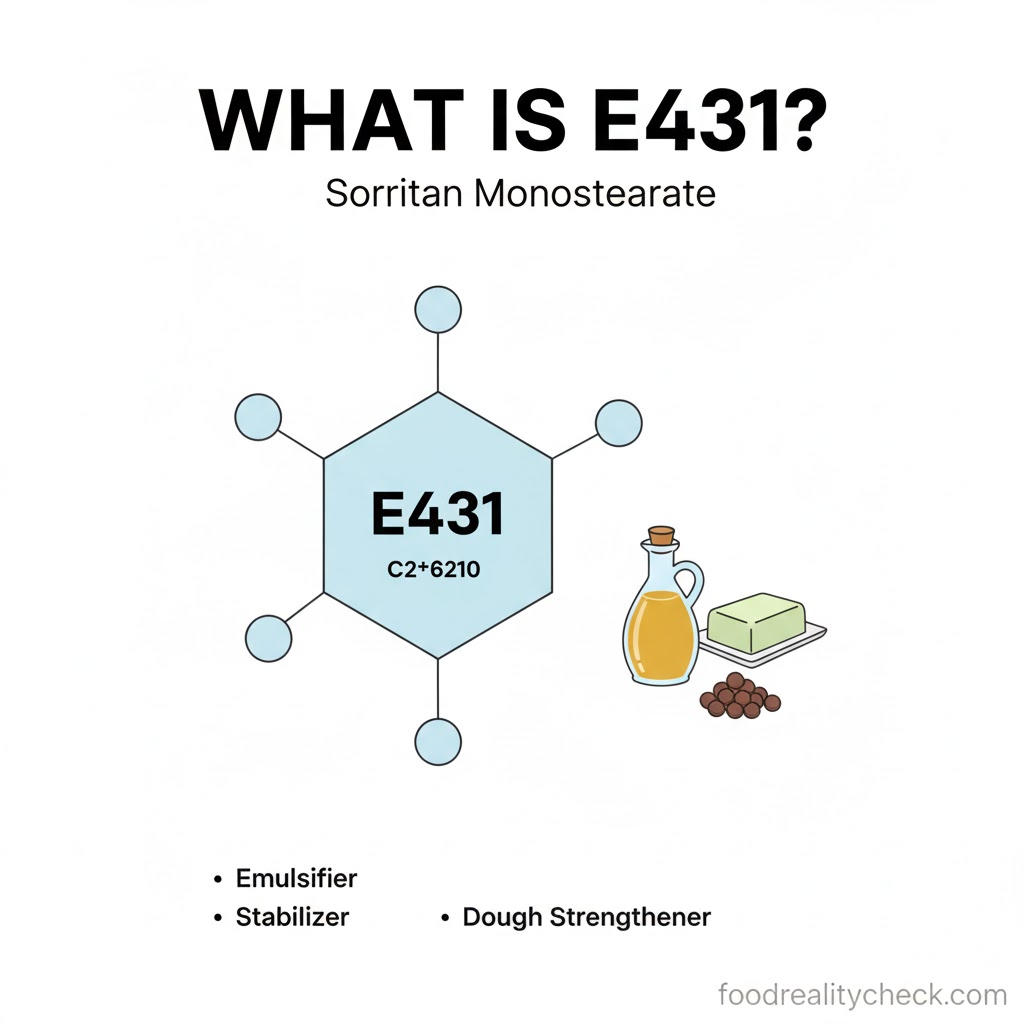
E431 is polyoxyethylene (40) stearate, a synthetic non-ionic emulsifier combining polyethylene glycol with stearic acid, used to stabilize emulsions and prevent ingredient separation in processed foods.
It’s used to maintain uniform consistency in foods containing both oil and water—allowing products to remain stable during storage without separating.
Most people consume it occasionally in processed foods like margarine, ice cream, baked goods, and sauces, though emerging research raises questions about emulsifier safety in general that warrant attention.
📌 Quick Facts
- Category: Emulsifier, Stabilizer, Non-ionic Surfactant
- Source: Synthetic—polyethylene glycol (PEG, from ethylene oxide) combined with stearic acid (from vegetable or animal fats)
- Found in: Margarine, ice cream, baked goods, puddings, jams, sauces, processed meats, cosmetics, pharmaceuticals
- Safety: FDA approved; EFSA approved with group ADI up to 25 mg/kg body weight per day for related compounds; NOT individually specified
- Natural or Synthetic: Fully synthetic (no naturally occurring version)
- Vegan/Vegetarian: Usually yes (vegetable stearic acid), but may be from animal fats—check source
- Key Concern: Recent research (2023-2024) links high emulsifier intake to increased cardiovascular disease and cancer risk
- Manufacturing Impurity: May contain potentially toxic 1,4-dioxane from production process
What Exactly Is It?
E431 is polyoxyethylene (40) stearate, also known as PEG-40 stearate. It’s a non-ionic surfactant created by chemically combining polyethylene glycol (an ethylene oxide polymer typically with 40 repeating ethylene oxide units) with stearic acid (an 18-carbon saturated fatty acid).
The chemical structure is an ester formed between polyethylene glycol chains (hydrophilic/water-loving) and stearic acid (lipophilic/oil-loving). This amphiphilic structure—having both water-loving and oil-loving properties—allows E431 to position itself at the oil-water interface, preventing droplet coalescence and maintaining stable emulsions.
Physically, E431 appears as a white to creamy-colored waxy or flaky solid. The molecular formula is complex due to the mixture nature of the product (40 refers to the average number of ethylene oxide units, but there is significant variation). The mixture typically includes mono- and diesters of polyethylene glycol with stearic acid.
E431 is fully synthetic—there is no naturally occurring version. It’s produced through chemical synthesis combining synthetic polyethylene glycol (derived from ethylene oxide) with naturally-derived or synthetic stearic acid.
Where You’ll Find It
E431 appears in select processed foods and products:
• Margarine and butter substitutes
• Ice cream and frozen desserts
• Baked goods (bread, cakes, pastries)
• Puddings and custards
• Jams, jellies, and fruit spreads
• Sauces and gravies
• Processed cheese
• Chocolate and cocoa products
• Pâtés and processed meats
• Soups (canned and packaged)
• Alcoholic beverages
• Cosmetics and skin creams
• Pharmaceutical emulsions and creams
• Shampoos and personal care products
• Toothpastes (often as antifoaming agent)
E431 is less commonly used than some other emulsifiers due to availability of alternatives and emerging safety concerns.
Why Do Food Companies Use It?
E431 performs three critical functions:
1. Oil-water emulsification and stabilization: E431 prevents oil and water from separating in emulsified products like margarine, mayonnaise, and sauces. Its amphiphilic structure positions itself at the oil-water interface, stabilizing tiny oil droplets suspended in water or vice versa.
2. Extended shelf life: By preventing separation and maintaining uniform consistency during storage, E431 extends product shelf life significantly—critical for commercial distribution and retail storage.
3. Texture improvement: In baked goods, ice cream, and other products, it creates smoother, more pleasant textures that improve consumer perception of quality.
Cost and availability considerations: E431 is used selectively because other emulsifiers (like lecithin, guar gum, or simpler emulsifiers) are often cheaper or have better functional properties for specific applications.
Is It Safe?
E431 is officially approved but with significant emerging safety questions from recent research.
Regulatory Approval:
• FDA (USA): Approved for food use; also used in cosmetics and personal care products
• EFSA (Europe): Approved as part of the polyoxyethylene group (E431-E436). Group ADI set at 25 mg/kg body weight per day. Note: No individual ADI was established for E431 specifically—it’s grouped with related compounds.
• JECFA (WHO/FAO): Approved and recognized as safe
Traditional Safety Assessment: Earlier toxicological studies (from 1970s-2000s) showed no significant adverse effects at reasonable intake levels. Humans tolerated oral doses up to 1,000 mg/kg body weight in animal studies without serious harm. However, these older studies did not evaluate long-term effects on cardiovascular health or cancer risk.
Documented side effects and concerns:
• At low doses (food use levels): Rare cutaneous (skin) reactions have been documented in sensitive individuals
• At high doses (beyond food use): Reported effects include urinary tract infections, digestive problems, kidney stones, and in extreme cases, liver cirrhosis—though these are from toxicological studies at extreme doses
• Emerging cardiovascular concerns: Recent epidemiological studies suggest association with increased CVD risk at high consumption levels
• Emerging cancer concerns: Recent epidemiological studies suggest association with increased cancer risk, particularly breast and prostate cancer, at high consumption levels
• Potential 1,4-dioxane contamination: Manufacturing impurity may present long-term cancer risk if present above safe thresholds
Important context: The recent research identifying associations between emulsifier intake and CVD/cancer risk does NOT prove that E431 causes these diseases. These are large observational studies that show correlations but cannot establish causation. However, they suggest that regulatory approval based primarily on short-term toxicological studies may be insufficient for compounds with decades of cumulative population exposure.
Production and Chemistry
E431 is produced through chemical synthesis:
1. Polyethylene glycol (PEG) is created by polymerizing ethylene oxide (a synthetic chemical compound) through controlled reactions
2. Stearic acid (derived from vegetable oils or animal fats) is isolated or synthesized
3. The stearic acid is chemically esterified with the polyethylene glycol chains through controlled reactions using catalysts
4. The mixture (typically PEG units with 8-40 ethylene oxide repeating units combined with stearic acid) is purified
5. The final product is dried and processed into a powder or flakes for food use
The process is entirely synthetic—no natural organism produces this compound. All components are manufactured in industrial facilities.
Natural vs Synthetic Version
E431 is entirely synthetic—there is no natural version.
Polyoxyethylene stearate only exists as a manufactured chemical. It doesn’t occur in nature and cannot be extracted from any natural source. The component parts (ethylene oxide, polyethylene glycol, stearic acid) can come from natural or synthetic origins, but the final combined product is always manufactured through chemical synthesis.
Vegetarian and Dietary Considerations
Vegetarian and vegan status: E431 is often suitable for vegetarians and vegans when derived from vegetable oils. However, stearic acid can be derived from animal fats (including pork), and the manufacturer’s documentation is required to verify the source. The product’s vegan status cannot be determined from the label alone—manufacturer confirmation is necessary.
Allergen potential: E431 itself is not considered an allergen. However, the stearic acid source (if from animal products) could theoretically trigger reactions in people allergic to specific animal sources, though this is extremely rare.
Comparison with Other Emulsifiers
E431 is one of many synthetic emulsifiers. Related compounds include:
• E432-E436: Polysorbates (polyoxyethylene derivatives of sorbitan esters)—similar chemistry but different structure
• E471: Mono- and diglycerides of fatty acids—simpler structure, more commonly used
• E472: Various esters of fatty acids—complex group with emerging safety concerns
• E473, E474, E475: Various esters combining fatty acids with other compounds
All of these are synthetic surfactants with broadly similar chemical mechanisms (amphiphilic emulsification) but different detailed structures and safety profiles.
Why Emulsifiers Are Under Scrutiny
A growing body of research suggests that synthetic emulsifiers may disrupt gut microbiota, increase intestinal permeability (creating “leaky gut” effects), and promote chronic inflammation—potential mechanisms linking emulsifier consumption to cardiovascular and cancer risk. Unlike many thickeners (which are fermented or plant-extracted and indigestible), synthetic emulsifiers may have biological activity that affects human physiology through mechanisms not fully understood.
Environmental Considerations
E431 production involves synthetic chemical processes with potential environmental impacts from ethylene oxide production. Ethylene oxide production generates volatile organic compounds and potential hazardous byproducts. The overall environmental footprint of E431 production is moderate to high compared to natural extraction-based additives.
Natural Alternatives
Want to avoid E431? Food companies sometimes use these alternatives:
• Lecithin (E322): Natural emulsifier from soy or eggs
• Guar gum (E412): Plant-based thickener and emulsion stabilizer
• Xanthan gum (E415): Fermentation-derived, though with emerging concerns
• Mono- and diglycerides (E471): Simpler synthetic emulsifiers (though also under research scrutiny)
• Agar or other seaweed products: Natural stabilizers
• Locust bean gum (E410): Plant-based thickener
Many of these alternatives have better natural-origin credentials, though some (like xanthan gum) also face emerging research concerns about emulsifier class effects.
The Bottom Line
E431 (polyoxyethylene stearate) is a fully synthetic emulsifier that is officially approved by FDA, EFSA, and JECFA, but faces emerging research concerns about its effects on cardiovascular health and cancer risk—concerns that apply to the broader emulsifier class rather than E431 specifically.
E431 functions effectively as an emulsifier and stabilizer, preventing oil-water separation in processed foods. Traditional toxicological studies show safety at reasonable intake levels. However, recent large-scale observational studies (2023-2024) have identified associations between high emulsifier consumption and increased cardiovascular disease and cancer risk—findings that have not been explained by traditional toxicological frameworks.
E431 appears less commonly in foods than many other emulsifiers, partly due to availability of alternatives and partly due to the emerging safety concerns affecting the entire synthetic emulsifier class. The additive may contain 1,4-dioxane manufacturing impurity, a potential carcinogen.
For consumers concerned about synthetic additives, emerging research suggests reducing intake of synthetic emulsifiers (E431, E432-E436, and related compounds) may be prudent pending further research clarification. For the general population, regulatory agencies continue to consider E431 safe at approved use levels, though they acknowledge that observational studies identifying potential cardiovascular and cancer associations warrant continued monitoring and research.