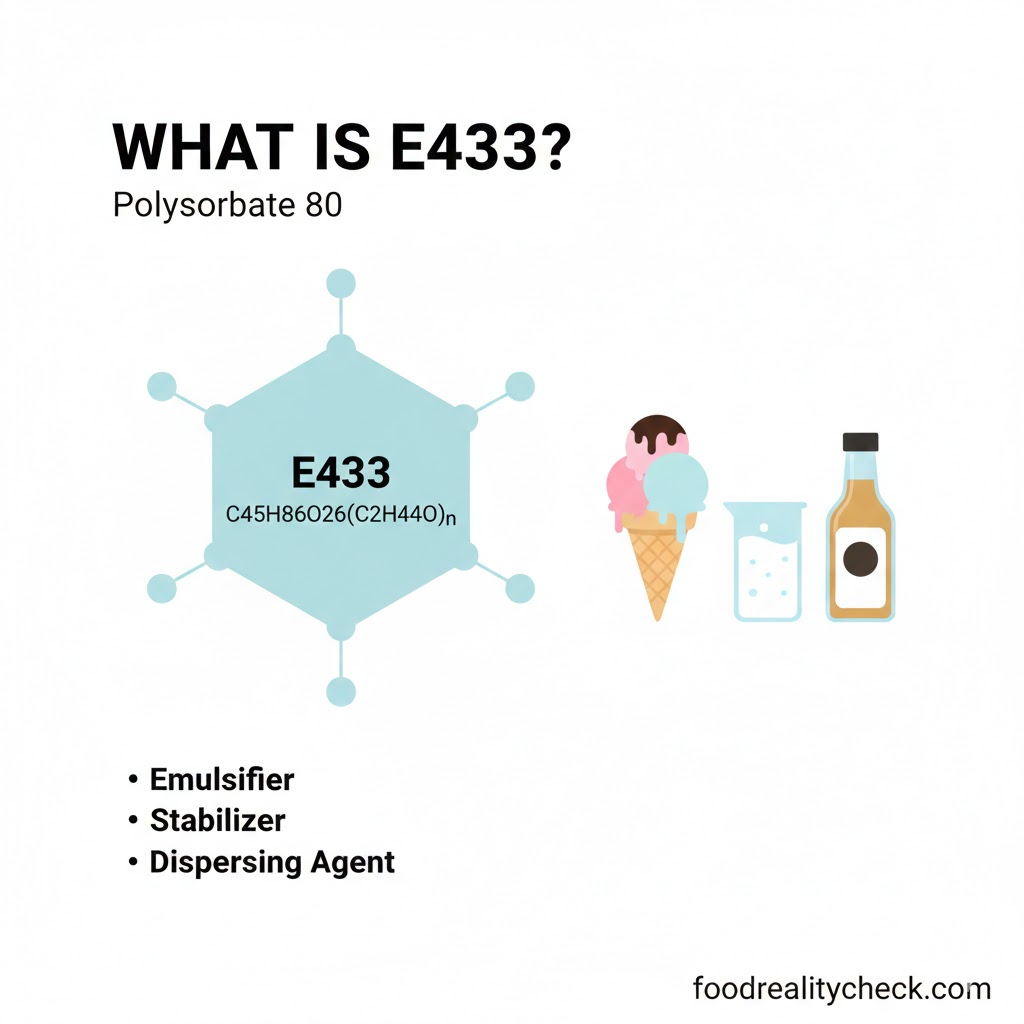
What is E433?
Complete guide to understanding E433 (Polysorbate 80) in your food
The Quick Answer
E433 is polysorbate 80 (also called polyoxyethylene sorbitan monooleate or Tween 80), a widely-used synthetic non-ionic emulsifier that prevents oil and water from separating in processed foods.
It’s used to stabilize emulsions, create creamy textures, and extend shelf life—particularly common in ice cream, baked goods, and confectionery.
Most people consume it regularly in processed foods, though emerging research has raised significant concerns about its effects on gut microbiota and intestinal health—concerns more substantial than those documented for related emulsifiers.
📌 Quick Facts
- Category: Emulsifier, Non-ionic Surfactant, Stabilizer, Solubilizer, Dispersing Agent
- Source: Synthetic—ethoxylated sorbitan monooleate (combination of sorbitol, ethylene oxide, and oleic acid)
- Found in: Ice cream, baked goods, confectionery, sauces, soups, chewing gum, alcohol, pâtés, pharmaceuticals
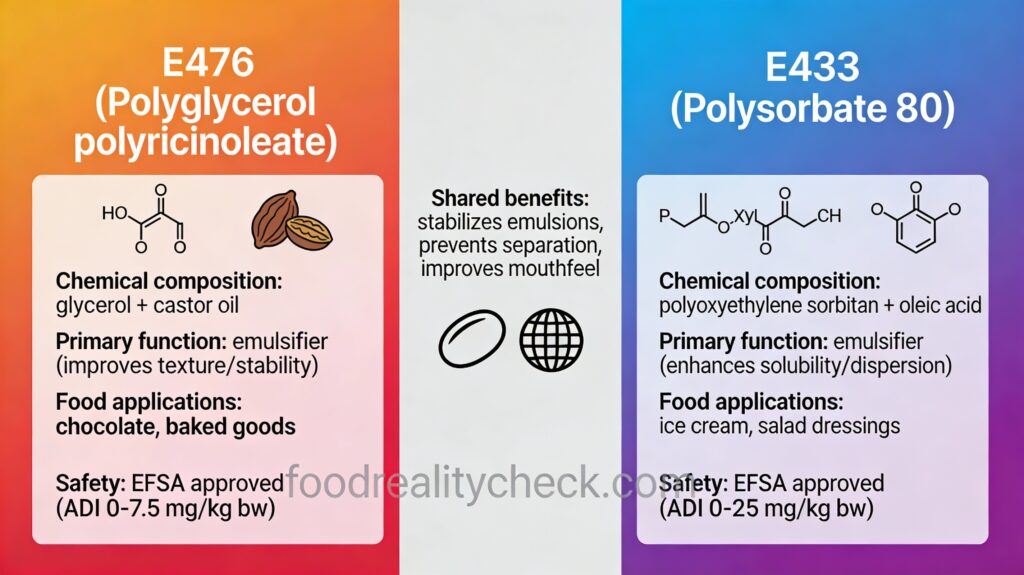
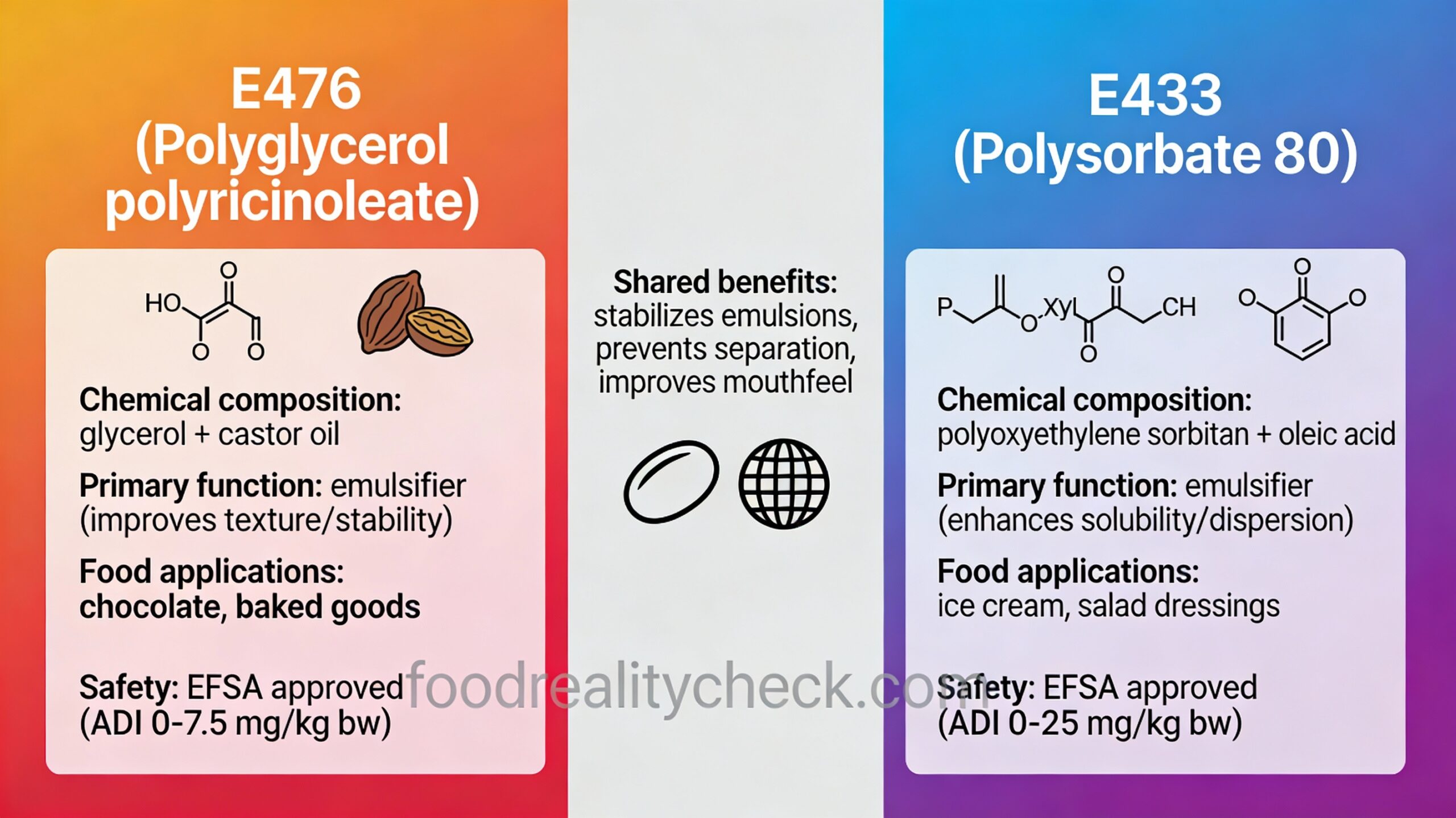
- Safety: FDA approved; EFSA group ADI 0-25 mg/kg body weight per day; JECFA ADI 0-25 mg/kg (since 1973)
- Natural or Synthetic: Fully synthetic (no naturally occurring version)
- Vegan/Vegetarian: Usually no—typically from animal fats; check manufacturer
- Commercial Names: Tween 80, Alkest TW 80, Kolliphor PS 80
- Key Concern: MOST CONCERNING emulsifier—research shows potential for profound gut microbiota disruption at food-use levels
What Exactly Is It?
E433 is polysorbate 80, a synthetic non-ionic surfactant created through the ethoxylation of sorbitan monooleate. The “80” refers to the average number of ethylene oxide (PEG) units attached (approximately 20 moles), though in practice these are distributed across multiple chains creating a mixture of related chemical species.
Chemically, polysorbate 80 is formed by: (1) dehydrating sorbitol (a sugar alcohol) to create sorbitan, (2) esterifying the sorbitan with oleic acid (an 18-carbon monounsaturated fatty acid), and (3) ethoxylating the result with approximately 20 moles of ethylene oxide through controlled reactions.
The final product is a golden-to-amber colored water-soluble viscous liquid with an oily feel and slightly bitter taste. The amphiphilic structure (having both water-loving and oil-loving regions) allows E433 to position itself at the oil-water interface, reducing interfacial tension and preventing droplet coalescence. E433 has a particularly high HLB (Hydrophilic-Lipophilic Balance) value of approximately 15, making it exceptionally effective at forming oil-in-water emulsions.
E433 is fully synthetic—there is no naturally occurring version. All component parts are manufactured in industrial facilities.
Where You’ll Find It
E433 appears in an extremely wide range of processed foods:
• Ice cream and frozen desserts (most common application)
• Baked goods (bread, cakes, pastries, fine bakery products)
• Confectionery and candy
• Sauces and gravies
• Soups and broths
• Chewing gum
• Margarine and butter spreads
• Pâtés and processed meats
• Chocolates and cocoa products
• Soft drinks and beverages
• Milk and cream analogues
• Vegetable protein drinks
• Pickles and preserved vegetables
• Vitamin and mineral supplements
• Dietary foods for special medical purposes
• Dietetic formulae for weight control
• Cosmetics and skin creams
• Pharmaceutical products and syrups
• Vaccines (as a stabilizing agent)
If you consume ice cream, baked goods, or processed foods regularly, you’ve almost certainly consumed E433 multiple times this week.
Why Do Food Companies Use It?
E433 performs four critical functions:
1. Superior oil-water emulsification: E433’s high HLB value makes it exceptionally effective at creating stable oil-in-water emulsions. Its amphiphilic structure stabilizes tiny oil droplets suspended in water, preventing separation during storage.
2. Ice cream texture enhancement: In ice cream production, E433 (typically at 0.5% concentration) prevents milk proteins from completely coating fat droplets, allowing them to aggregate in chains and networks that trap air, creating firm texture and preventing ice crystal formation that causes graininess.
3. Shelf life extension: By preventing separation of fat and water phases, E433 extends product shelf life significantly and maintains viscosity during storage.
4. Flavor and color stabilization: E433 functions as a solubilizer and dispersing agent, helping dissolve and distribute flavoring oils, fat-soluble colors, and other hydrophobic ingredients uniformly throughout products.
Market dominance: E433 is the most widely used polysorbate in food applications globally, particularly preferred for ice cream production due to superior functional properties.
Is It Safe?
E433 is officially approved but faces the most substantial emerging research concerns of any common food emulsifier.
Regulatory Approval:
• FDA: Approved as synthetic flavoring substance and adjuvant in food; also used extensively in pharmaceuticals
• EFSA: Approved as part of polysorbate group (E432-E436). Group ADI 0-25 mg/kg body weight per day established in 2018. No individual ADI for E433.
• JECFA: ADI 0-25 mg/kg body weight established in 1973
2. Intestinal Barrier Dysfunction (“Leaky Gut”): The same research documented increased intestinal permeability and disruption of the intestinal epithelial barrier—the protective lining separating gut contents from the bloodstream. This “leaky gut” effect allows bacterial lipopolysaccharides (endotoxins) to cross into the bloodstream, triggering systemic inflammation.
3. Low-Dose Effects at Food Levels: Unlike many toxicological concerns that only appear at extreme doses, the intestinal microbiota changes observed with E433 occur at concentrations similar to those consumed in food—making this a genuine population-level concern rather than theoretical risk.
4. Inflammatory Disease Promotion: Research suggests E433 exposure promotes intestinal inflammation that can increase risk of Crohn’s disease, ulcerative colitis, and colon cancer through mechanistic pathways documented in scientific literature.
5. Metabolic Dysfunction and Obesity: Studies document that polysorbate 80 exposure promotes weight gain through metabolic changes, potentially contributing to obesity, diabetes, and metabolic syndrome—effects attributed to gut microbiota-mediated mechanisms.
6. Behavioral Effects: Emerging research notes possible psychosocial consequences including anxiety-like behaviors—though this research is preliminary and mostly from animal models.
• 1,4-Dioxane: Classified as “possibly carcinogenic to humans” (Group 2B by IARC). Food-grade E433 contains less than 5 mg/kg 1,4-dioxane. Regulatory agencies consider this safe given low use levels (0.1-1% in food) and low impurity content.While the residual levels are considered acceptable, the presence of probable carcinogens as manufacturing byproducts warrants ongoing monitoring.
Documented allergic and sensitivity reactions:
• Anaphylactoid reactions (immediate hypersensitivity)
• Hypersensitivity reactions
• Immunological contact urticaria
• Dermatitis and skin reactions
• Cutaneous reactions at low food doses in sensitive individuals
Important context on emerging research: The 2015-2024 research showing gut microbiota disruption and intestinal permeability effects at food-relevant doses represents a fundamental challenge to the traditional safety approval framework. Traditional toxicology tests identify acute poisoning and carcinogenicity at high doses. This emerging research identifies chronic, low-dose effects on human physiology through mechanisms not captured by traditional testing. Regulatory agencies have not yet formally incorporated these mechanistic findings into approval frameworks, maintaining official safety approval despite accumulating evidence of biological activity at food-consumption levels.
Production and Chemistry
E433 is produced through multi-step chemical synthesis:
1. Sorbitol (a sugar alcohol) is dehydrated through controlled heating to produce sorbitan anhydride
2. Oleic acid (a fatty acid from vegetable oils or animal fats) is esterified to sorbitan through chemical reaction
3. The resulting sorbitan monooleate is ethoxylated by reacting with ethylene oxide (approximately 20 moles) under pressure and catalysis
4. The product is purified to remove unreacted materials and byproducts (including ethylene oxide and 1,4-dioxane)
5. The final product is dried and processed into liquid form for food use
The entire process is synthetic—no step involves natural extraction.
Natural vs Synthetic Version
E433 is entirely synthetic—there is no natural version.
Polysorbate 80 only exists as a manufactured chemical. It doesn’t occur in nature and cannot be extracted from any natural source. While component parts (sorbitol from fruits, oleic acid from fats) can come from natural sources, the final combined product is always synthetically manufactured.
Vegan and Vegetarian Status
E433 is usually NOT suitable for vegans and vegetarians.
While oleic acid can theoretically be derived from vegetable oils (particularly olive or coconut oil), most commercial E433 is sourced from animal fats (particularly beef tallow). The manufacturer’s documentation is required to verify the source. Like E432, E433 defaults to animal sources and is unsuitable unless specifically documented as vegetable-derived.
Comparison with Related Polysorbates
E433 is the most widely-used polysorbate in food. The polysorbate family includes:
• E432 (Polysorbate 20): With lauric acid; used less frequently; similar emerging concerns but fewer studies
• E434 (Polysorbate 40): With palmitic acid; similar applications
• E435 (Polysorbate 60): With stearic acid; similar applications
• E436 (Polysorbate 65): With trioleic acid; less commonly used
E433 is preferred in many applications because its high HLB value (15) and oleic acid component provide superior emulsifying properties for oil-in-water emulsions. However, the research evidence of gut microbiota disruption is most substantial for E433, suggesting it may be the most concerning polysorbate from a health perspective.
The E-Ferol Tragedy: Historical Precedent
In 1981-1982, 38 premature infants died after receiving intravenous E-Ferol (vitamin E formulation containing polysorbate 80 at 9% and polysorbate 20 at 1%). The infants experienced hepatotoxicity, cholestasis (bile duct blockage), kidney damage, and death. While this was an exceptional case involving IV administration at extreme doses (far exceeding food-use levels), it demonstrated that polysorbates can cause severe liver damage at sufficiently high exposures. This historical precedent suggests that polysorbates may have biological activity and organ toxicity potential that isn’t captured in lower-dose assessments.
Pharmaceutical Applications and Concerns
E433 is widely used in pharmaceutical products as an emulsifier and solubilizer, particularly in:
• Injectable medications (including the anti-arrhythmic drug amiodarone)
• Oral medications
• Vaccine formulations (as a stabilizer)
The pharmaceutical use at concentrations higher than food levels, combined with the emerging microbiota disruption research, raises questions about cumulative exposure from food, medications, and vaccines for individuals consuming high levels of processed foods while taking medications containing E433.
Environmental and Production Concerns
E433 production involves synthetic chemical processes with environmental impacts. Ethylene oxide production generates volatile organic compounds and potential hazardous byproducts. The manufacturing process creates 1,4-dioxane and ethylene oxide impurities that require purification. Overall environmental footprint is moderate to high compared to natural extraction-based additives.
Natural Alternatives
Want to avoid E433? Food companies sometimes use these alternatives:
• Lecithin (E322): Natural emulsifier from soy or eggs (though also under research scrutiny)
• Guar gum (E412) or Locust bean gum (E410): Plant-based stabilizers
• Mono- and diglycerides (E471): Simpler synthetic emulsifiers (also under research scrutiny)
• Xanthan gum (E415): Fermentation-derived (though facing emerging microbiota concerns)
• Agar or carrageenan: Seaweed-based stabilizers
• Starch or modified starch: Plant-derived thickeners
For ice cream specifically, where E433 has dominant market position, alternatives exist but are less functionally effective—which explains continued heavy reliance despite emerging safety concerns.
The Bottom Line
E433 (polysorbate 80) is a widely-used synthetic emulsifier that is officially approved by FDA, EFSA, and JECFA, but faces the most substantial emerging research evidence of health concerns of any common synthetic emulsifier—particularly regarding gut microbiota disruption and intestinal permeability effects at food-consumption levels.
E433 functions exceptionally well as an emulsifier and is particularly dominant in ice cream production. Traditional toxicological studies (1970s-2000s) established formal safety approval based on short-term studies showing no acute poisoning or carcinogenicity at high doses. However, peer-reviewed research from 2015-2024 documents that E433 causes measurable disruption of beneficial gut bacteria and increases intestinal permeability at concentrations similar to those encountered in food.
These emerging findings represent a fundamental challenge to traditional approval frameworks that rely on acute toxicity testing. The research demonstrates chronic, low-dose biological effects on human physiology that weren’t captured in historical safety testing. While regulatory agencies have not formally revoked approval based on this emerging evidence, the accumulating scientific literature suggests E433 may be less safe than currently classified.
E433 is derived from animal fats, making it unsuitable for vegans and vegetarians. It may contain 1,4-dioxane manufacturing impurity classified as a probable carcinogen.
For consumers concerned about emerging evidence of adverse biological effects, significantly reducing consumption of products containing E433 (and related polysorbates E432, E434-E436) is prudent pending formal regulatory reassessment. Regulatory agencies continue to consider E433 safe at approved use levels, though the accumulating mechanistic evidence of gut dysbiosis and intestinal barrier dysfunction warrants serious reconsideration of approval status as research continues.