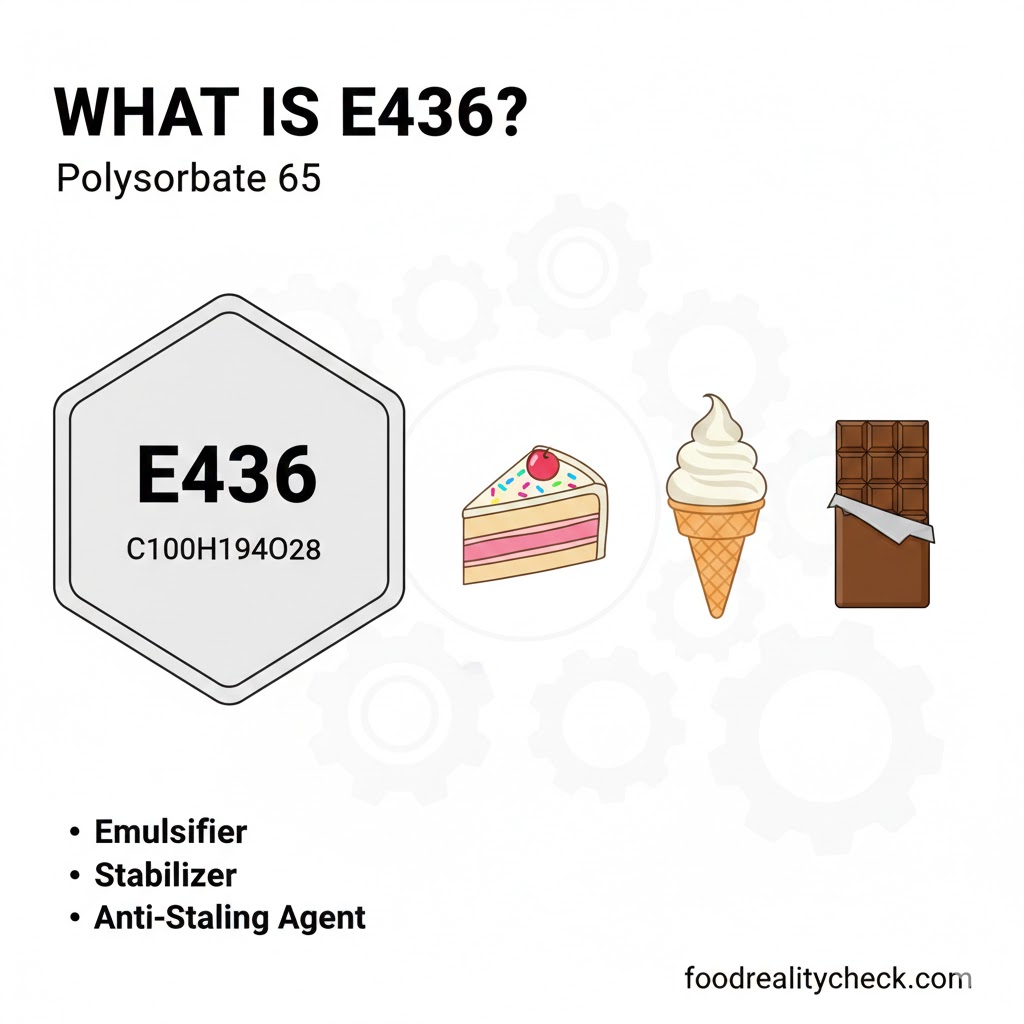
What is E436?
Complete guide to understanding E436 (Polysorbate 65) in your food
The Quick Answer
E436 is polysorbate 65 (also called polyoxyethylene sorbitan tristearate or Tween 65), a synthetic non-ionic emulsifier used to prevent oil and water from separating in processed foods.
It’s used to stabilize emulsions, create smooth textures, and extend shelf life—appearing less frequently than related polysorbates in food applications.
Most people consume it occasionally in processed foods, though E436 is the least commonly-used polysorbate in food. Like all polysorbates, it faces emerging research concerns about gut microbiota effects.
📌 Quick Facts
- Category: Emulsifier, Non-ionic Surfactant, Stabilizer, Solubilizer, Anti-foaming Agent, Dispersing Agent
- Source: Synthetic—ethoxylated sorbitan tristearate (combination of sorbitol, ethylene oxide, and stearic acid)
- Found in: Ice cream, cakes, confectionery, chewing gum, soft drinks, soups, puddings, pâtés, alcoholic drinks
- Safety: FDA approved; EFSA group ADI 0-25 mg/kg body weight per day; JECFA ADI 0-25 mg/kg (since 1973)
- Natural or Synthetic: Fully synthetic (no naturally occurring version)
- Vegan/Vegetarian: Usually no—typically from animal fats; requires manufacturer verification
- Commercial Names: Tween 65, Alkest TW 65, Kolliphor PS 65
- Unique Property: Only polysorbate with water-in-oil emulsification capability (HLB 10.5) vs. oil-in-water for others
What Exactly Is It?
E436 is polysorbate 65, a synthetic non-ionic surfactant created through the ethoxylation of sorbitan tristearate. The “65” refers to the mixture of stearate esters with ethylene oxide approximately 20 units, though commercial food-grade E436 contains a mixture of stearate and palmitate esters due to the natural composition of commercial stearic acid (which typically contains palmitic acid).
Chemically, polysorbate 65 is formed by: (1) dehydrating sorbitol (a sugar alcohol) to create sorbitan, (2) esterifying the sorbitan with stearic acid (an 18-carbon saturated fatty acid), and (3) ethoxylating the result with approximately 20 moles of ethylene oxide through controlled reactions. The molecular weight is approximately 1,312 g/mol.
The final product is a lemon to orange-colored oily liquid or semi-gel at room temperature. Unlike other polysorbates, E436 has a distinctive HLB (Hydrophilic-Lipophilic Balance) value of approximately 10.5, making it unique among food polysorbates—it functions primarily as a water-in-oil emulsifier rather than the oil-in-water emulsification that characterizes other polysorbates (E432, E433, E434, E435).
E436 is fully synthetic—there is no naturally occurring version. All component parts are manufactured in industrial facilities.
Unique Property: Water-in-Oil vs. Oil-in-Water
E436 is uniquely positioned as the only food polysorbate designed for water-in-oil emulsions.
The HLB value determines an emulsifier’s preference: HLB values 3-6 favor water-in-oil emulsions (where water droplets are suspended in oil), while HLB 7-18 favor oil-in-water emulsions (where oil droplets are suspended in water). E436’s HLB of 10.5 places it in the water-in-oil range, making it distinct from E432 (HLB ~14.9), E433 (HLB ~15), E434 (HLB ~15.6), and E435 (HLB ~14.9), which all favor oil-in-water emulsions.
This distinction gives E436 unique applications in products where creating stable water-in-oil systems is advantageous—primarily in cosmetics, pharmaceuticals, and specialized food formulations.
Where You’ll Find It
E436 appears in a limited range of processed foods—less common than other polysorbates:
• Ice cream and frozen desserts
• Cakes and fine bakery products
• Confectionery and candy
• Chewing gum (where water-in-oil properties are advantageous)
• Soft drinks and refreshments
• Instant soups
• Puddings and desserts
• Pâtés and processed meats
• Alcoholic beverages (particularly liqueurs)
• Sauces and condiments (select applications)
• Vegetable protein drinks
• Dietetic foods for body weight control
• Cosmetics and skin creams (primary use, not food)
• Pharmaceutical products (primary use, not food)
• Personal care products
• Industrial applications (textile chemicals, cutting oils)
E436 is notably the least commonly-used polysorbate in food applications. Its usage is limited compared to E433 (dominant in ice cream) or E435 (dominant in baked goods).
Why Do Food Companies Use It?
E436 performs four critical functions, primarily in specialized applications:
1. Water-in-oil emulsification (unique property): E436’s low HLB value makes it the only food polysorbate suitable for creating stable water-in-oil emulsions, where water droplets are suspended in oil—essential for certain confectionery coatings and specialty products.
2. Oil-solubility and flavor distribution: Unlike other polysorbates, E436 is oil-soluble (not water-soluble), making it valuable for distributing water-soluble flavors and ingredients into oil-based systems.
3. Chewing gum stability: In chewing gum formulations, E436’s water-in-oil properties maintain stable texture and prevent components from separating during storage and chewing.
4. Synergistic combinations: When combined with other emulsifiers, E436 provides functional advantages in complex food systems where both oil-in-water and water-in-oil emulsification are needed simultaneously.
Limited food use: E436 is used less frequently in food than other polysorbates because its water-in-oil properties are less commonly needed in typical food formulations. Most processed foods require oil-in-water emulsifications, making E433 or E435 more practical choices. E436 is more extensively used in cosmetics and pharmaceuticals where water-in-oil emulsions are standard.
Is It Safe?
E436 is officially approved but inherits the emerging research concerns of the broader polysorbate class.
Regulatory Status:
• FDA: Approved for food use as an emulsifier with various permitted applications
• EFSA: Approved as direct food additive (E436). Part of polysorbate group (E432-E436) with group ADI 0-25 mg/kg body weight per day established in 2015 re-evaluation.
• JECFA (WHO/FAO): ADI 0-25 mg/kg body weight established in 1973
• Gut microbiota disruption: Research suggests polysorbates alter bacterial composition and diversity
• Intestinal permeability increase: Evidence of “leaky gut” effects allowing bacterial endotoxins to cross into bloodstream
• Inflammatory disease promotion: Potential contribution to intestinal inflammation and chronic inflammatory diseases
• Metabolic dysfunction: Possible contribution to weight gain and metabolic syndromeThese effects are attributed to polysorbate class structure rather than being specific to E433, suggesting E436 may share these biological activities at food-consumption levels, though specific human studies of E436 mechanistic effects are limited compared to E433.
• 1,4-Dioxane: Classified as “possibly carcinogenic to humans” (Group 2B by IARC). Food-grade E436 contains less than 5 mg/kg 1,4-dioxane.Regulatory agencies consider residual levels safe given low use levels in food, though the presence of probable carcinogenic impurities warrants ongoing monitoring.
Documented effects and concerns specific to E436:
• At food-use levels: Rare cutaneous (skin) reactions in sensitive individuals; generally considered a nonsensitizer in animal studies
• Propylene glycol cross-reactivity: Individuals with known propylene glycol intolerance may experience reactions to E436, though the mechanism is unclear
• At extreme doses (beyond food use): Cutaneous reactions, digestive problems, kidney stones, and liver cirrhosis in extreme toxicological studies far exceeding food exposure
• Oxidation susceptibility: The oleate component in E436 is susceptible to oxidation during storage, potentially creating peroxides—though this occurs over extended storage periods and at concentrations far exceeding normal food levels
Production and Chemistry
E436 is produced through multi-step chemical synthesis:
1. Sorbitol (a sugar alcohol from glucose, typically from maize or tapioca) is dehydrated through controlled heating to produce sorbitan
2. Stearic acid (typically from vegetable oils like palm, soy, or coconut; can also be from animal fats) is esterified to sorbitan through chemical reaction—note that commercial stearic acid often contains palmitic acid, making E436 a mixture of stearate and palmitate esters
3. The resulting sorbitan esters are ethoxylated by reacting with ethylene oxide (approximately 20 moles) under pressure and catalysis
4. The product is purified to remove unreacted materials and byproducts (including ethylene oxide and 1,4-dioxane)
5. The final product is dried and processed into its characteristic oily/semi-gel form
The entire process is synthetic—no step involves natural extraction.
Natural vs Synthetic Version
E436 is entirely synthetic—there is no natural version.
Polysorbate 65 only exists as a manufactured chemical. It doesn’t occur in nature and cannot be extracted from any natural source. While component parts (sorbitol, stearic acid, ethylene oxide) can have natural or synthetic origins, the final combined product is always synthetically manufactured.
Vegan and Vegetarian Status
E436 is typically NOT suitable for vegans and vegetarians, though verification is needed.
While stearic acid can theoretically be derived from vegetable oils (palm, soy, coconut), most commercial E436 is sourced from animal fats (including tallow). Additionally, the stearic acid component in commercial food-grade E436 is typically mixed with palmitic acid from natural sources, and the origin cannot be determined from the label. Manufacturer documentation is required to verify the source. Most E436 products are unsuitable for vegans and vegetarians unless specifically documented as vegetable-derived.
Comparison with Related Polysorbates
E436 occupies a unique niche among polysorbates due to its distinctive water-in-oil emulsification capability. The polysorbate family includes:
• E432 (Polysorbate 20): HLB ~14.9; oil-in-water; with lauric acid
• E433 (Polysorbate 80): HLB ~15; oil-in-water; with oleic acid; dominates ice cream
• E434 (Polysorbate 40): HLB ~15.6; oil-in-water; with palmitic acid; limited FDA approval
• E435 (Polysorbate 60): HLB ~14.9; oil-in-water; with stearic acid; dominates baked goods
E436 is the only food polysorbate with water-in-oil emulsification (HLB 10.5), making it functionally distinct despite sharing the same chemical class. This distinction explains its limited food use—most food formulations require oil-in-water emulsions, making other polysorbates more practical. E436 finds greater use in cosmetics and pharmaceuticals where water-in-oil emulsions are needed.
Stability and Storage Concerns
E436 has unique stability considerations:
• Hygroscopic: E436 absorbs moisture from air; moisture content should be checked and material dried if necessary before use
• Oxidation susceptibility: The oleate component in E436 is susceptible to oxidation, particularly during extended storage
• Peroxide formation: Like other polyoxyethylene surfactants, E436 can produce peroxides during prolonged storage—though this occurs at storage timescales longer than typical food product shelf lives
• Acid and base sensitivity: E436 is stable to weak acids and bases but will gradually saponify (break down) in strong acids and strong bases
These stability considerations make E436 more demanding to work with than some other polysorbates, partly explaining its lower frequency of use in food.
Environmental and Production Concerns
E436 production involves synthetic chemical processes with environmental impacts from ethylene oxide production and manufacturing. The process generates carcinogenic byproducts (1,4-dioxane, ethylene oxide) requiring purification. Environmental footprint is moderate to high compared to natural extraction-based additives. Additionally, the oxidation susceptibility of the oleate component can create environmental concerns from peroxide byproducts during disposal.
Natural Alternatives
Want to avoid E436? Food companies sometimes use these alternatives:
• Lecithin (E322): Natural emulsifier from soy or eggs; limited water-in-oil capability
• Mono- and diglycerides (E471): Simpler synthetic emulsifiers; can work in water-in-oil systems
• Guar gum (E412) or Locust bean gum (E410): Plant-based stabilizers; different functional properties
• Xanthan gum (E415): Fermentation-derived (though facing emerging concerns)
• Other polysorbates (E432-E435): Related compounds with oil-in-water properties
• Agar or carrageenan: Seaweed-based stabilizers
• Beeswax or modified waxes: Natural water-in-oil emulsifiers (for specialty applications)
For water-in-oil emulsification specifically, E436 has limited alternatives among food additives, which partly explains its continued use despite emerging concerns about the polysorbate class. Beeswax or specially modified waxes can provide some water-in-oil functionality but lack the regulatory approval and versatility of E436.
The Bottom Line
E436 (polysorbate 65) is a fully synthetic emulsifier that is officially approved by FDA, EFSA (group ADI 25 mg/kg), and JECFA, but faces emerging research concerns applicable to the entire synthetic polysorbate class. E436 is the least commonly-used polysorbate in food due to its unique water-in-oil emulsification properties, which are less commonly needed in typical food formulations.
E436 functions as an emulsifier and has traditional toxicological approval based on 1970s-1980s safety studies showing no significant adverse effects at food-use levels. However, emerging research suggests polysorbates may disrupt gut microbiota and increase intestinal permeability through mechanisms not captured by traditional toxicology testing.
E436 appears in ice cream, cakes, confectionery, and specialty foods at very low concentrations. It is typically derived from animal fats, making it unsuitable for vegans and vegetarians unless specifically verified. The product may contain 1,4-dioxane manufacturing impurities and is susceptible to oxidation during storage, creating potential peroxide byproducts over extended periods.
For consumers concerned about emerging evidence of polysorbate class effects on gut health, avoiding E436 along with other polysorbates (E432-E435) is prudent pending further research. Regulatory agencies continue to consider E436 safe at approved use levels, though accumulating mechanistic evidence warrants ongoing monitoring. E436’s limited use in food compared to other polysorbates makes it relatively easier to avoid through simple label checking for “polysorbate 65” or “E436.”