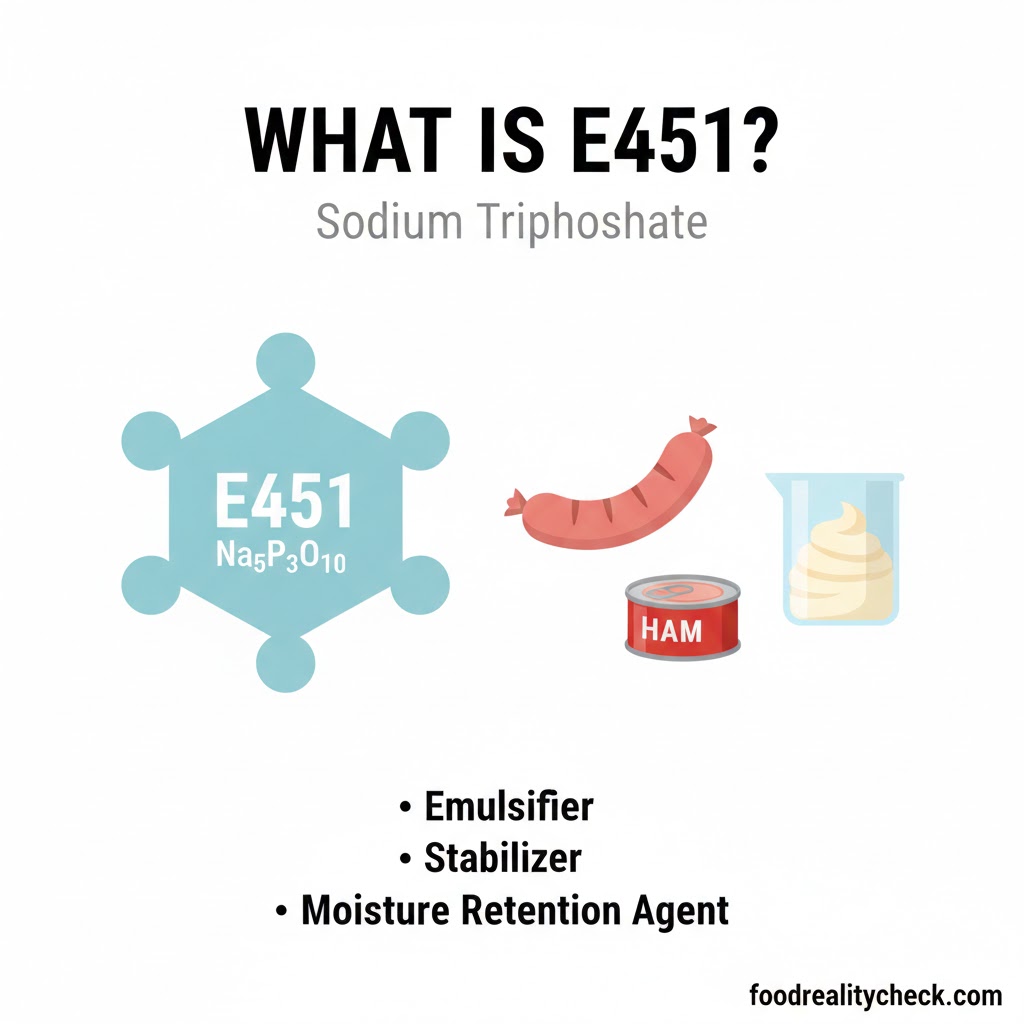
What is E451 (Sodium Tripolyphosphate)?
Complete guide to this water-retaining preservative with emerging cardiovascular and kidney health concerns
The Quick Answer
E451 is sodium tripolyphosphate (STPP)—a synthetic polyphosphate sequestrant used primarily to retain water in fish and meat products, improving texture, appearance, and weight. It’s created by synthesizing phosphoric acid with sodium compounds and exists in two forms: E451(i) sodium tripolyphosphate and E451(ii) potassium tripolyphosphate.
While regulatory authorities approve E451 as “generally recognized as safe,” emerging research identifies potential health risks, particularly for cardiovascular and kidney health. Unlike innocent water loss prevention, phosphate additives like E451 accumulate in processed foods at levels significantly higher than natural phosphate in whole foods, creating a health concern that regulators are only now beginning to address.
Recent research shows that high dietary phosphate intake—driven by widespread use of phosphate additives in processed foods—is associated with increased cardiovascular mortality, accelerated aging, and kidney damage, particularly in vulnerable populations.
📌 Quick Facts
- Category: Sequestrant, preservative, emulsifier, water-retaining agent, texturizer
- Source: Synthetic polyphosphate created from phosphoric acid and sodium compounds
- Found in: Frozen seafood/fish, processed meats, cured meats, pet foods, sauces, soups, dairy products
- Safety Status: FDA GRAS approved, but with emerging health concerns identified in recent research
- Chemical Forms: E451(i) Sodium tripolyphosphate; E451(ii) Potassium tripolyphosphate
- Controversy Level: MODERATE-HIGH—emerging cardiovascular and kidney health concerns; consumer fraud concerns
- Key Concern: Added phosphate is almost completely absorbed (unlike natural phosphate); accumulates in processed foods at problematic levels
- Sodium Content: ~31% sodium; contributes significantly to dietary sodium intake
What Exactly Is Sodium Tripolyphosphate?
Sodium tripolyphosphate (STPP) is a synthetic polyphosphate salt created by joining three phosphate units together and neutralizing with sodium. It’s a white crystalline powder with strong water-binding properties.
Chemical composition: Pentasodium tripolyphosphate has the chemical formula Na₅P₃O₁₀. The structure consists of three linked phosphate groups bonded to five sodium atoms. Food-grade STPP exists in two forms:
• E451(i) – STPP Anhydrous: Na₅P₃O₁₀; no water molecules
• E451(i) – STPP Hexahydrate: Na₅P₃O₁₀·6H₂O; six water molecules (more common in food)
In simple terms: It’s a mineral salt that acts like a sponge, absorbing and holding water in foods. When fish or meat is soaked in STPP solution before freezing, the protein structure absorbs water, making the thawed product appear plumper, juicier, and heavier than it actually is.
Key properties:
• Powerful water retention: Binds and holds water within protein structures
• Chelating agent: Binds metal ions (iron, calcium, magnesium), preventing discoloration and rancidity
• pH buffer: Creates slightly alkaline environment (pH 9.1-10.2) that stabilizes food
• Emulsifier: Helps mix oil and water phases in processed products
• Highly soluble: Dissolves readily in water for easy application to foods
• Completely absorbed: Unlike natural phosphate in foods (often bound as phosphate esters), synthetic phosphate additives are almost 100% absorbed in the digestive system
⚠️ Critical Distinction: Added vs Natural Phosphate
This is crucial for understanding E451’s health impact:
• Natural phosphate in food: Primarily exists as phosphate esters (bound forms) that are only partially absorbed (50-70%)
• E451 phosphate additive: Inorganic polyphosphate that is nearly 100% absorbed
This means 1 gram of E451 increases your phosphate absorption far more than 1 gram of phosphate from chicken or vegetables. This distinction is central to why phosphate additives pose health risks that natural phosphate doesn’t.
Where You’ll Find E451
Sodium tripolyphosphate appears primarily in water-sensitive foods:
• Frozen fish fillets and seafood
• Frozen shrimp and scallops
• Processed meats and sausages
• Cured meats (ham, bacon)
• Pet foods (cat and dog food)
• Processed cheese products
• Instant noodles and ramen
• Canned seafood
• Soups and broth products
• Sauces and gravies
• Canned vegetables
• Dairy desserts
• Steamed fish products
Most prevalence: Frozen seafood—particularly fish fillets, shrimp, and scallops—which use E451 most heavily for water retention.
How Is Sodium Tripolyphosphate Produced?
STPP production is a high-temperature chemical synthesis process:
Step 1: Starting Materials
Phosphoric acid (H₃PO₄) is neutralized with sodium compounds (sodium hydroxide, sodium carbonate, or soda ash).
Step 2: Initial Reaction
The neutralization creates a mixture of monosodium phosphate (NaH₂PO₄) and disodium phosphate (Na₂HPO₄):
Phosphoric acid + Sodium compounds → Monosodium phosphate + Disodium phosphate + Water
Step 3: High-Temperature Condensation
The mixture is heated to 500-550°C (932-1022°F). At this temperature, the phosphate units condense and polymerize, joining together:
NaH₂PO₄ + 2 Na₂HPO₄ → Na₅P₃O₁₀ (sodium tripolyphosphate) + 2 H₂O
Step 4: Cooling & Crystallization
The molten product is cooled, allowing it to crystallize into solid form.
Step 5: Grinding & Milling
The solid product is ground into powder or granules of the desired particle size.
Step 6: For Food-Grade Hydration
For food-grade hexahydrate form (more common), water is added under controlled conditions to create crystals with six water molecules per molecule of STPP.
Step 7: Quality Control & Purification
Tested for purity, phosphate content, sodium levels, and microbiological safety before food approval.
Functions of E451 in Food
E451 serves multiple critical functions, primarily in seafood and meat products:
As a water-retaining agent (primary function): The most important use. STPP binds water within protein structures. Fish soaked in STPP solution absorbs water, increasing weight by 10-25% before freezing. Upon thawing, this water is retained rather than being lost as purge—making the product appear plumper and more “fresh.”
As a sequestrant: Binds metal ions (iron, copper, calcium, magnesium) that would otherwise cause oxidation, discoloration, and rancidity. Critical in preventing “frozen burn” and color degradation in seafood.
As a preservative: The alkaline pH and chelating properties inhibit microbial growth and extend shelf life.
As an emulsifier and stabilizer: In processed meats and sauces, helps maintain texture and prevents separation.
As a pH buffer: Maintains stability in products where pH changes could affect safety or quality.
Is E451 Safe? The Regulatory vs Research Disconnect
This is where the story becomes complex: E451 is approved as safe, but emerging research identifies potential health risks that regulators are slow to acknowledge.
Regulatory Approvals:
• FDA: GRAS (Generally Recognized As Safe); approved as a food additive preservative and sequestrant
• EFSA: Approved as E451; maximum use level 50 mg/kg in certain products
• JECFA (WHO/FAO): ADI up to 70 mg/kg bodyweight for all phosphate additives combined
However, emerging research (2012-present) identifies serious cardiovascular and metabolic concerns:
A landmark 2012 study in Deutsches Ärzteblatt International reviewed phosphate additive health risks and concluded:
• Cardiovascular mortality: High-normal serum phosphate concentrations are independent predictors of cardiovascular events and death in the general population
• Kidney disease acceleration: In advanced chronic kidney disease (CKD stage 5), 12% of deaths are attributable to elevated phosphate levels
• Vascular calcification: Phosphate causes endothelial dysfunction and vascular calcification
• Aging acceleration: Phosphate additives accelerate age-related organ complications in animal models (muscle atrophy, skin aging, kidney failure progression)
• 100% absorption: Added phosphate is almost completely absorbed, unlike natural phosphate which is often bound and partially absorbed
⚠️ Critical Health Concern: Phosphate Accumulation
The core problem with E451 and other phosphate additives:
Processing and fast foods contain extraordinarily high levels of phosphate additives. A single meal of processed foods can contain more phosphate additives than your body needs in a day. Over time, this accumulates:
• Elevated blood phosphate (hyperphosphatemia): Associated with cardiovascular mortality
• Vascular damage: Phosphate causes inflammation and calcification in blood vessels
• Kidney damage: Elevated phosphate strains kidney function
• Hormonal disruption: Phosphate dysregulates fibroblast growth factor 23 (FGF23), causing systemic metabolic problems
• Premature aging: High phosphate intake accelerates aging processes
The 2012 study concluded: “Phosphate added to human food probably has similar effects in man” as observed in animal studies.
Health Effects & Side Effects
Short-term effects from food consumption (rare at typical levels):
• Nausea and vomiting (from high doses)
• Diarrhea (osmotic laxative effect)
• Abdominal cramping and pain
• Dizziness or headache
• Irregular heartbeat (from electrolyte imbalances with high intakes)
Potential long-term effects (from chronic consumption of phosphate-enriched processed foods):
• Elevated blood phosphate (hyperphosphatemia)
• Cardiovascular disease and vascular calcification
• Kidney function decline
• Accelerated aging and age-related diseases
• Bone health effects (phosphate-calcium balance disruption)
• Muscle weakness and atrophy
• Increased mortality risk
High-risk populations (from research findings):
• People with existing cardiovascular disease
• Those with chronic kidney disease (CKD stage 3-5)
• Elderly individuals (accelerated aging effects)
• Those consuming heavily processed diets
E451 & Consumer Fraud Concerns
Beyond health concerns, E451 raises ethical issues:
Water weight deception: When fish or shrimp is soaked in STPP solution, it absorbs 10-25% additional water by weight. Upon thawing, this water should drain away, but STPP’s binding keeps it in the product. Consumers essentially pay for water at the price of seafood. A product labeled “shrimp” might be 20% water artificially retained.
Quality masking: STPP prevents the discoloration, drying, and quality degradation that would naturally occur during freezing and storage. This masks the true age and quality of the product, preventing consumers from assessing freshness.
Regulatory inconsistency: Many countries limit or restrict E451 use specifically because of these concerns, yet it remains widely used in major food markets.
Who Should Avoid or Minimize E451?
Definitely reduce or avoid E451-containing foods if you have:
• Chronic kidney disease (CKD): Any stage; phosphate restriction is medically critical
• Cardiovascular disease: Emerging evidence shows phosphate additives increase mortality risk
• Hypertension: Associated with phosphate and sodium overload from processed foods
• Elevated blood phosphate (hyperphosphatemia): Already a documented risk factor
• History of kidney stones: High phosphate intake increases recurrence risk
• Bone health concerns: Phosphate-calcium balance is critical for bone metabolism
• Anyone over 65: Aging acceleration effects from high phosphate intake
General recommendation for everyone: Minimize consumption of heavily processed foods (which contain E451 and other phosphate additives). Choose whole foods—fresh fish instead of frozen fish with E451, fresh meat instead of processed meats, fresh vegetables instead of canned vegetables with phosphate additives.
The Bottom Line
E451 (sodium tripolyphosphate) is approved as safe by regulatory authorities but poses emerging health risks that exceed traditional food safety assessments. The disconnect between regulatory approval and research findings is significant.
Key takeaways:
• Regulatory approval but research concerns: FDA GRAS approved, but recent research identifies cardiovascular and kidney risks
• Complete absorption issue: Unlike natural phosphate, E451 is almost 100% absorbed, accumulating at problematic levels
• Cardiovascular mortality risk: Studies show high dietary phosphate intake increases death risk, particularly in CVD patients
• Kidney damage: High phosphate accelerates kidney failure and is specifically restricted in CKD management
• Aging acceleration: Animal studies show phosphate additives speed age-related organ damage
• Consumer fraud aspect: Water retention creates artificial weight increase, essentially selling water as seafood
• Synthetic product: Created at high temperature from phosphoric acid; not a natural or traditional ingredient
• Sodium content: Contributes ~31% sodium; adds significantly to dietary sodium intake
Practical recommendation: While E451 is technically “safe” at regulatory limits, the emerging research on phosphate additives’ cardiovascular and kidney effects warrants caution, particularly for those with existing health conditions. The most practical approach is avoiding processed foods containing E451 by choosing fresh fish, fresh meat, and whole foods instead. If you have cardiovascular disease or kidney disease, actively avoid E451-containing products. For the general population, reducing processed food consumption benefits health in multiple ways beyond just phosphate reduction.