What is E461?
Complete guide to understanding methyl cellulose in your food
The Quick Answer
E461 is methyl cellulose, a plant-based thickener and stabilizer derived from cellulose.
It’s used to improve texture, prevent separation, and act as dietary fiber in cheese, baked goods, processed foods, and table-top sweeteners.
Most people who eat processed foods or consume dietary supplements regularly encounter trace amounts of it.
📌 Quick Facts
- Category: Thickener, Stabilizer & Dietary Fiber
- Found in: Cheese, baked goods, table-top sweeteners, processed foods
- Safety: FDA-approved (GRAS), EFSA-approved, no ADI needed
- Approved by: FDA, EFSA, JECFA
- Key Fact: Water-insoluble, plant-based cellulose derivative
What Exactly Is E461?
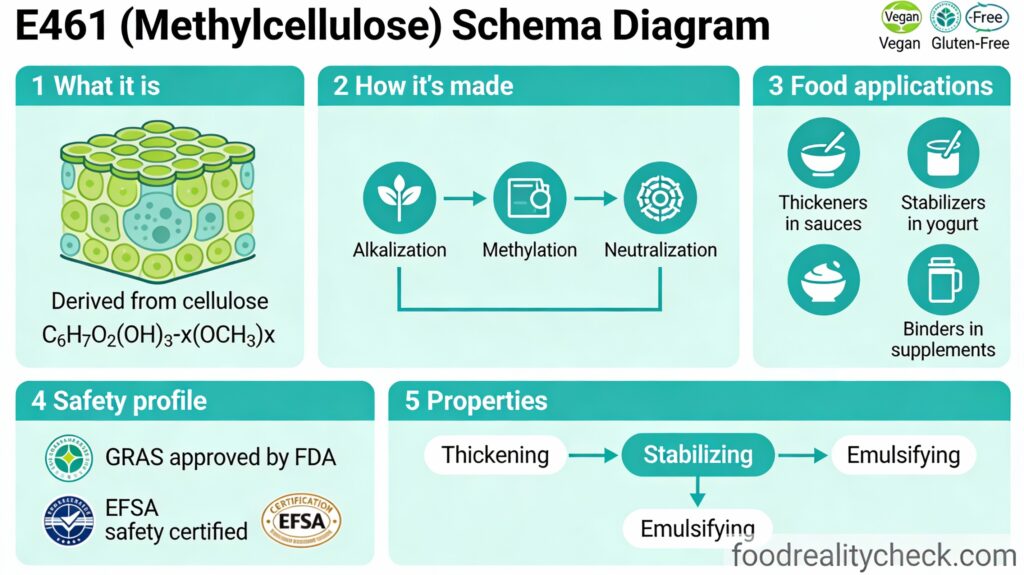
E461 is methyl cellulose, a plant-derived thickener and stabilizer created from cellulose—the main structural component of plant cell walls.
More specifically, cellulose from plant materials (wood chips or plant fibers) is chemically modified by attaching methoxyl groups (-OCH₃) through chemical methylation. This semisynthetic process creates a water-insoluble compound with unique properties useful in food production.
E461 appears as a white or off-white granular powder that is virtually odorless and tasteless. A key property distinguishing it from some other cellulose derivatives is that it’s insoluble in water.
In technical terms, it’s a nonionic polymer that thickens liquids, stabilizes emulsions, binds ingredients, and functions as dietary fiber. Unlike water-soluble celluloses, its insoluble property makes it particularly useful for certain applications.
Where You’ll Find E461
E461 appears in numerous processed foods requiring thickening or binding:
– Table-top sweeteners (tablets and powders)
– Sliced cheese and grated cheese
– Bread and bakery products
– Meat and sausages
– Pasta and pasta products
– Dairy products
– Frozen products
– Sweets and confectionery
– Sauces
– Various processed foods
If you eat processed cheese, baked goods, or use powdered sweeteners, you’ve likely consumed E461. It’s particularly common in cheese applications where its binding properties are valuable.
💡 Pro Tip: Look for “Methyl cellulose,” “Methylcellulose,” or “E461” on ingredient lists. It’s especially common in grated and sliced cheese products where it acts as a binder and prevents clumping.
How E461 Works in Food
E461 serves multiple critical functions in food production.
As a thickener: E461 increases the viscosity of liquids, giving them desired texture and mouthfeel. It’s the primary function in most applications.
As an emulsifier/stabilizer: E461 prevents separation of oil and water phases in complex mixtures, maintaining consistency in sauces and processed foods.
As a binder and filler: E461 binds ingredients together and provides bulk. In cheese, it prevents caking and clumping. In other products, it provides structure.
As dietary fiber: Unlike absorbed food additives, E461 acts like soluble fiber. It’s not absorbed in the small intestine but passes to the large intestine where it can be fermented by gut bacteria, promoting beneficial bacterial growth.
Why Do Food Companies Use E461?
E461 solves specific technical problems that manufacturers face.
In cheese, it prevents clumping and caking, particularly in pre-shredded products. In baked goods, it improves texture and moisture retention. In processed foods, it stabilizes mixtures that would otherwise separate.
E461 also serves a dual purpose—it’s both a functional additive and a source of dietary fiber, which appeals to health-conscious consumers and manufacturers.
Is It Safe?
Regulatory authorities confirm E461 is safe for food use.
The FDA classified methyl cellulose as “Generally Recognized As Safe” (GRAS) for use as an emulsifier, stabilizer, and thickener. The EFSA conducted a comprehensive re-evaluation in 2017-2018 and concluded there is “no need for a numerical ADI” and “no safety concern at reported uses and use levels.”
JECFA set the ADI as “not specified”—indicating no numerical limit is needed because safety is assured.
✓ Safety Confirmed: The EFSA’s 2017-2018 re-evaluation confirmed no safety concern for E461. No numerical ADI is needed, indicating exceptional safety. Actual exposure at approved use levels is far below any threshold for concern.
The EFSA’s 2017-2018 Comprehensive Safety Re-evaluation
The European Food Safety Authority’s thorough 2017-2018 re-evaluation of all cellulose derivatives provides authoritative reassurance.
Key findings:
– No numerical ADI needed for E461—indicating exceptional safety
– No safety concern at reported uses and use levels
– No carcinogenic properties detected
– No reproductive or developmental effects at doses greater than 1,000 mg/kg
– Combined cellulose exposure at 95th percentile: up to 506 mg/kg bw per day
The 2017-2018 EFSA Panel concluded that safety is assured at all approved use levels.
Understanding Recent Research
Important context about recent observational studies:
In 2023, a large BMJ study examined emulsifier intake and cardiovascular disease risk. The study found associations between higher intake of celluloses as a group (E460-E468) and CVD risk. Specifically, E460 (microcrystalline cellulose) and E466 (sodium carboxymethyl cellulose) had identifiable risk associations.
Critical point about E461: E461 was NOT specifically identified with risk associations in this study. While celluloses as a group showed an association, only specific celluloses (E460 and E466) had identifiable risk relationships.
Important limitations: This was an observational study, not definitive proof. Observational studies cannot establish causation—only correlation. Many confounding factors could explain any associations.
Absorption and Metabolism—Key Property
E461 is not absorbed from the small intestine—it functions like dietary fiber.
E461 passes through to the large intestine where it can be fermented by gut bacteria. This fermentation process promotes the growth of beneficial bacteria and generally contributes to gut health. For this reason, some regard E461 as a source of beneficial soluble fiber.
Potential Side Effects
At normal food use levels, no adverse effects are documented.
E461 is generally well-tolerated. Like other dietary fibers, consuming large amounts (particularly when first introducing it to the diet) might cause mild gastrointestinal discomfort including bloating, gas, or diarrhea. These effects are usually temporary and mild.
Allergic reactions are extremely rare. Very high doses might theoretically affect mineral absorption, but this is not a concern at normal dietary intake.
Plant-Based and Dietary Attributes
E461 is entirely plant-based with excellent dietary compatibility:
– Vegan ✓
– Vegetarian ✓
– Gluten-free ✓
– Kosher pareve ✓
– Plant-based ✓
– Suitable for all religious groups ✓
E461 is derived from cellulose sourced from plant materials (wood chips and plant fibers), making it suitable for all dietary preferences.
Manufacturing Process
E461 is manufactured through controlled chemical synthesis using plant-derived cellulose.
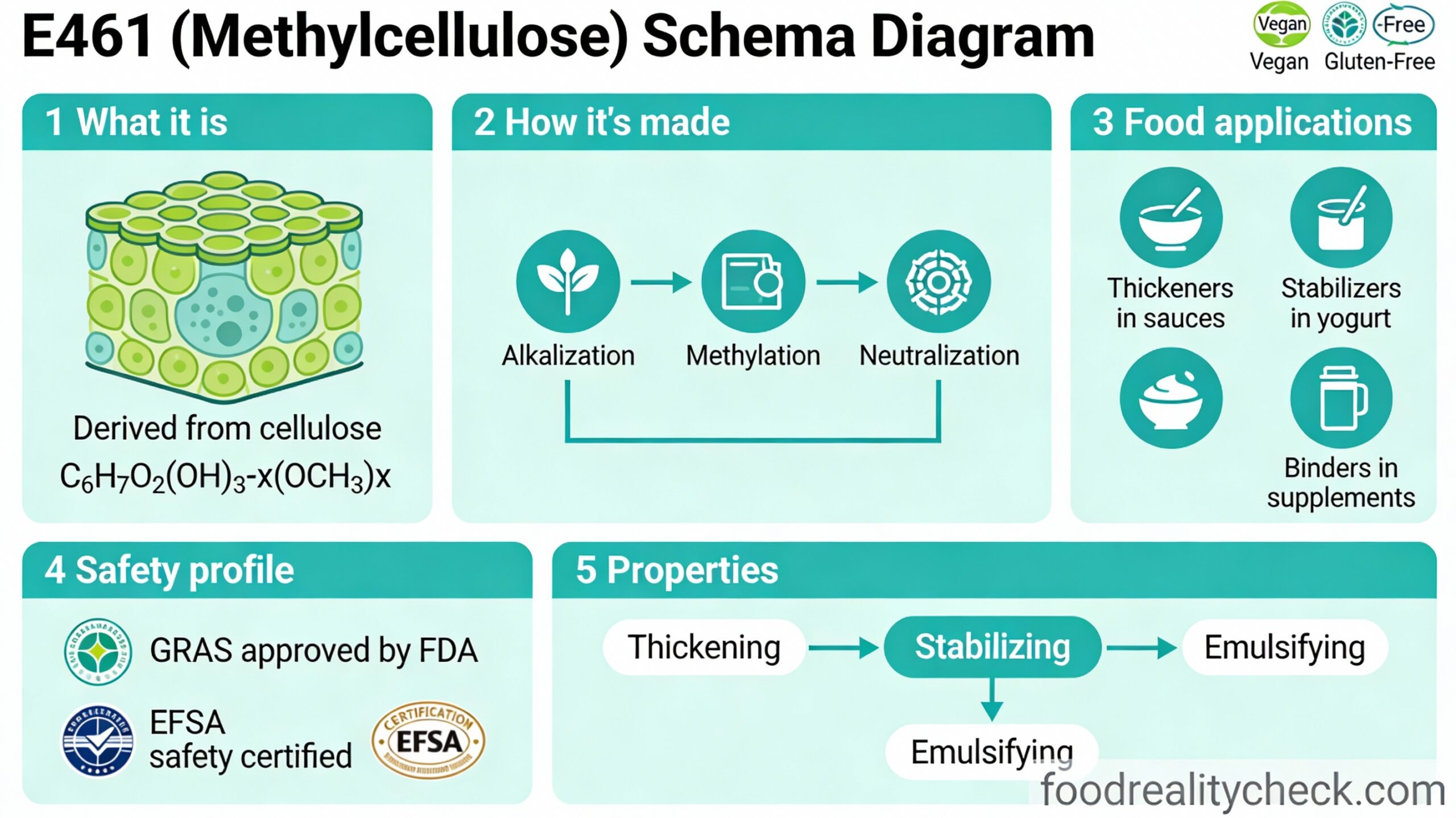
Step 1 – Alkalinization: Cellulose is treated with sodium hydroxide (NaOH), which prepares it for chemical modification.
Step 2 – Methylation: The alkalinized cellulose is treated with alcohol (methanol or dimethyl sulfate) to attach methoxyl groups (-OCH₃) to the cellulose molecules.
Food-grade E461 must contain methoxy groups at 27.5-31.5% on a dry-weight basis, ensuring consistent functionality.
Water-Insoluble Property
E461’s water-insoluble property is important to its functionality.
Unlike water-soluble celluloses (E463, E464, E465, E466), E461 does not dissolve in water. This makes it particularly useful for certain applications where the additive needs to maintain structure and stability without dissolving.
Distinction from Similar Additive
Don’t confuse E461 with E464:
– E461 (Methyl cellulose)—NOT water-soluble
– E464 (Hydroxypropyl methyl cellulose)—Water-soluble and more soluble than E461
These are different products with different properties and applications.
Comparison with Other Cellulose Additives
E461 is one of nine cellulose additives with different properties:
– E460: Microcrystalline cellulose (linked to CVD in 2023 study)
– E461: Methyl cellulose (this product—water-insoluble) ←
– E462: Ethyl cellulose (water-insoluble)
– E463: Hydroxypropyl cellulose (water-soluble)
– E464: Hydroxypropyl methyl cellulose (water-soluble)
– E465: Ethyl methyl cellulose (water-soluble)
– E466: Sodium carboxymethyl cellulose (water-soluble, restricted for infants)
– E468: Cross-linked sodium carboxymethyl cellulose
– E469: Enzymatically hydrolysed carboxymethyl cellulose
Regulatory Approval Across Regions
E461 approval is nearly universal:
– United States (FDA): GRAS—Generally Recognized As Safe
– European Union (EFSA): Approved food additive (specifically for table-top sweeteners in tablets/powders)
– International (JECFA): FAO/WHO approved
– Australia/New Zealand: Approved with code 461
This universal approval reflects confidence in its safety across different regulatory systems.
The Bottom Line
E461 (methyl cellulose) is a plant-based thickener, stabilizer, and dietary fiber used in cheese, baked goods, table-top sweeteners, and processed foods.
Regulatory authorities worldwide classify it as safe, with the FDA rating it GRAS and the EFSA confirming “no safety concern at reported uses and use levels.”
The EFSA’s 2017-2018 re-evaluation found no numerical ADI is needed—indicating exceptional safety.
At normal food use levels, actual exposure is far below any threshold for concern.
E461 functions as dietary fiber, passing through the small intestine unabsorbed and fermenting in the large intestine to promote beneficial bacterial growth.
E461 was not specifically identified with health risks in recent observational studies—only certain other celluloses (E460 and E466) showed associations.
E461 is entirely plant-based and suitable for vegan, vegetarian, gluten-free, and kosher diets.
Most people consuming processed foods or cheese consume E461 regularly without documented health concerns.
As always, food labels must declare E461 when used, enabling informed consumer choice.