What is E503?
Complete guide to understanding ammonium carbonates in your food
The Quick Answer
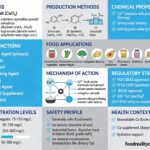
E503 is ammonium carbonates—a mixture of ammonium carbonate and ammonium bicarbonate—used primarily as a leavening agent (raising agent) and acidity regulator in baked goods.
When heated or exposed to moisture, it rapidly decomposes into ammonia, carbon dioxide, and water, which creates the bubbles that make cookies, crackers, and gingerbread light and fluffy.
It’s one of the oldest leavening agents, traditionally called “salt of hartshorn,” and has been used safely in food for over 200 years.
📌 Quick Facts
- Category: Leavening Agent & Acidity Regulator
- Found in: Cookies, crackers, gingerbread, biscuits, flat breads
- Safety: FDA-approved, EFSA-approved at food use levels
- Approved by: FDA, EFSA, JECFA
- Key Fact: Thermally unstable; decomposes when heated to produce leavening gas
What Exactly Is E503?
E503 is ammonium carbonates, which includes two related compounds: ammonium carbonate (i) and ammonium bicarbonate (ii).
Ammonium carbonate ((NH₄)₂CO₃) and ammonium bicarbonate (NH₄HCO₃) are both white crystalline powders with a slight ammoniacal odor. The defining characteristic of both is their thermal instability—when heated or exposed to moisture, they rapidly decompose into ammonia (NH₃), carbon dioxide (CO₂), and water (H₂O).
An important distinction: ammonium bicarbonate (E503(ii)) decomposes faster and more cleanly than ammonium carbonate (E503(i)), releasing more carbon dioxide and less ammonia. This makes E503(ii) the preferred choice for baking applications.
In technical terms, E503 functions as both a leavening agent and an acidity regulator. It’s part of a broader family of carbonate additives that includes E500 (sodium carbonates), E501 (potassium carbonates), and E504 (magnesium carbonates).
Where You’ll Find E503
E503 appears primarily in baked goods and confectionery requiring leavening:
– Cookies and biscuits
– Crackers
– Gingerbread (traditional use)
– Flat breads
– Pastries and cakes
– Confectionery products
– Powdered drink mixes
– Processed cheese and dairy products
– Ice cream and milk desserts
– Cacao and chocolate products
If you eat cookies, crackers, gingerbread, or biscuits, you’ve likely consumed E503. It’s particularly common in European and Scandinavian baking traditions.
💡 Pro Tip: Look for “Ammonium carbonate,” “Ammonium bicarbonate,” “Ammonium carbonates,” “Salt of hartshorn,” “Hornsalt,” or “E503” on ingredient lists. It’s especially common in cookies and gingerbread where its leavening properties are essential.
How E503 Works in Food
E503’s function as a leavening agent depends entirely on its thermal instability.
As a leavening agent: When E503 is added to cookie or gingerbread dough and exposed to heat in the oven, the compound rapidly decomposes. This decomposition produces carbon dioxide gas, which creates thousands of tiny bubbles throughout the dough. These bubbles expand with heat, causing the product to rise and become light and fluffy instead of dense and compact.
Decomposition reaction: NH₄HCO₃ → NH₃ + CO₂ + H₂O. The carbon dioxide is the key—it’s the gas that leavens the product.
Key advantage: Unlike modern baking powder (which requires an acidic component to react), E503 works solely through thermal decomposition. A single compound produces all the leavening needed.
As an acidity regulator: E503 is alkaline, so it neutralizes acids in food systems and helps regulate pH. Ammonium bicarbonate specifically acts as a buffer, regulating pH without significantly changing the overall alkalinity.
Why Do Food Companies Use E503?
E503 is an effective, economical, and time-tested leavening agent.
For flat baked goods like cookies and crackers, E503 has been the preferred choice for centuries. It requires no acidic component to activate (unlike baking powder), making formulation simpler. It’s inexpensive and produces consistent results. Most importantly, it’s been proven safe through more than 200 years of use.
E503(ii) (ammonium bicarbonate) is preferred in baking because it decomposes more cleanly and completely, releasing more CO₂ and less ammonia, and producing a more neutral flavor (baking powder can sometimes impart a metallic taste).
Is It Safe?
Regulatory authorities approve E503 as safe for food use at approved levels.
The FDA approved ammonium carbonates as food additives, specifically noting: “No risks to humans are expected from approved uses. The substance is approved as a food additive by the Food and Drug Administration (FDA) and as an inert pesticide ingredient by EPA, no toxic endpoints have been identified.”
The EFSA has authorized E503 as a food additive under Regulation (EC) No 1333/2008. No Acceptable Daily Intake (ADI) has been determined because the safety margin is so large that no upper limit is necessary.
✓ Safety Confirmed: FDA and EFSA both approve E503 as safe for food use. No toxic endpoints have been identified at approved food-use levels. No ADI determined—indicating exceptional safety. The compound has been used safely in food for over 200 years.
Safety Profile and Side Effects
At food-use levels, E503 is safe with no documented harmful effects.
According to regulatory sources: “So far, there are no known harmful effects of carbonates as raising agents. Carbonates are generally approved for food and without a maximum amount.” At approved food use levels, no adverse health effects occur.
Potential effects at excessive ingestion: Consuming large quantities of pure E503 (far exceeding typical food use) might cause gastrointestinal discomfort (nausea, vomiting, abdominal pain) due to its alkaline nature and ammonia-releasing properties. Inhalation of dust might cause respiratory irritation.
Finished baked goods: Freshly baked goods made with E503 are completely safe. The compound fully decomposes during baking, and most ammonia gas is released during the baking process. Finished products contain only trace residual ammonia.
Thermal Decomposition and Ammonia Release
When E503 is used as intended in baking, decomposition is complete, and ammonia is substantially eliminated.
E503 begins to decompose at temperatures around 60°C. Since baking typically occurs at 160-220°C, complete decomposition happens during the baking process. Most ammonia gas is released into the oven environment or escapes during normal baking.
Finished baked goods contain only trace residual ammonia, not meaningful amounts. This is why freshly baked goods made with E503 may have a slight ammoniacal aroma that completely dissipates as the product cools.
Historical Background—Salt of Hartshorn
E503 (ammonium carbonates) has an exceptionally long and safe history of use in food.
Traditional name: “Salt of hartshorn” (sal volatile) was produced commercially beginning in the 1700s and 1800s. It was obtained by the dry distillation of nitrogenous organic matter such as hair, horn, and leather—hence the name.
Pre-baking powder era: Before modern baking powder was invented, ammonium carbonates were THE standard leavening agent in home and commercial baking. Centuries of widespread use across multiple European cultures provide extensive real-world safety evidence.
Still referenced: Many Scandinavian and Northern European baking cookbooks still refer to it as “hartshorn” or “hornsalt.” Gingerbread is a classic application dating back centuries.
200+ years of documented safe use: The longest track record of any modern food additive.
Manufacturing Process
E503 is manufactured through simple, well-established chemical processes.
Modern method: Carbon dioxide gas is passed into aqueous (water-based) ammonia. The chemical reaction CO₂ + NH₃ + H₂O → (NH₄)HCO₃ produces ammonium bicarbonate. The reaction solution is kept cool (around 30°C or below) to promote crystallization of the white solid product.
Alternative method: Produced from ammonium sulphate and calcium carbonate (natural minerals).
Processing: The white crystalline solid is filtered, washed, and dried to produce food-grade ammonium carbonates. Global production is approximately 100,000 tons annually.
Key Difference: E503(i) vs E503(ii)
Although both are ammonium carbonates, the two forms differ in decomposition properties:
– E503(i) – Ammonium carbonate: (NH₄)₂CO₃ – Decomposes more slowly, releases more ammonia
– E503(ii) – Ammonium bicarbonate: NH₄HCO₃ – Decomposes faster and more completely, releases more CO₂ and less ammonia
Practical implication: E503(ii) is preferred for baking because it produces better leavening action, cleaner decomposition, and more neutral flavor. E503(ii) avoids the metallic taste sometimes associated with baking powder.
Vegan and Dietary Status
E503 is suitable for all dietary preferences:
– Vegan ✓ (fully synthetic chemical, no animal products)
– Vegetarian ✓
– Gluten-free ✓
– Kosher ✓
– Halal ✓
– Organic-approved ✓ (in plant-based foods)
E503 is completely synthetic with no animal-derived components. It’s even permitted in organic foods, specifically in cereal products, confectionery, cakes, and biscuits of plant origin.
Comparison with Related Additives
E503 is part of a broader family of carbonate leavening and acidity-regulating agents:
– E500: Sodium carbonates (sodium carbonate, sodium bicarbonate)
– E501: Potassium carbonates (potassium carbonate, potassium bicarbonate)
– E502/E503: Ammonium carbonates ← This product (note: E502 and E503 are often used interchangeably)
– E504: Magnesium carbonates
All function similarly as acidity regulators and leavening agents. E503’s ammonia-releasing property makes it particularly effective for certain applications like gingerbread and traditional baking.
Regulatory Approval Across Regions
E503 approval is nearly universal:
– United States (FDA): Approved as food additive
– European Union (EFSA): Authorized per Regulation (EC) No 1333/2008
– International (JECFA): FAO/WHO approved
– Organic certifications: Permitted in organic foods of plant origin
This universal approval reflects confidence in its safety across different regulatory systems.
Environmental Considerations
E503 is environmentally benign:
– Biodegradability: Readily decomposes into ammonia and carbon dioxide, both naturally occurring substances
– Soil persistence: No adsorption expected; unlikely to persist in environment
– Bioaccumulation: No bioaccumulation
– Environmental impact: Low at food-use concentrations
The Bottom Line
E503 (ammonium carbonates) is a traditional, effective, and safe leavening agent used primarily in cookies, crackers, gingerbread, and flat breads.
It works through thermal decomposition, releasing carbon dioxide gas that creates the light, fluffy texture characteristic of these products.
Regulatory authorities (FDA, EFSA, JECFA) approve E503 as safe for food use. No toxic endpoints have been identified at food-use levels.
E503 has been safely used in food for over 200 years—longer than almost any other modern food additive—providing extensive real-world safety evidence.
No Acceptable Daily Intake (ADI) was determined because the safety margin is so large.
At approved food-use levels, no adverse health effects are documented.
E503(ii) (ammonium bicarbonate) is preferred in baking because it decomposes more completely, producing better leavening and more neutral flavor than alternatives.
E503 is suitable for all dietary preferences (vegan, vegetarian, gluten-free, kosher, halal, organic) as it’s purely synthetic with no animal-derived components.
Most people eating cookies, crackers, gingerbread, or biscuits consume E503 regularly without any documented health concerns.
As always, food labels must declare E503 when used, enabling informed consumer choice.