What is E551?
Complete guide to understanding E551 (Silicon Dioxide/Silica) in your food
The Quick Answer
E551 is a synthetic amorphous silicon dioxide (silica) anti-caking agent that prevents powders from clumping.
It’s used in table salt, powdered milk, spices, flour mixes, and other powdered foods.
It contains nanoparticles but in October 2024, EFSA conclusively determined it is safe for all population groups, including infants under 16 weeks, with no safety concerns at approved use levels—though some ongoing research questions remain about nano-specific effects.
📌 Quick Facts
- Category: Inorganic anti-caking agent (synthetic amorphous silica)
- Chemical Name: Silicon dioxide or synthetic amorphous silica (SAS)
- Chemical Formula: SiO₂
- Form: Nano-structured synthetic amorphous silica (particles 2–28 nm, aggregated into larger structures)
- Found in: Table salt, powdered milk, spices, flour, baking powder, instant foods, powdered supplements
- Safety Status: FDA GRAS; EU approved; EFSA October 2024 conclusive re-evaluation: NO SAFETY CONCERN for all populations including infants <16 weeks
- Key Concern Addressed: Nanoparticle composition; EFSA confirmed aggregates (not isolated nanoparticles) act as anti-caking agent; no nano-specific safety concerns at approved levels
What Exactly Is It?
E551 is synthetic amorphous silicon dioxide (silica) produced industrially through high-temperature chemical processes.
Its chemical formula is SiO₂ (identical to natural silica).
E551 consists of nano-sized particles (mostly 2–28 nanometers) that clump together into larger aggregates and agglomerates in the micrometer range. The aggregates—not the isolated nanoparticles—function as the anti-caking agent.
Two primary manufacturing methods produce E551:
• Fumed (pyrogenic) silica: Produced by heating chlorosilanes (silicon tetrachloride) at very high temperature (~1,000°C)
• Precipitated silica: Produced through wet chemical synthesis (sodium silicate + acid precipitation)
E551 is identical in chemical composition to natural amorphous silica found in plants, but food-grade E551 achieves much higher purity and consistent quality through industrial synthesis.
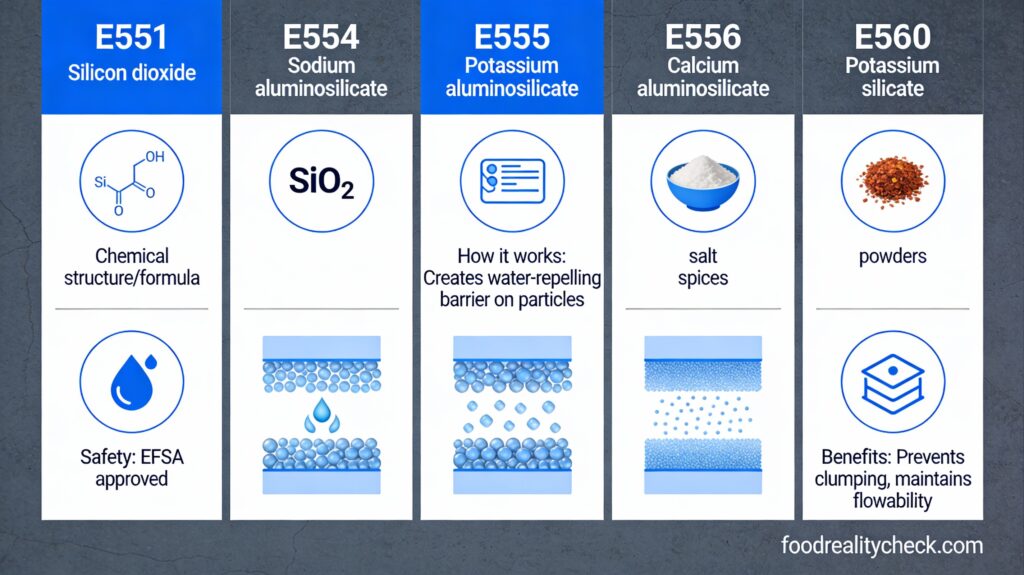
Mechanism: E551 particles absorb excess moisture (water) and oils, preventing crystal bridging and particle aggregation that causes caking. The particles also coat food powder surfaces, reducing interparticle interactions.
Where You’ll Find It
E551 appears in many powdered and granulated foods:
• Table salt and sea salt
• Powdered milk and milk replacer
• Spices and seasonings
• Flour and baking mixes
• Baking powder
• Instant beverages (coffee, cocoa, tea)
• Powdered sugar and icing sugar
• Dried food powders
• Powdered supplements and vitamins
• Instant soup and broth powders
• Food colorings
• Dry baby food and formula (permitted in infant foods)
E551 is extremely common in powdered food products globally.
Why Do Food Companies Use It?
E551 serves critical preservation functions:
Prevents caking and maintains flowability: Powders absorb moisture, causing caking. E551 absorbs moisture and oils, maintaining free-flowing consistency for months or years.
Highly effective: Small quantities (0.5–2% by weight) provide significant anti-caking benefit.
Cost-effective: Inexpensive manufacturing and high efficacy make it economical.
Heat and pH stable: Resists degradation across wide temperature and pH ranges.
Regulatory approval: Globally approved and widely used for decades, reducing manufacturer liability concerns.
Is It Safe?
Yes—EFSA’s October 2024 comprehensive re-evaluation conclusively determined E551 is safe for all population groups, including infants under 16 weeks, with no safety concerns at approved use levels.
The FDA classifies silicon dioxide as GRAS (Generally Recognized as Safe).
The EFSA’s 2018 re-evaluation found the data insufficient to establish traditional ADI; the 2024 follow-up completed the assessment with manufacturer-provided characterization data and concluded no safety concern exists.
✓ EFSA OCTOBER 2024 CONCLUSIVE RE-EVALUATION – KEY FINDINGS:
Overall Safety Conclusion: “E 551 does not raise a safety concern in all population groups at the reported uses and use levels.”
Infant Safety (New in 2024): “The use of E 551 in food for infants below 16 weeks of age does not raise a safety concern at the current exposure levels.”
Nano-Specific Assessment: EFSA applied nano-specific risk assessment using 2021 Guidance. Finding: No nano-specific safety concerns identified at approved use levels. Margin of Safety (MOE) approach confirmed all population groups have MOE >36 (protective threshold).
What’s in E551: Synthetic amorphous silica (SAS) without crystalline structure; nano-sized particles (2–28 nm) clumped into larger aggregates; aggregates (not isolated nanoparticles) act as anti-caking agent.
Absorption: Systemic bioavailability very low; silicon dioxide poorly absorbed through GI tract; no accumulation in body tissues.
No Genotoxicity: No DNA damage identified; no carcinogenicity concerns.
What Are The Health Concerns?
E551 has no identified safety concerns at approved food use levels based on EFSA’s October 2024 comprehensive re-evaluation. However, some ongoing research questions and uncertainties remain:
Nanoparticle composition (ADDRESSED BY EFSA 2024): E551 contains nano-sized particles aggregated into larger structures. EFSA explicitly confirmed that it is the aggregates—not isolated nanoparticles—that function as anti-caking agent. No isolated nanoparticles are found in commercial E551 products. Nano-specific risk assessment performed; no safety concerns identified.
Minimal absorption (CONFIRMED SAFE): Silicon dioxide is poorly absorbed through the gastrointestinal tract. Systemic bioavailability is very low; does not accumulate in body tissues.
Uncertainty in toxicological database (ACKNOWLEDGED BY EFSA): EFSA explicitly noted limited toxicological studies specifically examining nano-sized aggregates/agglomerates. However, despite this uncertainty, EFSA concluded no safety concern at approved use levels based on available evidence.
Potential surface carry of genotoxic agents (RESEARCH QUESTION): Some independent research suggests silica nanoparticles might carry genotoxic agents on their surface. However, EFSA found no genotoxicity or carcinogenicity in approved food-use products and concluded no safety concern.
Celiac disease predisposition (RESEARCH QUESTION): A 2024 mouse model study suggested E551 might predispose to celiac disease. EFSA explicitly noted “effects in predisposing to food allergy and autoimmune-mediated coeliac diseases deserves further investigation, particularly in humans.” This remains a research area requiring human data.
Impurities (MANAGED): Lead, mercury, aluminum, and arsenic can be present in E551 as impurities from manufacturing. EFSA specifications require limits on these impurities; levels in approved products are safe.
Vitamin C degradation (GENERAL ANTI-CAKING CONCERN): Some studies suggest anti-caking agents may slightly reduce vitamin C stability in fortified foods. This is a general concern for the class, not specific to E551, with minimal practical impact.
Natural vs Synthetic Version
E551 is synthetic but identical in composition to natural amorphous silica.
It’s produced through industrial synthesis (fumed or precipitated methods) rather than extraction from natural sources. However, E551 has identical SiO₂ chemical composition and structure to naturally occurring amorphous silica in plants—just with higher purity and consistency.
Natural Alternatives
Want to avoid E551?
Natural anti-caking agents include:
• Calcium carbonate (E170) – natural mineral
• Magnesium carbonate (E504) – natural mineral
• Talc (E553b) – natural mineral (though controversial)
• Bentonite (E558) – natural clay
• Kaolin (E559) – natural clay mineral
• Diatom earth – natural silica powder (also contains silicon dioxide)
• No anti-caking agent – accept potential clumping
Natural alternatives are less effective and more expensive, which is why E551 remains widely used globally.
The Bottom Line
E551 (Silicon Dioxide/Silica) is a synthetic amorphous silica anti-caking agent that EFSA’s October 2024 comprehensive re-evaluation conclusively determined is safe for all population groups, including infants under 16 weeks, with no safety concerns at approved use levels.
Regulatory Confidence: EFSA’s 2024 re-evaluation represents a conclusive safety assessment after addressing previous uncertainties. Nano-specific risk assessment was performed; no nano-specific safety concerns identified.
Nanoparticle Clarification: E551 contains nano-sized particles, but these aggregate into larger structures. No isolated nanoparticles are present in commercial products. It is the aggregates—not isolated nanoparticles—that provide anti-caking function.
Infant Safety (New in 2024): EFSA explicitly confirmed safe use in infant foods (< 16 weeks old), addressing previous uncertainty. Current exposure levels do not raise safety concern.
Absorption and Accumulation: Silicon dioxide is poorly absorbed; does not accumulate in body tissues; minimal systemic bioavailability.
Ongoing Research Questions: EFSA acknowledged that some research areas deserve further investigation (celiac disease predisposition, specific nano-aggregate toxicology). However, existing evidence supports safety at approved use levels.
Compared to Alternatives: E551 is more effective than natural alternatives and is less expensive, making it the dominant global anti-caking agent.
Recommendation: Based on EFSA’s October 2024 conclusive re-evaluation, E551 can be considered a safe food additive at approved use levels for all populations. However, if you prefer natural alternatives (calcium carbonate, magnesium carbonate) for personal reasons unrelated to safety, those options exist but are less effective and more expensive.
Hey very interesting blog!