What is E554?
Complete guide to understanding E554 (Sodium Aluminosilicate) – an approved anti-caking agent with incomplete safety assessment and aluminum concerns
The Quick Answer
E554 (Sodium Aluminosilicate) is an anti-caking agent approved in the EU but with incomplete safety assessment and potential aluminum exposure concerns that exceed tolerable intake levels.
What makes E554 unique and concerning: Unlike most approved food additives where EFSA has completed a comprehensive safety assessment, E554 is different. Despite being officially approved, EFSA’s 2020 re-evaluation explicitly concluded that the safety of E554 “could not be assessed” due to insufficient toxicological data and inadequate characterization. More concerning, EFSA calculated that exposure to aluminum from E554, particularly from food supplement use, may exceed the tolerable weekly intake established for aluminum from all sources. E554 demonstrates a regulatory gap where an approved additive lacks adequate safety evidence and may pose aluminum exposure concerns.
E554 is officially approved but with critical safety assessment gaps and aluminum concerns.
📌 Quick Facts
- Chemical Name: Sodium Aluminosilicate; Sodium Silicoaluminate
- Type: Anti-caking agent; food additive; inorganic compound
- Chemical formula: Variable composition; typical: Na₂Al₂Si₁₄O₃₂·3H₂O
- Found in: Salt, spices, instant foods, food supplements (most common)
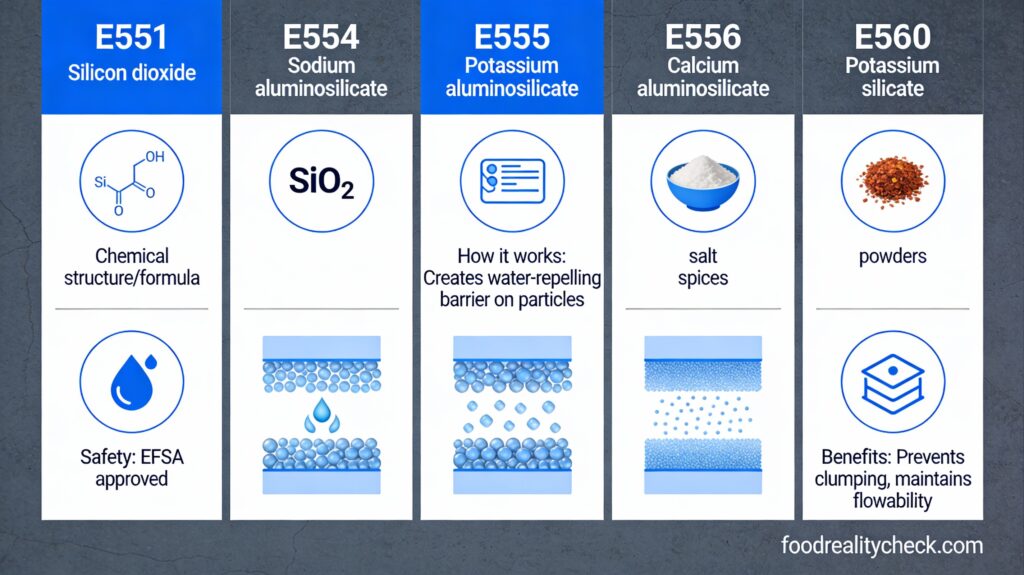
- Primary function: Prevents caking; keeps powders free-flowing
- EU Status: Officially approved BUT safety could NOT be assessed (EFSA 2020)
- FDA Status: GRAS (Generally Recognized As Safe)
- CRITICAL FINDING: Aluminum exposure may exceed tolerable intake (especially supplements)
- Key concern: Aluminum content; insufficient safety data
- Regulatory gap: Approved without complete safety assessment
What Exactly Is It?
E554 is sodium aluminosilicate, a white powder used to prevent caking in foods — 100% synthetic, manufactured from sodium, aluminum and silicon compounds.
Chemical composition: Na₂Al₂Si₁₄O₃₂·3H₂O (typical; variable stoichiometry)
Appearance: White powder; odorless
Key properties:
- Anti-caking: absorbs moisture; prevents crystalline fusion
- High hygroscopicity: excellent water absorption capacity
- Aluminum-containing: significant aluminum component
- Amorphous structure: non-crystalline composition
- Hydrophobic: makes particles water-repellent
- Heat stable: survives food processing
- Carrier agent: facilitates distribution of other substances
- Water-insoluble: doesn’t dissolve but may partially degrade
Where You’ll Find E554
E554 is commonly used in powdered and dried foods, with particularly high use in food supplements.
| Product Category | Function | Frequency | Concern Level |
|---|---|---|---|
| Food supplements (PRIMARY) | Anti-caking agent | Very common | HIGHEST aluminum exposure |
| Table salt | Anti-caking agent | Very common | Moderate; dilute exposure |
| Powdered spices and seasonings | Anti-caking; flow agent | Common | Moderate |
| Instant powdered foods | Anti-caking agent | Common | Moderate |
| Powdered cheese and dairy | Anti-caking agent | Common | Moderate |
| Dried egg powder | Anti-caking agent | Limited | Low to moderate |
Key concern: Food supplement use presents the highest aluminum exposure risk due to high permitted levels (quantum satis in many supplement forms) and regular consumption.
The Critical EFSA 2020 Finding
Most important finding: EFSA’s 2020 re-evaluation conclusion on E554 safety.
Official EFSA Panel statement (2020):
“Considering that only very limited toxicological data and insufficient information on the physicochemical characterisation of both food additives were available, the Panel concluded that the safety of sodium aluminium silicate (E 554) could not be assessed“.
What this means in plain language:
Despite E554 being officially approved as a food additive in the EU, EFSA could NOT complete a proper safety assessment. The data is simply insufficient to conclusively determine whether E554 is safe or unsafe.
Specific EFSA Findings on Aluminum Exposure
CRITICAL: Aluminum exposure concerns identified by EFSA.
EFSA calculated aluminum exposure from E554 in food supplements:
- Mean exposure level: 2.9 mg/kg body weight/day (children)
- High exposure level (P95): 3.9 mg/kg body weight/day (children)
- EFSA aluminum TWI (Tolerable Weekly Intake): 1 mg/kg bw/week = 2 mg/kg bw/day maximum
- Conclusion: Calculated exposure EXCEEDS tolerable intake
EFSA explicit statement: “This single use at the maximum permitted level could theoretically far exceed the TWI”.
Why Safety Could Not Be Assessed
Data deficiencies identified by EFSA:
1. Insufficient toxicological data:
- Very limited toxicological studies available
- No adequate chronic toxicity testing
- Inadequate genotoxicity data
- No sufficient carcinogenicity studies
2. Inadequate physicochemical characterization:
- Insufficient characterization of chemical composition
- Poor definition of particle size distribution
- Variable stoichiometry not adequately specified
- Different manufacturing methods not properly characterized
3. Data gaps on bioavailability:
- Limited information on how much aluminum is actually absorbed
- Unclear whether aluminum is released in digestive tract
- Inadequate bioavailability studies in human subjects
Is E554 Safe? The Regulatory Paradox
E554 represents a regulatory paradox: officially approved but safety not assessed.
| Question | Answer | Implication |
|---|---|---|
| Is E554 approved in EU? | YES – officially authorized | Legal to use in food |
| Has EFSA assessed E554 safety? | NO – safety could NOT be assessed | Safety status UNKNOWN |
| Is aluminum exposure concerning? | YES – may exceed tolerable intake | Potential health risk |
| Should consumers avoid E554? | No definitive answer | Individual risk assessment needed |
| Should regulatory action be taken? | Further assessment recommended | Regulatory review warranted |
Aluminum Concerns in Context
E554’s aluminum content places it in the same regulatory concern category as other aluminum additives (E541, E520-E523).
| Aluminum Additive | Regulatory Status | Safety Assessment | Concern Level |
|---|---|---|---|
| E554 (Sodium aluminum silicate) | Approved | Could NOT be assessed | HIGH |
| E541 (Sodium aluminum phosphate) | Approved but RESTRICTED | Assessed; approved | MODERATE-HIGH |
| E520-E523 (Aluminum sulfates) | Approved but LIMITED | Assessed with concerns | MODERATE |
| E551 (Silicon dioxide) | Approved | Recently reassessed; safe | LOW-MODERATE |
Key point: E554’s regulatory status is uniquely problematic because assessment is incomplete (unlike E541 which was assessed) AND aluminum exposure exceeds tolerable intake (unlike E551 which is aluminum-free).
The Bottom Line
E554 is officially approved but represents a significant regulatory gap with incomplete safety assessment and potential aluminum exposure concerns.
For consumers to understand:
- It’s officially approved: E554 is in the EU approved additives list
- But safety assessment is incomplete: EFSA explicitly concluded safety could NOT be assessed
- Aluminum exposure is concerning: Calculated levels may exceed tolerable intake
- Data gaps exist: Insufficient toxicological data and characterization
- No emergency ban: No evidence of acute toxicity, just incomplete assessment
- Higher risk in supplements: Food supplements present highest aluminum exposure