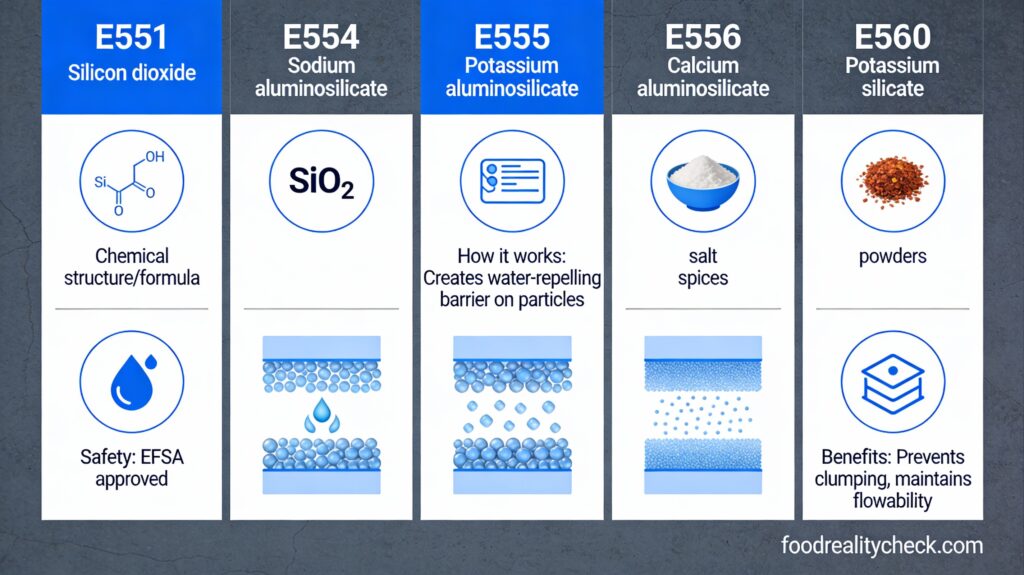
What is E555?
Complete guide to understanding E555 (Potassium Aluminosilicate) — an approved additive with CRITICAL safety assessment gaps and extreme aluminum exposure risks
The Quick Answer
E555 (Potassium Aluminosilicate) is an approved additive used as a carrier for food colorants (and anti-caking agent) with incomplete safety assessment and EXTREME aluminum exposure concerns that exceed tolerable intake by 40-55 times.
What makes E555 uniquely critical and concerning: E555 represents perhaps the most severe regulatory gap in the EU food additive system. Unlike most approved additives where EFSA has completed comprehensive safety assessment, EFSA’s 2020 re-evaluation of E555 concluded the safety “could not be assessed” due to insufficient toxicological data. But more critically, EFSA’s calculation of aluminum exposure from E555’s authorized use (as carrier for colorants at up to 90% relative to pigment) found it could potentially exceed the tolerable weekly intake for aluminum from all sources by 40-55 TIMES. E555 is a textbook example of a regulatory failure: approved without adequate safety evidence, with potential aluminum exposure risks orders of magnitude beyond safe levels.
E555 presents the most severe regulatory concern of all food additives reviewed in this collection.
📌 Quick Facts
- Chemical Name: Potassium Aluminosilicate; Potassium Aluminum Silicate
- Type: Colorant carrier; anti-caking agent; food additive; inorganic compound
- Chemical formula: K₂Al₂Si₁₄O₃₂·4H₂O (variable stoichiometry)
- Found in: Any foods containing titanium dioxide (E171) or iron oxide (E172) colorants
- Primary function: Carrier for food colorants (90% max relative to pigment)
- EU Status: Officially approved BUT safety could NOT be assessed (EFSA 2020)
- FDA Status: GRAS (Generally Recognized As Safe)
- CRITICAL CONCERN: Aluminum exposure calculated at 297-388 mg/kg bw/week (EXCEEDS TWI by 40-55x)
- Aluminum content: 20.4% (MUCH HIGHER than E554’s 7.8%)
- Key issue: Safety assessment incomplete; aluminum exposure EXTREME
What Exactly Is It?
E555 is potassium aluminosilicate, a white powder used primarily as a carrier for food colorants — 100% synthetic, manufactured from potassium, aluminum, and silicon compounds.
Chemical composition: K₂Al₂Si₁₄O₃₂·4H₂O (typical; variable stoichiometry)
Appearance: White powder or crystalline mineral; odorless
Key properties:
– Colorant carrier: holds pigments in suspension; prevents settling
– Aluminum-rich: 20.4% aluminum (MUCH higher than E554’s 7.8%)
– Anti-caking: moisture absorption; maintains flowability
– Hydrophobic: makes particles water-repellent
– Heat stable: survives food processing
– Water-insoluble: remains as fine particles in products
– Potassium-containing: provides potassium alongside aluminum
– Particulate: distributed throughout colored food products
Where You’ll Find E555
E555 is found in any foods colored with titanium dioxide (E171) or iron oxides (E172) — which means thousands of food products.
| Product Category | Function | Frequency | Concern Level |
|---|---|---|---|
| Vitamins & supplements (PRIMARY) | Colorant carrier | Very common | CRITICAL – high consumption of E555 |
| Baking ingredients & mixes | Colorant carrier | Very common | CRITICAL – frequent use |
| Powdered foods with pigments | Colorant carrier | Common | HIGH |
| Any E171 or E172 colored products | Carrier | Extremely common | CRITICAL – ubiquitous |
Key concern: Because E555 is used as the carrier for E171 (titanium dioxide – white pigment) and E172 (iron oxides – various colors), it’s found in virtually all white-colored or pigmented food products. This is extremely widespread.
The CRITICAL EFSA 2020 Finding
Most important and alarming finding: EFSA’s 2020 re-evaluation conclusion on E555 safety and aluminum exposure.
Official EFSA Panel statement on safety assessment:
“Considering that only very limited toxicological data and insufficient information on the physicochemical characterisation of both food additives were available, the Panel concluded that the safety of… potassium aluminium silicate (E 555) could not be assessed.”
Official EFSA Panel statement on aluminum exposure:
“Considering that potassium aluminium silicate (E 555) contains 20.4% aluminium… the maximum exposure to aluminium from potassium aluminium silicate (E 555) as carrier for E 171 could be up to 388 mg/kg bw per week and the maximum exposure to aluminium from potassium aluminium silicate (E 555) as carrier for E 172 could be up to 297 mg/kg bw per week.”
Critical context:
EFSA’s tolerable weekly intake (TWI) for aluminum from all sources: 1 mg/kg bw/week (7 mg/kg bw/week PTWI maximum)
Calculation:
– E555 aluminum exposure: 297-388 mg/kg bw/week
– Tolerable intake: 7 mg/kg bw/week
– EXCESS MULTIPLE: 42-55 times the tolerable intake
– Single use at maximum permitted level could exceed tolerable intake by ORDERS OF MAGNITUDE
Why This Is Worse Than E554
Comparison of aluminum exposure risks:
| Additive | Aluminum Content | Calculated Exposure | vs. Tolerable Intake | Severity |
|---|---|---|---|---|
| E555 (as colorant carrier) | 20.4% | 297-388 mg/kg bw/week | 40-55x EXCEEDS | CRITICAL |
| E554 (as anti-caking agent) | 7.8% | 1.58-2.13 mg/kg bw/week | Several-fold exceeds | HIGH |
| Tolerable Intake (comparison) | — | 7 mg/kg bw/week PTWI | BASELINE | — |
Key finding: E555 is far MORE concerning than E554. The difference is not just of degree but of orders of magnitude.
Why Safety Could Not Be Assessed
Data deficiencies for E555 (same as E554):
1. Insufficient toxicological data:
– Very limited toxicological studies
– No adequate chronic toxicity testing
– Inadequate genotoxicity data
– No sufficient carcinogenicity studies
2. Inadequate physicochemical characterization:
– Poor definition of chemical composition
– Insufficient particle size distribution data
– Variable stoichiometry not adequately specified
– Different manufacturing methods not properly characterized
3. Data gaps on bioavailability:
– Unknown how much aluminum is absorbed
– Unclear whether aluminum is released in digestive system
– Inadequate human bioavailability studies
Is E555 Safe? The Most Severe Regulatory Paradox
E555 represents perhaps the most extreme regulatory paradox in food safety: officially approved yet with unsafe aluminum exposure.
| Question | Answer | Implication |
|---|---|---|
| Is E555 approved in EU? | YES – officially authorized | Legal to use in food |
| Has EFSA assessed E555 safety? | NO – safety could NOT be assessed | Safety status UNKNOWN |
| Is aluminum exposure safe? | NO – 40-55x tolerable intake | Potentially UNSAFE |
| Should consumers avoid E555? | Strongly recommended | Major health concern |
| Should regulatory action be taken? | URGENT action required | Critical regulatory failure |
The Bottom Line
E555 is officially approved but represents the most severe regulatory failure, with incomplete safety assessment and aluminum exposure risks 40-55 times the safe limit.
Critical facts about E555:
- It’s officially approved: E555 is in the EU approved additives list
- But safety assessment is incomplete: EFSA explicitly concluded safety could NOT be assessed
- Aluminum exposure is EXTREME: Calculated at 40-55 TIMES tolerable intake
- Data gaps are severe: Insufficient toxicological and physicochemical data
- Widespread exposure: Found in all E171/E172 colored products (thousands globally)
- No emergency fix: Approval persists despite these critical concerns
- Highest risk in supplements: Vitamin/supplement industry’s heavy use of E555 as colorant carrier