What is E556?
Complete guide to understanding E556 (Calcium Aluminosilicate) — an approved additive that was RECOMMENDED FOR DELETION in 2008 and remains approved despite clear regulatory failure
E556 (Calcium Aluminosilicate) remains officially approved as a food additive in the EU. However, EFSA’s 2008 opinion explicitly stated that E556 “should be deleted from the list of all additives” because dietary exposure to aluminum from E556 and other aluminum-containing additives “largely exceeds” the tolerable weekly intake. The European Parliament identified E556 for banning in 2012. Yet in 2025, 17 years after the deletion recommendation, E556 remains legally approved and widely used. This represents the most catastrophic regulatory failure in food additive oversight.
The Quick Answer
E556 (Calcium Aluminosilicate) is an anti-caking agent approved in the EU but explicitly recommended for deletion by EFSA in 2008 — a recommendation never implemented, making it the most glaring example of regulatory failure in food additive oversight.
What makes E556 uniquely emblematic of regulatory failure: E556 represents something worse than incomplete safety assessment or extreme exposure concerns. E556 represents pure regulatory inaction. EFSA explicitly recommended in 2008 that E556 be deleted from the list of approved additives because dietary exposure to aluminum from E556 and other sources “largely exceeds” the tolerable weekly intake. The European Parliament identified E556 for banning in 2012. Yet here in 2025, 17 years after the deletion recommendation, E556 continues to be legally approved and used in thousands of food products globally. No replacement, no restriction, no reclassification — just regulatory silence and inaction. E556 is the poster child for how food safety systems can fail not through bad science but through sheer bureaucratic indifference.
E556 represents the most severe regulatory failure: recommended for deletion 17 years ago; still approved today.
📌 Quick Facts
- Chemical Name: Calcium Aluminosilicate; Calcium Aluminum Silicate
- Type: Anti-caking agent; food additive; inorganic compound
- Chemical formula: CaAl₂Si₂O₈ (anorthite form; variable as additive)
- Found in: Table salt, vanilla powder, milk powders, spices
- Primary function: Prevents caking; maintains powder flowability
- EU Status: Officially approved BUT recommended for deletion 2008 (NOT implemented)
- FDA Status: GRAS (Generally Recognized As Safe)
- CRITICAL FINDING: Dietary exposure to aluminum EXCEEDS tolerable intake
- Years since deletion recommended: 17 years (2008-2025)
- Regulatory status: Regulatory failure; should have been banned
What Exactly Is It?
E556 is calcium aluminosilicate, a white powder used as an anti-caking agent in salt, vanilla powder, and powdered foods — 100% synthetic or mined from natural minerals.
Chemical composition: CaAl₂Si₂O₈ (anorthite form; variable stoichiometry)
Appearance: White powder or crystalline mineral; odorless
Key properties:
– Anti-caking: absorbs moisture; prevents crystalline fusion
– High hygroscopicity: excellent water absorption capacity
– Aluminum-containing: significant aluminum component
– Amorphous or crystalline: variable structure
– Heat stable: survives food processing
– Water-insoluble: remains as fine particles in products
– Mineral origin: can be natural or synthetic
– Low bioavailability: only 0.018-0.12% absorbed
Where You’ll Find E556
E556 is found in table salt, vanilla powder, milk powders, and various powdered food products.
| Product Category | Function | Frequency | Regulatory Concern |
|---|---|---|---|
| Table salt (PRIMARY) | Anti-caking agent | Very common | HIGH – widespread exposure |
| Vanilla powder | Anti-caking agent | Specialized use | MODERATE |
| Powdered milk & dairy | Anti-caking agent | Common | HIGH – frequent consumption |
| Spices and seasonings | Anti-caking agent | Limited | MODERATE |
| Baking ingredients | Anti-caking agent | Common | MODERATE |
Key concern: Table salt is the primary application, meaning virtually everyone consuming salt in E556-treated products (which is most commercial salt) is exposed to this additive.
The 2008 EFSA Recommendation: Deletion
The most critical finding: EFSA’s 2008 official recommendation regarding E556.
Official EFSA recommendation (2008):
“The aluminium containing food additives calcium aluminium silicate E 556 and aluminium silicate (kaolin) E 559 should be deleted from the list of all additives in Part B of Annex II to Regulation (EC) No 1333/2008.”
Reason for deletion recommendation:
“It is therefore appropriate to amend the current conditions of use and reduce the use levels for aluminium-containing food additives, including aluminium lakes, to ensure that the revised TWI is not exceeded.”
Translation: Dietary exposure to aluminum from E556 and other sources exceeds the tolerable weekly intake established for human safety. E556 must be deleted to protect public health.
EFSA 2008 Aluminum Safety Assessment
EFSA’s key findings on aluminum safety:
– TWI (Tolerable Weekly Intake) for aluminum: 1 mg/kg body weight/week
– Adult dietary exposure: 0.2-1.5 mg/kg bw/week
– Children dietary exposure: 0.7-2.3 mg/kg bw/week
– EFSA conclusion: “The TWI of 1 mg aluminium/kg bw/week is likely to be exceeded in a significant part of the European population”
CCFA 2013 Dietary Exposure Reconfirmation
EFSA’s 2013 document to Codex Committee on Food Additives (page 30 of BFR presentation):
“Dietary exposure assessment based on the maximum levels recommended by the CCFA for:”
– E 523: aluminium ammonium sulphate
– E 541 (i, ii): sodium aluminium phosphates
– E 554: sodium aluminosilicate
– E 556: calcium aluminium silicate
– E 559: aluminium silicate
“Mean and 95th percentile dietary exposure estimates to the five aluminium-containing food additives largely exceed the TWI established by EFSA”
Key point: Even 5 years after the deletion recommendation, EFSA reconfirmed that E556 exposure EXCEEDS tolerable intake.
The 2012 European Parliament Response
Political recognition of the E556 problem, never implemented.
European Parliament question (E-7-2012-003799):
“Three aluminium containing food additives will be banned (bentonite (E 558), calcium aluminium silicate (E 556) and aluminium silicate (kaolin) (E 559)).”
What this shows: Not only did EFSA recommend deletion in 2008, but the European Parliament explicitly acknowledged in 2012 that E556 would be banned. Yet 13 years later, the ban never occurred.
Is E556 Safe? The Regulatory Abandonment Question
E556 represents not a question of safety but a question of regulatory abandonment.
| Question | Answer | Implication |
|---|---|---|
| Does EFSA recommend E556 deletion? | YES – since 2008 | Recognized as problematic |
| Does dietary exposure exceed tolerable intake? | YES – confirmed 2013 | Unsafe exposure levels |
| Did Parliament identify E556 for banning? | YES – in 2012 | Political mandate existed |
| Has E556 been deleted? | NO – still approved 2025 | REGULATORY FAILURE |
| Years since deletion recommended? | 17 years (2008-2025) | Institutional negligence |
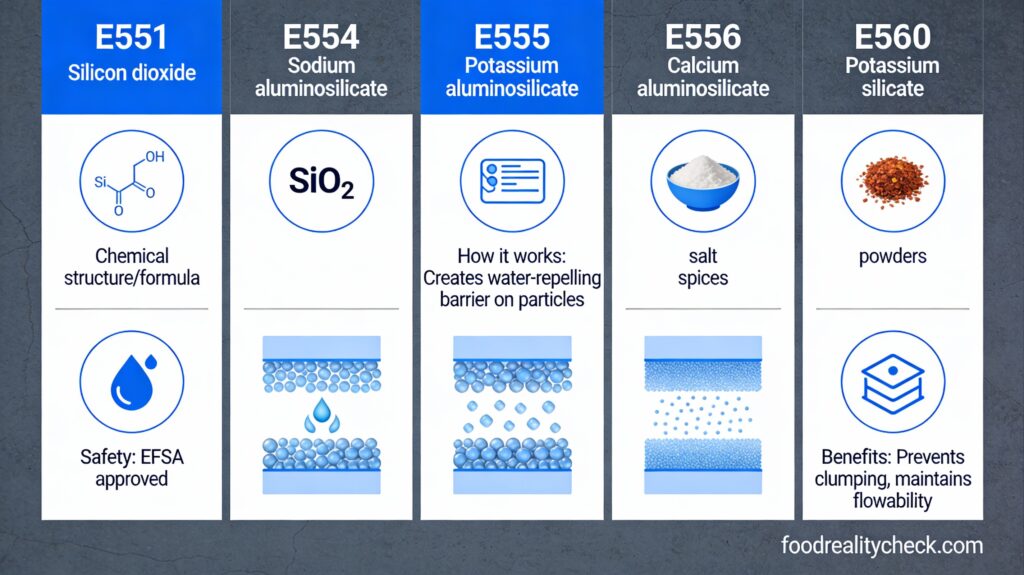
Comparison: E554, E555, and E556
The three aluminum silicate additives and their different failure modes:
| Additive | Failure Type | Status in 2025 | Severity |
|---|---|---|---|
| E554 (Sodium aluminum silicate) | Incomplete safety assessment | Approved; incomplete assessment | HIGH |
| E555 (Potassium aluminum silicate) | Extreme aluminum exposure (40-55x TWI) | Approved; extreme exposure | CRITICAL |
| E556 (Calcium aluminum silicate) | Recommended for deletion; not implemented | Approved; should be banned | CATASTROPHIC |
E556’s unique position: Not unknown risk (E554), not extreme exposure (E555), but recognized problem neglected for 17 years. This is worse than scientific uncertainty; it’s institutional failure.
The Bottom Line
E556 represents the most severe form of regulatory failure: a substance explicitly recommended for deletion that remains approved through institutional inaction.
The E556 regulatory timeline:
– 2008: EFSA recommends E556 deletion (reason: aluminum exposure exceeds safe limits)
– 2008-2012: No regulatory action; no response to EFSA recommendation
– 2012: European Parliament identifies E556 for banning
– 2012-2013: EFSA reconfirms E556 exposure “largely exceeds” tolerable intake
– 2013-2025: Complete regulatory silence; E556 remains approved
– 2025: 17 years after deletion recommended; E556 still legally sold in food