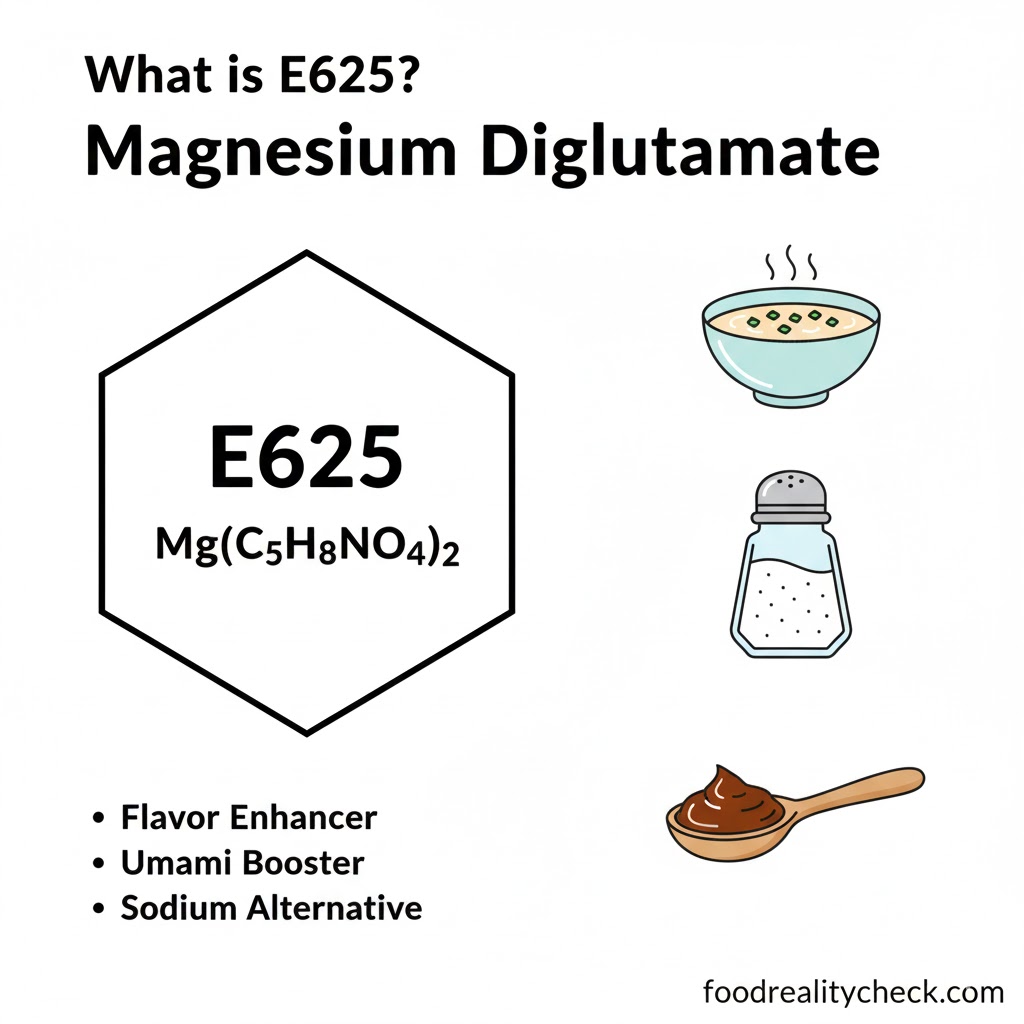
What is E625?
Complete guide to understanding E625 (Magnesium Diglutamate) in your food
The Quick Answer
E625 is magnesium diglutamate, a synthetic flavor enhancer and member of the glutamate family (MSG-related compounds) that intensifies savory/umami taste in processed foods.
It’s used to enhance food flavor perception, making foods taste richer and more flavorful while using less natural ingredient flavoring—a purely taste-enhancement function without nutritional contribution.
Most people consuming soups, broths, instant noodles, sauces, seasonings, and processed savory foods regularly encounter E625, though it remains largely invisible to consumers because flavor enhancement is subtle but universal in processed food.
📌 Quick Facts
- Category: Synthetic Flavor Enhancer, Glutamate Compound, Umami Stimulator
- Source: Fully synthetic—magnesium salt of glutamic acid
- Found in: Broths, soups, instant noodles, sauces, seasonings, savory snacks, processed meats, gravies
- Safety: FDA GRAS approved; EFSA approved with GROUP ADI 30 mg/kg bw (E620-E625 collectively); JECFA ADI “not specified”
- Natural or Synthetic: Fully synthetic (though glutamic acid occurs naturally)
- Vegan/Vegetarian: Yes
- Key Concern: Part of controversial glutamate/MSG family; cumulative exposure concerns; synergistic toxicity documented with other additives
- Chemical Formula: Mg(C₅H₈NO₄)₂; magnesium salt of glutamic acid
What Exactly Is It?
E625 is magnesium diglutamate, the magnesium salt form of glutamic acid with chemical formula Mg(C₅H₈NO₄)₂ and molecular weight of approximately 414.6 g/mol.
E625 is one of several glutamate flavor enhancers in the E620-E625 group: E620 (glutamic acid itself), E621 (monosodium glutamate/MSG, the most common form), E622 (monopotassium glutamate), E623 (calcium diglutamate), E624 (monoammonium glutamate), and E625 (magnesium diglutamate). These compounds all function identically as flavor enhancers—the cation (sodium, potassium, calcium, magnesium, ammonia) is essentially irrelevant to taste functionality; the glutamate anion provides the umami taste enhancement.
Physically, E625 appears as a white to off-white crystalline powder that is odorless or nearly odorless. It is freely soluble in water and highly soluble in ethanol, making it suitable for both aqueous and organic food systems. The compound is heat-stable and remains functional during normal food processing.
E625 functions identically to all glutamates: it binds to umami taste receptors on the tongue, specifically the mGluR4 and NMDA receptors, triggering the perception of savory/”umami” taste—a fundamental taste category recognized since 1908 when Japanese chemist Kikunae Ikeda isolated this taste sensation from kombu seaweed.
Where You’ll Find It
E625 appears in a wide range of savory processed foods:
• Broths and stock cubes
• Instant soups and soup mixes
• Instant noodles and ramen
• Sauces and gravies
• Condiments and flavor pastes
• Processed meats (sausages, paté, cured meats)
• Snack seasonings
• Cheese products and processed cheese
• Spreads and dressings
• Instant meals and ready-to-eat dishes
• Meat analogs (plant-based meat substitutes)
• Nutritional supplements
• Pharmaceuticals (taste masking)
• Cosmetics and personal care products
E625 is particularly prevalent in products marketed in Asia and developing economies where umami flavor enhancement is culturally more accepted and demanded.
Why Do Food Companies Use It?
E625 performs one critical function with significant economic advantage:
Umami flavor enhancement enabling ingredient reduction: E625 and other glutamates intensify the perception of savory flavor, allowing manufacturers to use significantly less actual meat stock, broth, cheese, or other expensive natural flavoring ingredients while maintaining perceived flavor intensity. This achieves dual goals: (1) reduces manufacturing cost, and (2) creates flavor perception matching higher-quality ingredients despite using lower quantities. For instant soups and broths, this cost reduction is profound—a small amount of E625 can create the savory richness that would otherwise require substantial concentrated stock.
Why it’s used selectively: E625 is the magnesium form—less common than monosodium glutamate (MSG, E621) which is the standard form. E625 might be selected specifically for applications where magnesium is desired (certain nutritional formulations) or where sodium reduction is important. However, it faces the same controversial reputation as all glutamates.
Is It Safe?
E625’s safety status is officially approved but remains highly controversial, with the 2017 EFSA re-evaluation documenting concerning exposure levels.
Regulatory Status:
• FDA (USA): Generally Recognized As Safe (GRAS) for use in foods at levels defined as “safe and appropriate” in food production
• EFSA (Europe): Approved as food additive (E625); GROUP ADI for all glutamates (E620-E625) 30 mg/kg body weight per day
• JECFA (WHO/FAO): ADI “not specified” (meaning safety assumed at any realistic intake level)
⚠️ Critical 2017 EFSA Finding—Exposure Exceeds Safety Limits for Some Populations: The 2017 EFSA re-evaluation of glutamates (E620-E625) explicitly documented a critical finding:”The Panel noted that the exposure to glutamic acid and glutamates (E 620–E 625) EXCEEDED NOT ONLY THE PROPOSED ADI, BUT ALSO DOSES ASSOCIATED WITH ADVERSE EFFECTS IN HUMANS FOR SOME POPULATION GROUPS.”
This landmark statement means that actual consumer consumption of glutamates from foods exceeds the established safe intake level for certain populations. This is NOT the same as proven harm, but rather indicates that real-world consumption surpasses regulatory safety thresholds.
• Exposure concerns: Actual exposure (particularly in children and frequent consumers of instant foods) exceeds the 30 mg/kg bw/day ADI for the glutamate group
• Cumulative exposure: Multiple sources—broths, soups, seasonings, processed meats, cheese products—combine to create total daily glutamate exposure exceeding safety margins
• Population vulnerability: Some groups (high consumers of instant foods, Asian populations with higher cultural use) may exceed safe limits by significant margins
• Synergistic toxicity documented: Liverpool University research documented that glutamate (E621) combined with food dyes (E104 quinoline yellow + E133 brilliant blue) and aspartame (E951) showed MULTIPLIED harmful effects on nerve cells—not additive but exponential (46.1% growth reduction vs. 15.8% expected)
• Neurotoxic concerns: Evidence of neurotoxic effects at high doses; potential mechanism through NMDA receptor activation related to glutamate’s role as neurotransmitter
• Chinese Restaurant Syndrome: While officially dismissed as “placebo,” documented cases of acute reactions (headache, numbness, nausea, chest pain) following high-dose glutamate consumption persist in medical literature
Important distinction: The 2017 EFSA finding that exposure exceeds safe levels does NOT mean E625 is proven harmful at current exposure levels. Rather, it means real-world consumption surpasses the regulatory safety threshold that was established using conservative assumptions. This creates regulatory uncertainty—the gap between what is “approved” and what is actually being consumed.
Documented concerns and controversies:
• Neurotransmitter-related effects: Glutamate is a primary excitatory neurotransmitter; concerns about over-stimulation of NMDA receptors at high doses are theoretically plausible though debated
• MSG Sensitivity: While “Chinese Restaurant Syndrome” is officially dismissed, some individuals report acute reactions to high-dose glutamate consumption including headaches, flushing, chest pain, and numbness
• Infant sensitivity: Developing nervous systems may be more vulnerable to glutamate exposure than adults; some regulatory systems restrict glutamate use in infant foods
• Synergistic toxicity: Research documents that glutamate combined with other additives shows multiplied harmful effects—not additive toxicity but exponential
• Long-term health concerns: Associations documented (though not causally proven) with obesity, metabolic disorders, neurodegenerative diseases (Alzheimer’s, Parkinson’s), and other chronic conditions
• Cumulative exposure uncertainty: Total daily glutamate from all sources exceeds approved limits for some populations, creating unknown long-term effects
Regulatory Disconnect
A key issue with E625 and all glutamates is the disconnect between regulatory approval and actual consumption exposure:
The EFSA’s 2017 statement that actual exposure “exceeded not only the proposed ADI, but also doses associated with adverse effects in humans for some population groups” creates a paradox: the additive is “approved” but actual consumption exceeds safe levels in some populations. This reflects regulatory assumptions (based on theoretical “average” consumption) diverging from real-world consumption patterns—particularly in countries with high instant food consumption.
Production Process
E625 magnesium diglutamate is produced through chemical synthesis:
1. Glutamic acid is synthesized or sourced (typically through bacterial fermentation using Corynebacterium glutamicum or similar species)
2. Glutamic acid is combined with magnesium oxide or magnesium hydroxide
3. The mixture is neutralized and crystallized to form magnesium diglutamate
4. The product is purified, dried, and standardized
Modern glutamic acid production uses biotechnological fermentation—bacteria convert sugars (from various agricultural sources including tapioca starch) into glutamic acid. Some production strains are genetically modified organisms (GMOs), though this is not typically disclosed on labels.
Natural vs Synthetic Version
E625 is fully synthetic, though with natural-origin raw materials:
Glutamic acid occurs naturally (as a protein amino acid), but isolated, concentrated E625 magnesium diglutamate as a food additive is entirely synthetic and intentionally concentrated at levels far exceeding normal food intake. The distinction is critical: glutamic acid in whole foods (in cheese, tomatoes, mushrooms, meat) is dramatically different from isolated E625 as an additive.
Comparison with Other Flavor Enhancers
E625 is one form among the glutamate and nucleotide flavor enhancer family:
• E620 (Glutamic acid): Free acid form; less commonly used than salts
• E621 (Monosodium glutamate/MSG): Sodium salt; most common form; identical taste function to E625
• E622 (Monopotassium glutamate): Potassium salt; similar function; useful for sodium-reduced applications
• E623 (Calcium diglutamate): Calcium salt; similar function
• E624 (Monoammonium glutamate): Ammonia salt; similar function
• E625 (Magnesium diglutamate): Magnesium salt; similar function to all above
• E627 (Disodium guanylate): Nucleotide flavor enhancer; similar umami effect; often combined with E625 or E621
• E631 (Disodium inosinate): Nucleotide flavor enhancer; synergistic with glutamates
• E635 (Disodium ribonucleotides): Combination of E627 + E631; marketed as MSG alternative
All glutamates function identically regardless of cation (magnesium, sodium, potassium); the choice of E625 versus E621 reflects manufacturing or regulatory preferences rather than functional differences.
Environmental and Sustainability
E625 production using bacterial fermentation is relatively sustainable when using renewable sugar sources (tapioca, corn). However, concerns about GMO organisms and energy-intensive fermentation exist. The compound itself poses no significant environmental toxicity—it metabolizes like dietary glutamic acid.
Natural Alternatives
Want to avoid E625? Food companies sometimes use these alternatives:
• Natural meat broth and stock: Genuine umami flavor from real ingredients; expensive
• Mushroom and yeast extracts: Naturally contain nucleotides (GMP, IMP) providing umami; less intense than isolated glutamates
• Fermented ingredients: Soy sauce, miso, fish sauce contain naturally concentrated glutamates and umami compounds
• Cheese powder: Natural source of glutamates; expensive
• Tomato or seaweed extracts: Natural umami sources
• E627/E631 nucleotides alone: Umami stimulation without glutamate (though less powerful); marketed as “MSG-free”
• No flavor enhancer: Accept natural lower flavor intensity; premium positioning as “additive-free”
The Bottom Line
E625 (magnesium diglutamate) is a fully synthetic flavor enhancer that is officially FDA GRAS approved and EFSA approved as part of the glutamate group (E620-E625), but the 2017 EFSA re-evaluation explicitly documented that actual consumer exposure EXCEEDS the established safe intake level for some population groups.
E625 functions identically to all other glutamates, binding to umami taste receptors and intensifying perception of savory flavor—allowing manufacturers to reduce expensive natural ingredients while maintaining perceived quality. It is absorbed, presystemically metabolized, and excreted like dietary glutamic acid with no evidence of accumulation.
The official regulatory assessment maintains that E625 is safe at approved levels, with no genotoxicity, carcinogenicity, or teratogenicity demonstrated. However, the critical 2017 EFSA statement that actual exposure exceeds both the proposed ADI AND doses associated with adverse effects in humans for some populations creates a fundamental disconnect between regulatory approval and real-world consumption.
Research documents concerning effects at high doses including synergistic toxicity with other additives (multiplied harmful effects when combined with food dyes and other additives), neurotoxic potential related to glutamate’s role as a neurotransmitter, and potential contributions to metabolic disorders and chronic diseases—though causality remains debated.
For consumers concerned about glutamate exposure (particularly high consumers of instant foods), limiting consumption of E625 and all glutamate flavor enhancers is prudent. The regulatory approval, while official, exists alongside documented evidence that real-world exposure exceeds safety thresholds—a situation warranting cautious consumer awareness even if regulatory authorities maintain overall approval.