What is E900?
Complete guide to understanding E900 (Dimethylpolysiloxane) in your food
The Quick Answer
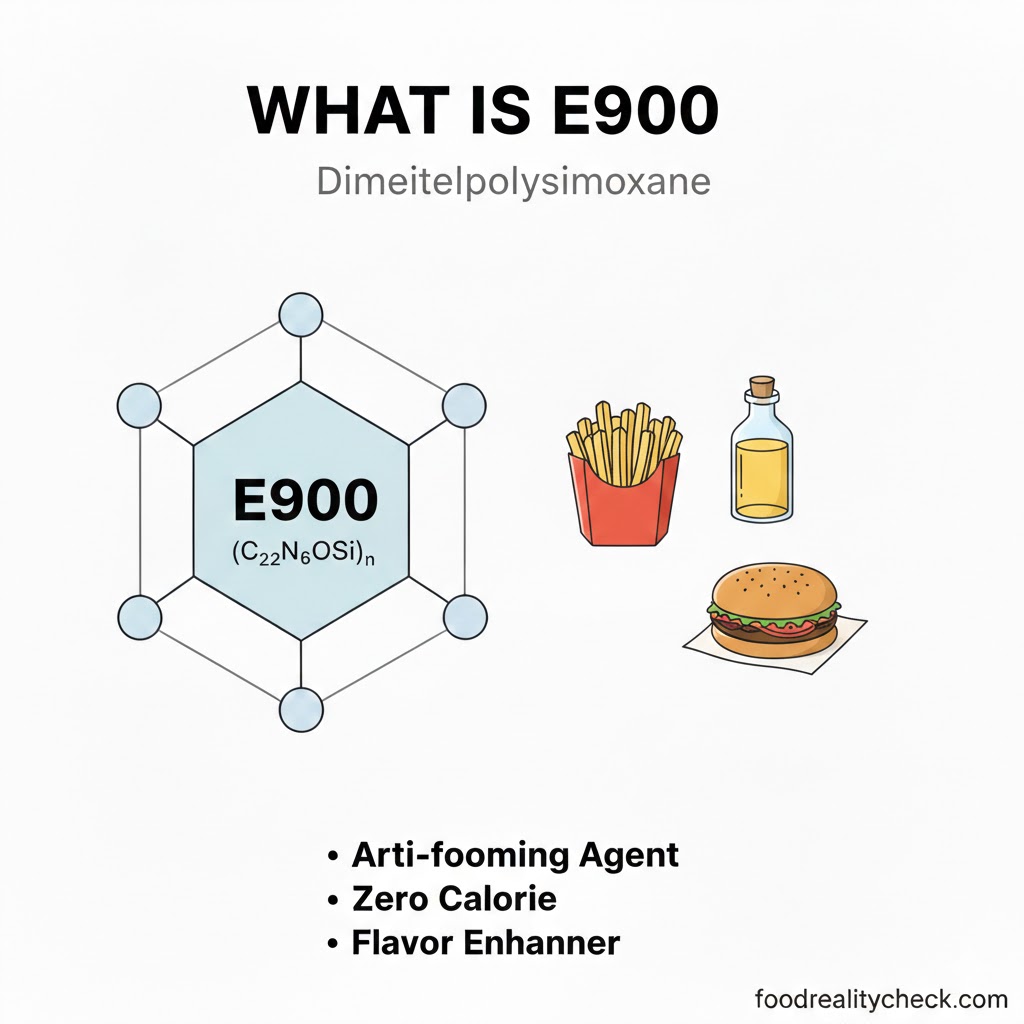
E900 is a silicon-based anti-foaming agent.
It’s used in food to prevent foam and bubbling during cooking and processing.
You’ve most likely eaten it in fried foods, oils, and processed items.
📌 Quick Facts
- Category: Anti-foaming agent and processing aid
- Also Known As: Dimethylpolysiloxane, polydimethylsiloxane (PDMS), dimethicone
- Found in: Cooking oils, fried foods, confectionery, juices, chewing gum, chocolate
- Safety: Generally recognized as safe (GRAS) by FDA and EFSA
- ADI (EFSA): 17 mg per kg of body weight per day (as of 2020)
What Exactly Is It?
E900 is made from silicone polymers derived from silicon.
Its chemical formula is (C₂H₆OSi)ₙ, making it a silicon-oxygen chain with methyl groups attached.
It’s produced by hydrolysis of dimethyldichlorosilane and a small quantity of trimethylchlorosilane.
It appears as a clear, colorless, viscous liquid with no odor.
Despite being silicone-based (plastic-like), it’s chemically inert and doesn’t break down or react in food.
Where You’ll Find It
E900 appears in many common foods:
• Cooking oils (especially for frying)
• Fast food items (fried chicken, french fries, donuts)
• Confectionery and chocolate coatings
• Chewing gum
• Fruit and vegetable juices
• Canned or bottled fruits and vegetables
• Soups and broths
• Flavored drinks and beverages
• Battered and breaded foods
• Ready-to-eat desserts and spreads
• Gelatin products
It’s particularly common in fried foods, which is where it serves its most important function.
Why Do Food Companies Use It?
E900 does one primary job: prevent foam and bubbling during cooking and food processing.
When frozen food is suddenly placed in hot oil (such as frozen french fries), it causes rapid foaming that can lead to oil splattering, burns, and safety hazards.
E900 reduces surface tension, breaking down foam bubbles and keeping oil clear and safe.
In other applications, it prevents foam during juice production, wine-making, sugar refining, gelatin production, and chewing gum manufacturing.
Food companies use it because it’s extremely effective, remains stable at high temperatures, and requires only tiny amounts to work.
Is It Safe?
Yes, E900 is considered safe by major regulatory bodies.
The FDA classifies it as “Generally Recognized as Safe” (GRAS) for food use.
The European Food Safety Authority (EFSA) re-evaluated it in 2020 and established an ADI (Acceptable Daily Intake) of 17 mg per kg of body weight per day.
To exceed safe limits, you would need to consume approximately 1,000–2,000 mg of E900 daily, which is practically impossible through normal food consumption.
What Are The Health Concerns?
E900 has very few documented health concerns. Scientific research shows:
Absorption: Almost no absorption through skin or the gastrointestinal tract—it exits the body unchanged
Toxicity: No acute toxicity or allergic reactions observed in studies
Carcinogenicity: No evidence of cancer risk
Teratogenicity: No evidence of birth defects or developmental harm
Genetic toxicity: No evidence of genetic damage
Rare side effect: Isolated reports of ocular (eye) lesions in very high-dose animal studies, but not replicated in humans at normal exposure levels
The main reason some consumers avoid E900 is the “clean eating” movement preference for avoiding synthetic additives, rather than proven safety concerns.
Natural vs Synthetic Version
E900 is always synthetic (made in a laboratory).
There is no natural version of dimethylpolysiloxane.
It is chemically designed in a factory through the hydrolysis of silicon compounds.
Natural Alternatives
Want to avoid E900?
While true “natural” alternatives don’t exist, food companies sometimes use:
• Soy lecithin – natural emulsifier with some anti-foam properties
• Polyglycerol polyricinoleate (PGPR) – plant-derived emulsifier
• Beeswax – natural release agent
• Vegetable monoglycerides – natural emulsifiers
These alternatives are less effective and more expensive, which is why E900 remains the industry standard.
The Bottom Line
E900 is a silicon-based anti-foaming agent that is widely approved, well-studied, and considered safe for consumption.
It’s nearly invisible to your body—it passes through unchanged and is completely excreted.
Regulatory bodies in the USA, Europe, and worldwide have deemed it safe at approved use levels.
If you’re concerned about synthetic additives and prefer minimally processed foods, you can reduce E900 exposure by cooking fresh foods rather than eating fried or heavily processed items.
But based on scientific evidence, E900 is one of the safest food additives available.