What is E901?
Complete guide to understanding E901 (Beeswax) – the natural glazing agent from honeybees
The Quick Answer
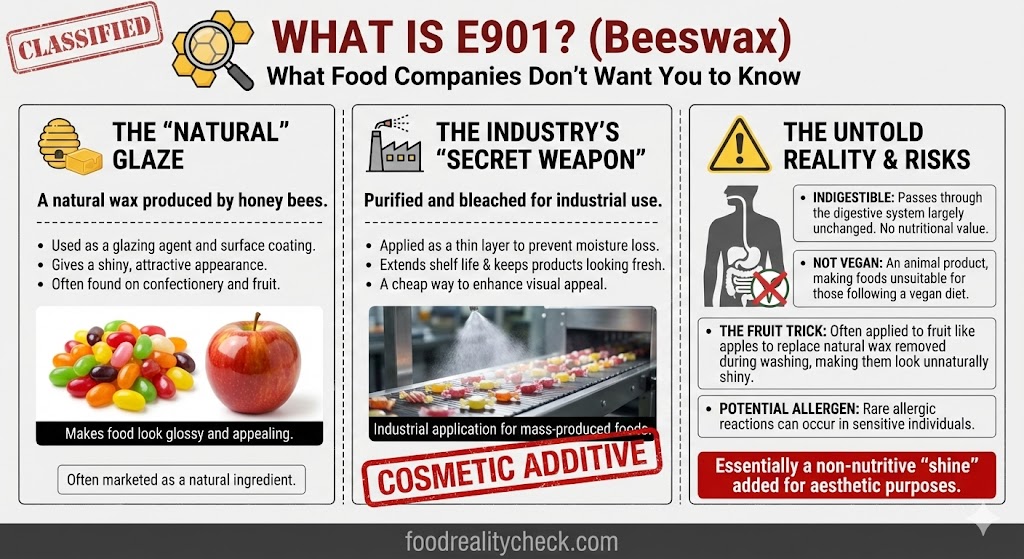
E901 is beeswax—a natural waxy substance produced by honeybees (Apis mellifera and related bee species) that is secreted from special glands in the bee’s abdomen and used by bees to build honeycomb cells for honey storage and larval protection. Beeswax is approved globally as a safe food additive and is used primarily as a glazing agent (surface coating) to provide shine, prevent water loss, and protect foods from spoilage. It comes in two forms: E901(i) white beeswax (bleached) and E901(ii) yellow beeswax (natural).
E901 is approved by JECFA, EFSA, FDA, and virtually all regulatory authorities worldwide. The EFSA evaluated beeswax in 2007 as a glazing agent and carrier for flavourings and confirmed safety. Beeswax is one of the safest food additives, with no known adverse effects at food use levels. E901 is widely used in confectionery, chocolates, coffee beans, nuts, fruits, and baked goods to provide protective glazing and visual appeal. E901 beeswax is non-toxic, has been used safely in foods for centuries, requires no determined ADI (Acceptable Daily Intake), and is acceptable to vegetarians and most ethical consumers (some vegans accept beeswax as it is an exudate of bees, not from insect bodies).
E901 is part of the glazing agent family (E900-E915+), which includes natural waxes and protective coatings. Beeswax is unique among glazing agents in being completely natural, produced by living bees as part of their biological function.
📌 Quick Facts
- Chemical: Beeswax; natural wax exudate from honeybees; primarily esters of long-chain alcohols and fatty acids
- Also known as: Beeswax, cera alba (white wax), cera flava (yellow wax), E901
- Chemical composition: Palmitate, palmitoleate, and oleate esters of long-chain aliphatic alcohols; principal constituents include triacontanyl palmitate and cerotic acid
- Primary producers: Honeybees (Apis mellifera and related bee species); secreted from eight wax glands in abdominal segments 4-7 of worker bees
- CAS number: Yellow beeswax: 8006-40-4; White beeswax: 8012-89-3
- INS number: 901
- Physical form: Solid at room temperature; E901(i) white beeswax (bleached/refined); E901(ii) yellow beeswax (natural); available as granules, blocks, or pellets
- Melting point: 62-64°C (144-147°F)
- Taste: Neutral; mild honey aroma in yellow beeswax
- Source: 100% natural; produced by honeybees; no synthetic substitute in food industry
- Purity: Food-grade beeswax is highly refined and tested for contaminants; free from pesticides, heavy metals, and pathogens at proper grades
- Key properties: Non-toxic, water-resistant, hydrophobic, protective coating, improves visual appearance, prevents water loss, extends shelf life, excellent gloss
- Caloric value: Negligible; not digestible; passes through digestive system largely intact
- Glycemic Index: 0; has no impact on blood glucose
- Primary functions: Glazing agent, coating, protective barrier, surface shine, water-loss prevention
- Food uses: Confectionery (candy, sweets), chocolate products, coffee beans, nuts, fruits (citrus, melons, apples, pears, peaches, pineapples), fine bakery products, chewing gum, food supplements
- Usage levels: Typically 200-1,200 mg/kg in foods; some uses permit up to 4,000 mg/kg per GMP (Good Manufacturing Practice)
- Safety status: JECFA-approved as INS 901; EFSA confirmed safe (2007); FDA-approved; globally approved in virtually all countries
- ADI (Acceptable Daily Intake): None determined; considered safe at all practical food use levels
- Absorption: Not absorbed; passes through digestive system largely intact; no toxicity in humans
- EFSA assessment: 2007 comprehensive evaluation as glazing agent and flavor carrier; concluded no safety concern; no ADI needed
- Primary advantage: 100% natural, highly safe, provides excellent protective and visual properties without synthetic additives
- Dietary restrictions: Acceptable to vegetarians (exudate, not animal tissue); some vegans accept beeswax; acceptable to all major religious groups
- Regulatory trajectory: Stable; approved since establishment of E-number system; no safety controversies
- Sustainability: Produced by bees as part of natural biological function; harvesting sustainable when ethical beekeeping practices used
What Exactly Is It?
E901 beeswax is a natural waxy substance secreted by worker honeybees (Apis mellifera) from eight specialized wax-producing glands located on the inner sides of the sternites (ventral plates) of abdominal segments 4 through 7. The bees secrete tiny wax scales (approximately 3mm across and 0.1mm thick) which they collect, chew, and use to build honeycomb cells. About 1,100 wax scales are needed to produce one gram of beeswax. The wax is initially clear and colorless, becoming progressively yellower or browner as bees incorporate pollen, propolis, and oils into it.
Think of beeswax as “nature’s protective coating”—it evolved in honeybees specifically to create waterproof, durable structures for honey storage and brood protection. When applied to food surfaces, beeswax creates a water-resistant, protective barrier that prevents oxidation, water loss, and microbial contamination while providing attractive shine and gloss. The waxy coating is completely inert and safe for human consumption.
Key characteristic: E901’s most valuable property is being completely natural, non-toxic, and providing excellent protective coating properties without any synthetic chemicals. It’s the safest and most traditional glazing agent, used safely in foods for centuries.
Chemical identity:
• Primary component: Long-chain esters and hydrocarbons
• Principal constituents: Triacontanyl palmitate (C₃₀H₆₁O₂C) and cerotic acid (C₂₇H₅₄O₂) in approximately 6:1 ratio
• Other components: Palmitate, palmitoleate, oleate esters of long-chain (C30-C32) aliphatic alcohols
• Cerotic acid content: Approximately 13% of yellow beeswax; varies in white beeswax
• Hydrophobic character: Completely water-repellent; creates protective barrier
• Melting point: 62-64°C (144-147°F)
• Solubility: Insoluble in water; soluble in hot oils and organic solvents
• Acid value: 17-24 (measure of free fatty acid content)
• Color: E901(i) white/colorless (bleached); E901(ii) yellow/brown (natural with pollen/propolis)
• Physical consistency: Solid waxy substance; becomes plastic when warmed
How it’s produced:
E901 beeswax is produced entirely by living honeybees through natural biological processes:
• Bee biology: Eight wax glands in worker bee abdomen secrete wax as bees consume honey/nectar
• Temperature requirement: Hive temperature must be 33-36°C (91-97°F) for wax secretion to occur
• Secretion process: Wax initially secreted as clear, colorless scales (approximately 3mm × 0.1mm)
• Bee processing: Worker bees collect wax scales and chew them, incorporating propolis and pollen
• Color development: Yellow beeswax develops natural color from pollen oils and propolis; white beeswax bleached by sunlight or hydrogen peroxide treatment
• Honeycomb construction: Bees build six-sided cells for honey storage and larval development
• Harvest timing: Beeswax harvested when honey is extracted; uncapped honeycomb cappings are primary source
• Processing: Raw beeswax melted, filtered, and refined to remove impurities and debris
• Bleaching options: White beeswax obtained by exposure to sunlight or treatment with hydrogen peroxide (food-grade only)
• Food-grade production: Food-grade beeswax further purified and tested for pesticides, heavy metals, and contaminants per EU Commission Regulation 231/2012
• Production efficiency: 1 kilogram of beeswax sufficient to produce honeycomb capable of storing 22 kg of honey
Where You’ll Find It
E901 appears in foods where protective glazing, shine, and water-loss prevention are desired:
Primary Food Applications:
• Confectionery (PRIMARY USE) – sweets, candies, toffees; provides shine and protective coating; prevents sticking and moisture loss
• Chocolate and chocolate products (PRIMARY USE) – coatings, decorations, fillings (but not on chocolate-covered items for some uses); improves gloss and durability
• Coffee beans – glazing to provide shine and protective barrier; preserves freshness
• Nuts and processed nuts – protective coating; prevents oxidation and moisture loss
• Fresh fruits (surface treatment) – citrus fruits, melons, apples, pears, peaches, pineapples; approved as glazing agent for selected varieties
• Fine bakery products – small products with chocolate coating; provides shine and protection
• Chewing gum – standard ingredient; provides texture and surface coating
• Food supplements – tablet and capsule coatings; pharmaceutical-grade food supplement shells
• Coffee extracts and coffee products – glazing agent for coffee beans
• Cereals and snacks – potato-based, cereal-based, flour-based, or starch-based snacks; glazing and protection
• Edible ices – coatings on prepacked wafers with ice cream; protective layer
• Honey and honey products – beeswax from same hive; natural pairing
• Cheese (HISTORICAL USE) – coating for cheese during aging and maturation; prevents mold growth and moisture loss (traditional practice)
Regulatory scope (widely approved): JECFA—Approved as INS 901; listed in Codex GSFA Table 3; permitted per GMP (Good Manufacturing Practice) across numerous food categories. EU—E901 approved under Commission Regulation 231/2012; permitted as glazing agent on confectionery, fruits, nuts, bakery products, and other foods. FDA—Approved as direct food additive. Approved globally in virtually all countries.
Market prevalence: E901 beeswax is one of the most widely used natural glazing agents globally. Its safety, natural origin, and effectiveness make it standard in premium confectionery, chocolate, and specialty foods. Market particularly strong in Europe and Asia where natural ingredients preferred.
Why Do Food Companies Use It?
E901’s unique advantage is providing completely natural, proven-safe protective glazing without synthetic chemicals—combining excellent functionality with the clean-label appeal of a natural bee product.
Food manufacturers use beeswax for:
• Water-loss prevention: Creates hydrophobic barrier preventing water vapor loss; maintains freshness
• Protective coating: Shields food from air exposure and oxidation; extends shelf life
• Visual appeal: Provides attractive shine and gloss to candies, chocolates, nuts, fruits
• Mold prevention: Waxy barrier inhibits microbial contamination; traditional cheese-coating benefit
• Natural ingredient: 100% natural; appeals to clean-label and natural ingredient consumers
• Safety history: Used safely for centuries; no documented adverse effects; EFSA-confirmed safety
• Regulatory approval: Approved globally; no restrictions on use levels in most applications
• Sensory neutrality: No taste or odor at food use levels; does not alter food flavor
• Versatility: Works on wide range of foods: confectionery, chocolate, coffee, nuts, fruits, baked goods
• Premium positioning: Natural beeswax associated with premium, artisanal, and traditional foods
• No ADI requirement: EFSA determined no ADI needed; indicates highest safety confidence
• Digestive safety: Not absorbed; passes through digestive system intact; no toxicity
• Ethical appeal: Sustainable when sourced from ethical beekeeping practices
• Religious acceptance: Acceptable to all major religious groups and vegetarians
Key advantage: E901 enables food manufacturers to create visually premium products with protective coating using a completely natural, safe ingredient—impossible with synthetic alternatives that some consumers want to avoid. The centuries-long safety history and clean-label appeal make beeswax uniquely valuable for premium and natural foods.
Is It Safe?
✓ YES — E901 BEESWAX IS SAFE
The EFSA’s 2007 comprehensive evaluation concluded that beeswax (E 901) is safe as a glazing agent and carrier for flavours. No adverse effects have been documented at food use levels. No Acceptable Daily Intake (ADI) has been determined—the highest confidence level indicating complete safety.
Regulatory approval status:
• JECFA (WHO/FAO): Approved as INS 901; ADI “not specified” (highest confidence)
• EFSA: Comprehensively evaluated in 2007 as glazing agent and flavor carrier; confirmed safe; no ADI needed
• EU: Approved under Commission Regulation 231/2012; permitted in multiple food categories
• FDA (USA): Approved as direct food additive; classified as GRAS (Generally Recognized As Safe)
• Codex Alimentarius: Listed as INS 901 in GSFA Table 3; permitted per GMP
• Global approval: Approved in virtually all countries; no countries prohibit food-grade beeswax
Safety profile (EFSA 2007 assessment):
• No acute toxicity: Safe at all practical food use levels; no toxic effects documented
• No chronic toxicity: No adverse effects from long-term consumption
• No carcinogenicity: No cancer-causing potential
• No genotoxicity: No evidence of genetic damage
• No reproductive/developmental effects: Safe for pregnant women, children, all populations
• Metabolic fate: Not absorbed in digestive system; passes through intact; no bioavailability
• No bioaccumulation: Cannot accumulate in body; completely eliminated unchanged
• No allergen potential: Not a recognized allergen; suitable for all populations (though some with severe bee allergies may theoretically react)
• Natural product safety: Bees secrete beeswax continuously; natural product has coevolved with humans for millennia
• Long safety history: Used safely in foods for centuries; no documented safety incidents
• ADI status: “Not specified”—highest regulatory confidence
• EFSA conclusion: No safety concern identified; safe at reported use levels and use categories
• Food-grade certification: Food-grade beeswax tested for pesticides, heavy metals, pathogens per strict standards
Important nutritional note:
• Not digestible: Beeswax is not broken down by human digestive enzymes
• Not absorbed: Passes through digestive system unchanged; not absorbed into bloodstream
• Zero calories: Contributes negligible calories (essentially 0 kcal) to diet
• Glycemic impact: Zero; does not raise blood glucose
• Not a toxin: Complete absence of toxicity; safe even for infants and young children
• Coating protection: The coating on food is never meant to be digested; remains on surface of food
✓ EFSA 2007 VERDICT ON BEESWAX (E901):
“No adverse effects were observed [in the safety assessment]. The Panel concluded that there was no safety concern for the use of beeswax as a glazing agent and as a carrier for flavours at the reported use levels.”
The determination of “no ADI needed” reflects the highest level of regulatory confidence. Beeswax is one of the safest food additives ever evaluated.
E901 Beeswax vs Other Glazing Agents
| Glazing Agent | E-Number | Origin | Safety Status | Natural | Typical Use |
|---|---|---|---|---|---|
| Beeswax | E901 | Honeybees | EFSA safe (2007); no ADI | ✓ 100% Natural | Confectionery, chocolate, coffee, nuts, fruits |
| Candelilla wax | E902 | Plant (Euphorbia cerifera) | EFSA safe; no ADI | ✓ Natural plant wax | Confectionery, chocolate, gum |
| Carnauba wax | E903 | Plant (Copernicia prunifera palm) | EFSA safe; no ADI | ✓ Natural plant wax | Confectionery, chocolate, coffee beans |
| Shellac | E904 | Insect (lac beetle secretion) | EFSA safe; no ADI | ✓ Natural animal product | Confectionery, fruit coating, coffee |
| Microcrystalline wax | E905c | Petroleum-derived | EFSA safe | ✗ Synthetic | Chewing gum, confectionery |
The Bottom Line
E901 (beeswax) is a completely natural, 100% safe food additive produced by honeybees that provides protective glazing and visual shine to foods without any synthetic chemicals or known adverse effects. The EFSA’s 2007 comprehensive evaluation confirmed safety with no need for a determined ADI limit—the highest regulatory confidence level. Beeswax has a centuries-long safety history and represents one of the safest food additives ever evaluated.
Key facts: E901 is completely safe at all practical food use levels. No ADI determined (EFSA 2007) indicating highest regulatory confidence. Approved globally in virtually all countries. 100% natural; produced by honeybees as part of biological function. Not absorbed in digestive system; passes through unchanged. No documented adverse effects in centuries of use. Acceptable to vegetarians and most ethical consumers.
Primary function: E901’s main value is providing completely natural protective glazing that preserves freshness, prevents oxidation, provides attractive shine, and extends shelf life without any synthetic chemicals—uniquely compatible with clean-label and natural ingredient consumer trends.
For consumers: E901 beeswax is safe to consume. Products glazed with beeswax are not health risks. The thin coating on food is not meant to be digested; it remains on the food surface. The safety of beeswax is proven and uncontroversial. It’s one of the most traditional and safest food additives used. Safe for all ages including infants and children. Acceptable to vegetarians. Many vegans accept beeswax as it is an exudate of bees (not derived from insect bodies).
Premium and natural positioning: E901 beeswax is valued in premium, artisanal, and natural foods for its clean-label appeal. 100% natural origin, centuries-long safety record, and zero synthetic components make beeswax uniquely attractive to consumers seeking natural ingredients.
Bottom recommendation: E901 is one of the safest and most thoroughly evaluated food additives. The 2007 EFSA evaluation is definitive. Beeswax has centuries of safe use history. No precautions necessary. Consume freely. Particularly suitable for premium and natural foods. Safe for all ages and dietary preferences. Choose food-grade beeswax sources to ensure highest purity and safety standards.