What is E950?
Complete guide to understanding E950 (Acesulfame Potassium) in your food
The Quick Answer
E950 is a synthetic artificial sweetener 200 times sweeter than sugar with zero calories, used in beverages, confectionery, baked goods, and other low-calorie products.
It is heat-stable (unlike aspartame) and often blended with other sweeteners to mask aftertaste.
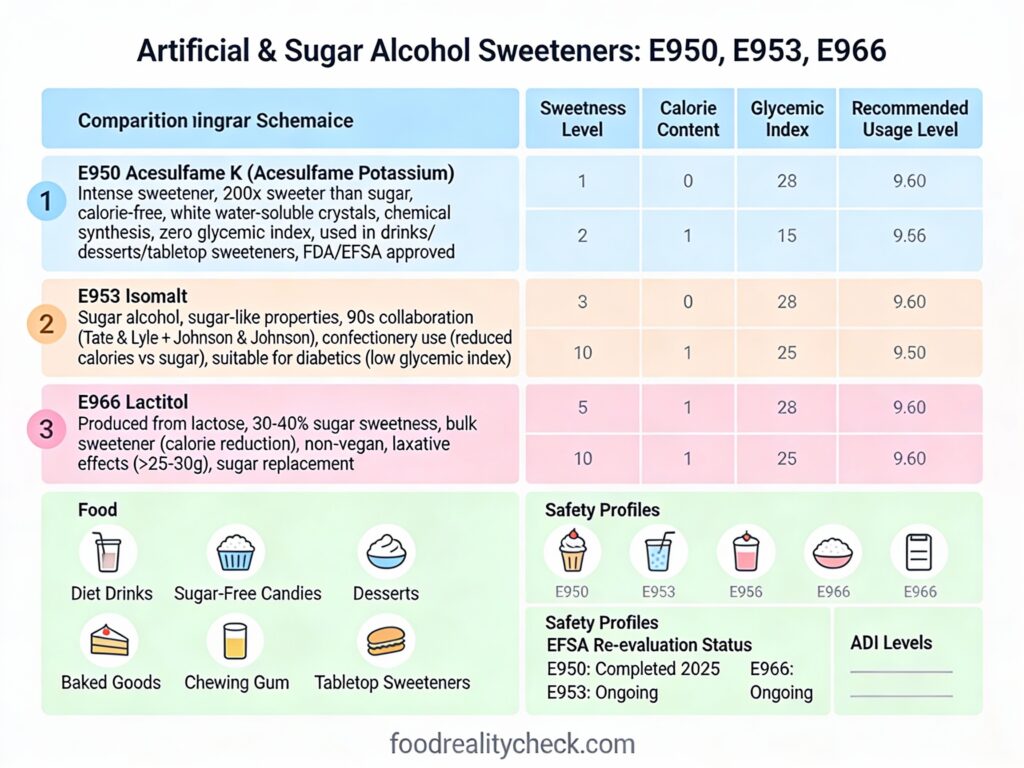
In April 2025, EFSA completed a comprehensive re-evaluation concluding E950 is safe with no adverse health effects at approved intake levels, while raising the ADI from 9 to 15 mg/kg body weight per day. However, EFSA flagged contamination concerns (lead, mercury, acetylacetamide) in commercial samples and recommended specification amendments. Emerging cancer research remains inconclusive but warrants continued monitoring.
📌 Quick Facts
- Category: Synthetic artificial sweetener (non-nutritive)
- Full Name: Acesulfame potassium or acesulfame K (Ace K)
- Chemical Formula: C₄H₄KNO₄S
- Sweetness: 200 times sweeter than sucrose; similar to aspartame; has slightly bitter aftertaste (often blended with other sweeteners to mask)
- Brand Names: Sunett, Sweet One
- Found in: Beverages (sodas, juices, sports drinks), confectionery, baked goods, dairy products, tabletop sweeteners, pharmaceuticals
- Safety Status: FDA GRAS; EU approved; EFSA April 2025 re-evaluation: Safe; ADI raised to 15 mg/kg body weight/day; quality concerns identified
- Critical Update: Commercial samples show contamination with lead, mercury, and acetylacetamide; EFSA recommending specification amendments
What Exactly Is It?
E950 is acesulfame potassium—a synthetic artificial sweetener chemically produced as the potassium salt of 6-methyl-1,2,3-oxathiazin-4(3H)-one-2,2-dioxide.
Its chemical formula is C₄H₄KNO₄S; molecular weight 201.24.
E950 appears as an odorless, white crystalline powder that is highly water-soluble.
Discovered accidentally in 1967 by German chemist Karl Clauss at Hoechst AG (now Nutrinova), acesulfame potassium was synthesized through chemical synthesis, not extracted from natural sources.
Key properties: E950 is 200 times sweeter than sugar; has slightly bitter aftertaste (especially at high concentrations); heat-stable (unlike aspartame) at normal cooking temperatures and even at moderately acidic or basic pH; has minimal caloric content (technically 0 calories for practical purposes).
Metabolism: E950 is poorly metabolized by humans and is largely excreted unchanged through urine. Small amounts may undergo degradation, including potential conversion to acetoacetamide (toxic at high doses).
Where You’ll Find It
E950 appears in many low-calorie and diet products:
• Soft drinks and colas (diet/zero varieties)
• Fruit juices and flavored waters
• Sports drinks and energy drinks
• Confectionery and candies (sugar-free)
• Baked goods (cakes, cookies, bread)
• Dairy products (yogurt, ice cream, pudding)
• Chewing gum
• Tabletop sweeteners (sachets, tablets)
• Syrups and preserves
• Sauces and condiments (low-sugar)
• Jams and jellies
• Pharmaceuticals (chewable/liquid medicines)
• Protein shakes and nutritional products
E950 is extremely common globally in low-calorie and diet products.
Why Do Food Companies Use It?
E950 serves critical functional advantages:
Heat stability: Unlike aspartame (which degrades at elevated temperatures), E950 remains stable during baking, cooking, and in hot beverages. This enables use in baked goods and shelf-stable products aspartame cannot be used in.
200× sweetness potency: High potency enables very small use quantities, reducing aftertaste impact and cost.
pH stability: Stable across wide pH ranges (acidic to basic), enabling use in various product types.
Long shelf-life: Stable during extended storage without degradation (unlike aspartame).
Synergistic blending: When combined with aspartame or sucralose, the sweeteners mask each other’s aftertastes, producing more sugar-like taste perception.
Cost-effective: Cheaper than many alternative sweeteners.
Regulatory approval: Approved globally with long history of use (approved 1988 FDA, 1987 EU) reducing manufacturer liability concerns.
Is It Safe?
Yes—EFSA’s April 2025 comprehensive re-evaluation concluded E950 is safe with no adverse health effects at approved intake levels, raising the ADI from 9 to 15 mg/kg body weight per day. However, quality concerns with commercial products (contamination with lead, mercury, acetylacetamide) require specification amendments.
The FDA approved E950 in 1988 as GRAS (Generally Recognized as Safe) and maintains this classification.
EFSA approved E950 in the EU and conducted the first comprehensive re-evaluation since 2000, with results published April 2025.
✓ EFSA APRIL 2025 RE-EVALUATION – KEY FINDINGS:
Safety Conclusion: “Based on the available data, no safety concerns arise for genotoxicity of acesulfame K (E 950) and its degradation products.”
Health Effects Assessment: “It is unlikely that intake of acesulfame K (E950) is associated with (i) cancer, (ii) disturbances of the glucose or insulin homeostasis, (iii) cardiovascular risk factors and disease, (iv) general toxicity, (v) hematological effects, (vi) nephrotoxicity, (vii) liver toxicity or (viii) toxicity in any organ or tissue.”
ADI Increase: Raised from 9 mg/kg (2000 SCF assessment) to 15 mg/kg body weight per day—reflecting increased regulatory confidence based on comprehensive data review.
Exposure Safety: “The highest estimate of exposure to acesulfame K (E 950) was generally below the ADI in all population groups.”
Quality Concerns Identified: Commercial samples exceeded EU limits for lead, mercury, and acetylacetamide; EFSA recommended amending specifications.
Impurity Limit Recommendations:
• Lead: Lower limit recommended (current: 1 mg/kg; exceeded in samples)
• Mercury: Lower limit recommended (current: 1 mg/kg; exceeded in samples)
• Acetylacetamide (degradation product): New limit of 1 mg/kg recommended (currently no limit)
• 5-Chloro-acesulfame (impurity): Maximum limit of 0.1 mg/kg recommended
What Are The Health Concerns?
E950 has no documented adverse health effects at approved intake levels according to EFSA’s 2025 re-evaluation. However, several considerations and emerging research questions exist:
Genotoxicity and carcinogenicity (ADDRESSED): EFSA 2025 explicitly concluded no genotoxicity concerns and low likelihood of carcinogenicity association based on available animal and human data. Degradation products also assessed and found non-concerning.
Emerging cancer epidemiology (INCONCLUSIVE): A 2022 French population study (102,856 adults) reported associations between acesulfame K (and aspartame) and increased cancer risk. However, observational epidemiological data cannot establish causation and are susceptible to confounding. EFSA evaluated this evidence but concluded it insufficient to change safety assessment pending additional research. This remains an area requiring continued monitoring.
Acetoacetamide degradation product (CONCERN IDENTIFIED): E950 can degrade to acetoacetamide, which is toxic at high doses. However, EFSA found no safety concern at food-use levels where acetoacetamide levels remain minimal. EFSA recommended maximum limit of 1 mg/kg acetylacetamide in E950 specifications (currently no limit, though samples show detectable levels).
Lead and mercury contamination (CONCERN IDENTIFIED): Commercial samples of E950 exceed current EU limits for lead (1 mg/kg) and mercury (1 mg/kg). EFSA recommended lowering these limits to prevent excessive contamination.
Aftertaste and palatability (NOT A HEALTH CONCERN): E950 has slightly bitter licorice-like aftertaste, which is why it’s blended with other sweeteners. This is a taste preference issue, not a health concern.
Microbiome effects (RESEARCH ONGOING): Like all non-metabolizable sweeteners, E950 may affect gut bacterial composition. Research is ongoing; no safety conclusion yet.
Glucose and insulin effects (NO CONCERN): EFSA concluded unlikely that E950 intake is associated with glucose or insulin disturbances.
Cardiovascular effects (NO CONCERN): EFSA concluded unlikely that E950 intake is associated with cardiovascular risk factors or disease.
Natural vs Synthetic Version
E950 is entirely synthetic—there is no natural form.
It is chemically manufactured, not extracted from any natural source.
Natural Alternatives
Want to avoid E950?
Natural sweeteners include:
• Stevia (E960) – natural plant extract, 200–300× sweeter than sugar
• Monk fruit – natural sweetener, 150–200× sweeter than sugar
• Xylitol (E967) – sugar alcohol, equal sweetness to sugar (but lower calorie)
• Erythritol (E968) – sugar alcohol, 70% sweetness (emerging cardiovascular concerns)
• Regular sugar – accept full calories and glycemic impact
• Honey/maple syrup – natural alternatives with trace nutrients and calories
The Bottom Line
E950 (Acesulfame Potassium) is a synthetic artificial sweetener that EFSA’s April 2025 comprehensive re-evaluation concluded is safe with no adverse health effects at approved intake levels, raising the ADI from 9 to 15 mg/kg body weight per day. However, quality control concerns (lead, mercury, acetylacetamide contamination) in commercial samples require specification amendments. Emerging cancer epidemiology warrants continued monitoring.
EFSA 2025 Safety Conclusion: Explicit statement that no safety concerns arise for genotoxicity, carcinogenicity, glucose/insulin disturbances, cardiovascular effects, or organ toxicity at approved intake levels.
ADI Increase Significance: Raising from 9 to 15 mg/kg reflects increased regulatory confidence based on comprehensive data review, not decreased safety concerns.
Critical Quality Issues Identified: Commercial samples exceed EU limits for lead and mercury; acetylacetamide (degradation product) detected at levels lacking regulatory limit. EFSA recommended specification amendments to address these manufacturing quality concerns.
Cancer Epidemiology Context: 2022 French study reported associations with cancer risk, but observational epidemiological data cannot establish causation. EFSA evaluated and deemed insufficient to change safety assessment pending additional research.
Heat Stability Advantage: Unlike aspartame, E950 remains stable during cooking and in hot beverages, enabling use in baked goods and heat-processed products aspartame cannot be used in.
Aftertaste Issue: Bitter aftertaste is why E950 is almost always blended with other sweeteners (aspartame, sucralose) to produce more sugar-like taste perception through complementary masking.
Regulatory Consensus: FDA GRAS, EFSA approved (with quality recommendations), global approval indicates regulatory agreement on safety at approved levels.
If You Want to Minimize Exposure: Choose natural sweeteners (stevia, monk fruit) or regular sugar in moderation. Limit consumption of multiple diet products blending E950 with other sweeteners.
Recommendation: Based on EFSA’s April 2025 re-evaluation, E950 is safe at approved intake levels for the general population. Quality control improvements (lower lead/mercury/acetylacetamide limits) are warranted to address contamination concerns. Continued monitoring of emerging cancer epidemiology research is prudent, though current evidence remains inconclusive. For individuals avoiding artificial sweeteners preferentially, natural alternatives (stevia, monk fruit) are available.