What is E953?
Complete guide to understanding E953 (Isomalt) in your food
The Quick Answer
E953 is isomalt, a sugar alcohol (polyol) derived from sucrose that provides sweetness without sugar’s calories or metabolic effects, used in sugar-free and reduced-calorie foods.
It’s used as a bulk sweetener, providing sweetness (about 50-60% of sugar’s intensity) while maintaining the texture and mouthfeel of traditional sugar-containing products.
Most people consuming sugar-free candies, chewing gums, and diet products regularly encounter E953, though it remains less common than some other sweeteners due to its higher cost and specific functional advantages in specialized applications.
📌 Quick Facts
- Category: Sugar Alcohol (Polyol), Bulk Sweetener, Anti-caking Agent, Texturizer, Sweetening Agent
- Source: Synthetically produced from sucrose through chemical transformation and hydrogenation
- Found in: Sugar-free candies, hard-boiled sweets, chewing gum, baked goods, chocolate, confectionery, ice cream, desserts, beverages
- Safety: FDA GRAS approved; EFSA approved; JECFA ADI “not specified” since 1985
- Natural or Synthetic: Semi-synthetic (chemically derived from natural sugar)
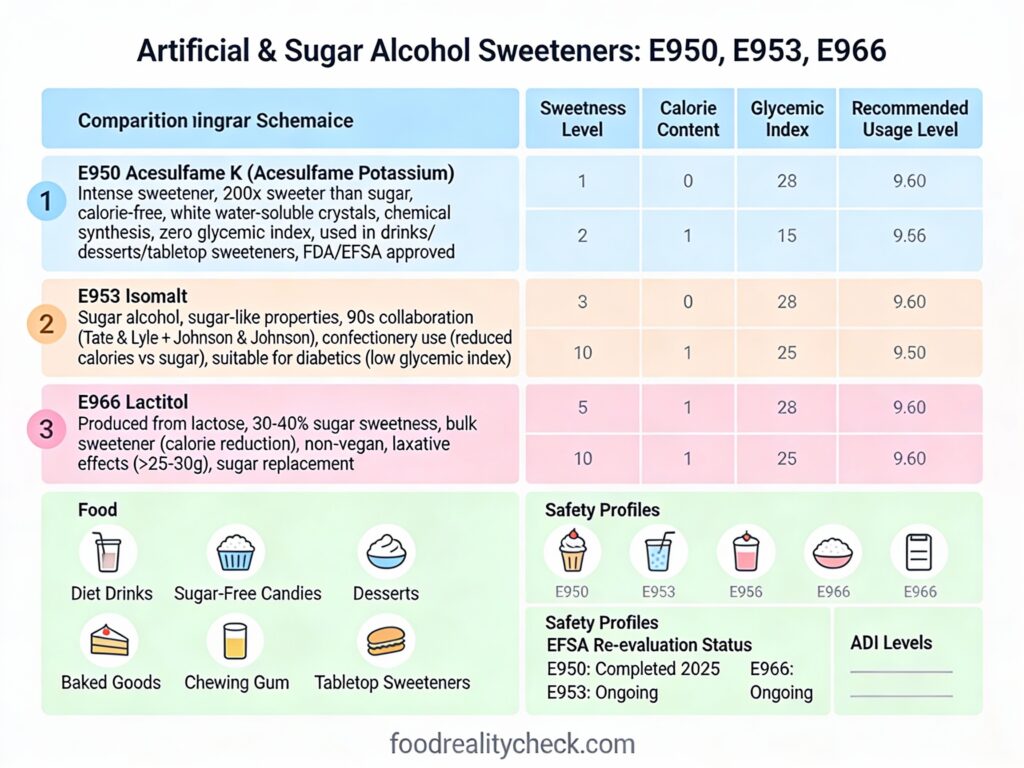
- Sweetness Level: 45-60% as sweet as sugar (typically 50-55% in food)
- Calories: 2 calories per gram (vs. 4 for sugar); minimal metabolic impact
- Glycemic Impact: Glycemic Index of only 2; no insulin response
What Exactly Is It?
E953 is isomalt, also known as isomaltitol or hydrogenated isomaltose. It’s an equimolar mixture of two disaccharide polyols: 6-O-α-D-glucopyranosyl-D-sorbitol (GPS, also called glucose-sorbitol) and α-D-glucopyranosyl-1,1-D-mannitol (GPM, also called glucose-mannitol).
Chemically, isomalt is produced in a two-step process: (1) sucrose is enzymatically rearranged using Saccharomyces cerevisiae bacteria to isomaltulose (palatinose), a disaccharide with altered glycosidic bonds, and (2) isomaltulose is hydrogenated under pressure and catalysis to produce the mixture of glucose-sorbitol and glucose-mannitol. The molecular weight is approximately 344 g/mol.
Physically, isomalt appears as a white, crystalline powder or granular substance with approximately 5% water of crystallization. It is essentially odorless with a pleasant sugar-like taste. Isomalt has a melting point of 145-150°C, making it heat-stable for cooking and baking. It has exceptionally low hygroscopicity (water absorption capacity)—at 85% relative humidity it absorbs only minimal moisture, maintaining texture and preventing stickiness during storage.
The most distinctive property of isomalt is its combination of sugar-like physical and taste properties with minimal metabolic impact. It dissolves slowly in the mouth, providing sustained sweetness release. Importantly, complete hydrolysis of isomalt yields glucose (50%), sorbitol (25%), and mannitol (25%)—all naturally occurring compounds.
Where You’ll Find It
E953 appears in a wide range of sugar-free and reduced-calorie foods:
• Hard-boiled sweets and lollipops (most common application)
• Sugar-free chewing gum
• Sugar-free candies and confectionery
• Baked goods (cakes, cookies, bread)
• Chocolate and chocolate coatings (including sugar-free versions)
• Ice cream and frozen desserts (sugar-free varieties)
• Dessert fillings and spreads
• Lozenges and throat sweets
• Diabetic confectionery
• Weight-control foods and dietetic products
• Sugar-free jams and marmalades
• Beverages (sugar-free drinks)
• Breakfast cereals (dietetic versions)
• Pharmaceutical preparations (tablets, lozenges)
• Dental products (non-cariogenic sweetener)
• Nut and seed coatings
• Sugar decorations and artistic confectionery
Isomalt is particularly valued in applications where sugar-like crystalline appearance and transparency are important (hard candies, lollipops, and decorative elements).
Why Do Food Companies Use It?
E953 performs five critical functions in sugar-free formulations:
1. Sugar replacement with maintained texture and appearance: Unlike artificial sweeteners (aspartame, sucralose, saccharin) which provide only sweetness, isomalt provides bulk—allowing manufacturers to achieve sugar-like texture, mouthfeel, and crystalline appearance in hard candies and confectionery.
2. Heat stability for baking and cooking: With a melting point of 145-150°C and minimal degradation at high temperatures, isomalt withstands baking, cooking, and confectionery processes where sugar-level heat stability is required. Many artificial sweeteners break down or become bitter at high temperatures.
3. Low hygroscopicity for extended shelf life: Isomalt’s minimal water absorption keeps sugar-free products crisp and prevents stickiness during storage. This property is particularly valuable for hard candies, lollipops, and chewing gum which must maintain texture throughout shelf life.
4. Synergy with other sweeteners: Isomalt combines effectively with intense sweeteners (aspartame, acesulfame-K, stevia) to mask artificial sweetener aftertastes and create more sugar-like taste profiles. Many reduced-sugar products use 70% isomalt + 30% intense sweetener to achieve optimal taste.
5. Tooth-friendly sweetening: Unlike sugar which promotes dental caries, isomalt is not metabolized by cariogenic bacteria (Streptococcus mutans), making it tooth-friendly. This property enables marketing of sugar-free products as beneficial for dental health.
Cost and use considerations: Isomalt is more expensive than sugar and many other sweeteners, which limits its use primarily to premium sugar-free products where its functional advantages justify the cost.
Is It Safe?
E953 is considered very safe with strong regulatory approval and favorable safety profile.
Regulatory Status:
• FDA (USA): Recognized as GRAS (Generally Recognized As Safe) for food use
• EFSA (Europe): Approved as direct food additive (E953)
• JECFA (WHO/FAO): ADI “not specified” since 1985, indicating safety at any practical consumption level
• Osmotic diarrhea: Unabsorbed isomalt draws water into the colon by osmotic effect, potentially causing loose stools or diarrhea
• Bloating and gas: Colonic fermentation of unabsorbed isomalt produces gases (H₂, CO₂, methane) and volatile fatty acids, causing bloating and flatulence
• Abdominal pain and cramping: Fermentation-induced gas and osmotic effects may cause discomfort
• Individual sensitivity variation: Effects depend on individual digestive microbiota composition and adaptation—regular consumers develop tolerance as their microbiota adapt
• Labeling requirement: In the EU, foods with high isomalt content must carry warning: “Excessive consumption may produce laxative effects”
Important note on gastrointestinal effects: These are not toxicological concerns or true adverse effects—they reflect the intended mechanism of action of sugar alcohols. At normal consumption levels (5-20 g per serving, typical in confectionery), gastrointestinal effects are minimal or absent in most people. The effects only become apparent at excessive intakes (>20-30 g single dose or >50 g daily). This contrasts with other polyols where effects may occur at lower intakes.
Other documented considerations:
• Glycemic impact: Negligible—blood glucose rises minimally (glycemic index of only 2); no insulin response
• Insulin response: Minimal to absent; suitable for diabetics
• Dental health: Not metabolized by cariogenic bacteria; promotes dental health
• Metabolism: Absorbed sorbitol and mannitol are metabolized via normal pathways; glucose component raises blood sugar negligibly
• Caloric content: 2 calories per gram (vs. 4 for sugar)—approximately 50% caloric reduction
Production Process
E953 isomalt is produced through multi-step enzymatic and chemical synthesis:
1. Sucrose (table sugar) is dissolved in water and treated with nonviable cells of Saccharomyces cerevisiae yeast
2. Bacterial enzymes in the yeast cells catalyze enzymatic rearrangement of sucrose into isomaltulose (palatinose), a disaccharide with modified glycosidic bonds
3. Free unreacted sucrose is removed
4. The isomaltulose solution is hydrogenated under pressure and catalysis, converting the reducing disaccharide into the mixture of glucose-sorbitol and glucose-mannitol (isomalt)
5. The product is crystallized, washed, dried, and milled into powder
6. The final product is standardized for purity and granule size
The entire process uses enzymatic transformation and hydrogenation—no chemical synthesis with foreign reagents.
Natural vs Synthetic Version
E953 is semi-synthetic—derived from natural sugar but requiring chemical and enzymatic transformation.
Unlike truly natural compounds (extracted directly from plants) or fully synthetic chemicals (created entirely from chemical precursors), isomalt occupies a middle ground: it’s made from naturally-derived sucrose but requires enzymatic rearrangement and hydrogenation to produce. The end product—an equimolar mixture of glucose-sorbitol and glucose-mannitol—could theoretically occur in nature but doesn’t exist naturally as an isolated product.
This semi-synthetic status makes isomalt neither fully natural nor fully synthetic, but rather a chemically engineered natural derivative.
Comparison with Other Sugar Alcohols
Isomalt is one of several polyol sweeteners with similar functions but different properties:
• Sorbitol (E420): Simpler polyol; more hygroscopic (absorbs water); higher laxative potential at lower doses
• Mannitol (E421): Simpler polyol; creates cooling sensation; higher laxative potential; lower sweetness
• Maltitol (E965): Similar polyol to isomalt; slightly higher sweetness (75-90% of sugar); similar laxative potential
• Xylitol (E967): Different polyol; higher sweetness (100% of sugar); higher laxative potential; cooling sensation; more expensive
• Erythritol (E968): Different polyol; zero calories; no laxative effect; cooling sensation; lower sweetness (70%)
Among polyols, isomalt is valued specifically for its combination of low hygroscopicity (excellent shelf life), heat stability, and moderate laxative threshold (20-30 g)—making it ideal for hard candies, chewing gum, and products where crystalline appearance matters.
Dietary and Health Considerations
Isomalt is specifically beneficial for certain populations:
Diabetics: The minimal glycemic impact (GI of only 2) and absence of insulin response make isomalt extremely suitable for diabetic dietary management. Unlike sugar, isomalt doesn’t affect blood glucose control.
Weight management: At 2 calories per gram versus 4 for sugar, isomalt provides 50% caloric reduction—enabling reduced-calorie products that maintain texture and taste of full-sugar alternatives.
Dental health: Non-cariogenic properties make isomalt beneficial for dental health, enabling tooth-friendly confectionery.
Prebiotic effects: The partial fermentation of isomalt produces short-chain fatty acids (butyrate, propionate) that support colonic health and beneficial microbiota—potentially beneficial effects similar to other fermentable fibers.
Environmental and Sustainability
Isomalt production uses sucrose (from sugarcane or sugar beets) as raw material. If sourced from sustainable sugarcane or sugar beets, isomalt production is considered sustainable. However, the hydrogenation step requires hydrogen gas and catalysts, creating moderate environmental footprint. The process generates minimal waste, and the one-to-one molar yield from sucrose means efficient conversion. Overall sustainability is moderate—acceptable but not as favorable as simpler extracted additives.
Natural Alternatives
Want to avoid E953? Food companies sometimes use these alternatives:
• E420 (Sorbitol): Cheaper sugar alcohol; more hygroscopic; higher laxative potential
• E421 (Mannitol): Different properties; cooling sensation; higher laxative potential
• E965 (Maltitol): Similar polyol; similar cost and properties
• E967 (Xylitol): Higher sweetness; no laxative effect; much more expensive
• E968 (Erythritol): Zero calories; no laxative effect; lower sweetness
• Stevia (E960): Natural intense sweetener; lacks bulk for candy production
• Aspartame (E951): Artificial sweetener; lacks bulk; bitter aftertaste in some applications
• Sugar itself: Full-calorie traditional sweetener
For applications requiring sugar-like texture, crystalline appearance, and bulk (hard candies, lollipops), isomalt and maltitol remain among the best options despite being more expensive than sugar.
The Bottom Line
E953 (isomalt) is a semi-synthetic sugar alcohol that is FDA GRAS approved, EFSA approved, and JECFA ADI “not specified,” providing sugar-like sweetness and texture in sugar-free foods without sugar’s calories or metabolic effects.
Isomalt functions as a bulk sweetener (45-60% as sweet as sugar) that maintains physical and sensory properties of sugar-based products while providing only 2 calories per gram versus 4 for sugar. It is heat-stable, has excellent shelf life due to low hygroscopicity, and is particularly valued in hard candies, lollipops, and chewing gums where crystalline appearance matters.
The primary documented concern is gastrointestinal effects (bloating, gas, diarrhea) when consumed in excessive quantities (>20-30 g single dose), due to incomplete absorption and colonic fermentation. These effects are not toxicological but represent the expected behavior of unabsorbed carbohydrates—similar to high-fiber foods. Regular consumption leads to microbiota adaptation and tolerance.
Isomalt is specifically beneficial for diabetics (minimal glycemic impact), weight management (50% caloric reduction), and dental health (non-cariogenic). The semi-synthetic nature and higher cost limit its use to premium sugar-free products where its functional advantages justify the expense.
For consumers seeking sugar-free alternatives for confectionery and baked goods, isomalt offers superior texture and taste profile compared to artificial sweeteners, though at higher cost. The gastrointestinal threshold is higher than some other polyols, making isomalt one of the more tolerable sugar alcohols for most consumers.