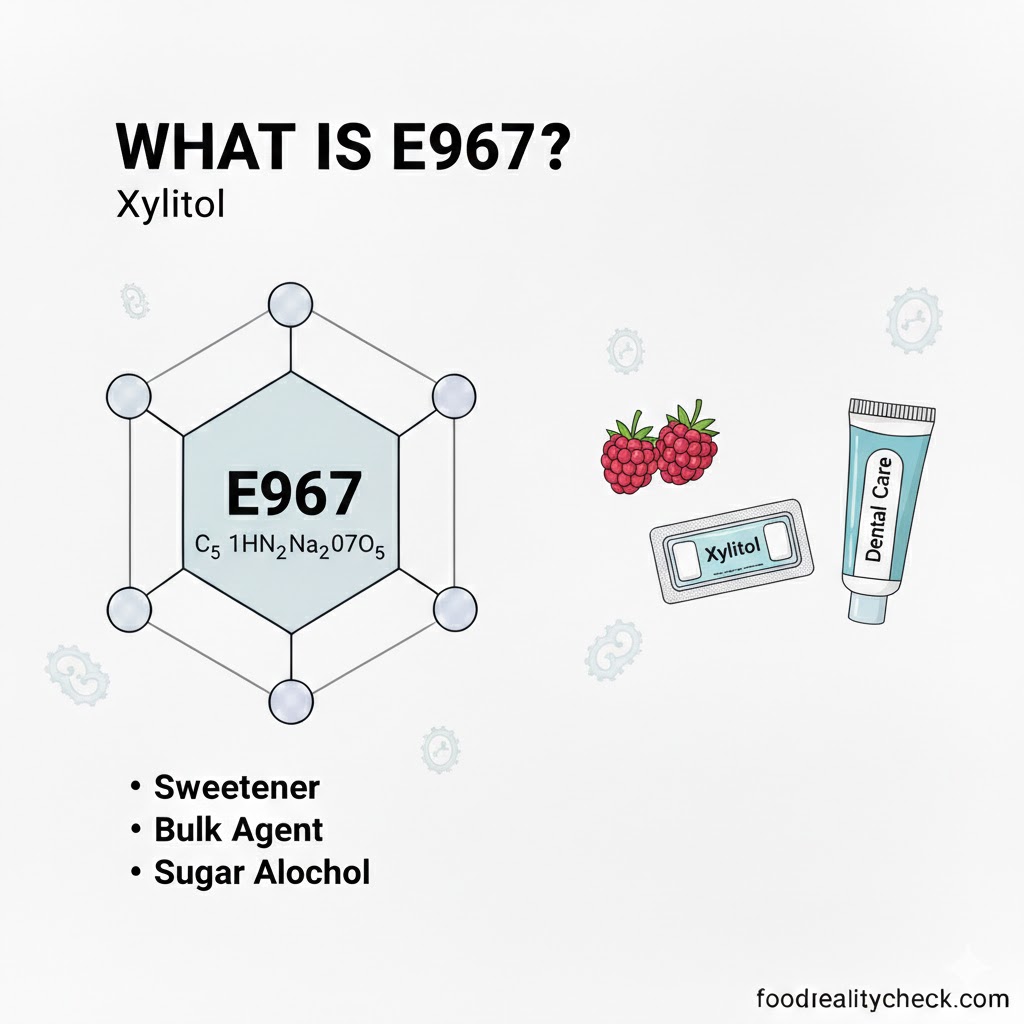
What is E967?
Complete guide to understanding E967 (Xylitol) in your food
The Quick Answer
E967 is a natural sugar alcohol (polyol) derived from wood pulp or corn that tastes like sugar with 40% fewer calories.
It’s used in sugar-free products, chewing gum, confectionery, and baked goods as a diabetic-friendly sweetener.
It was historically considered safe, but emerging 2024 research suggests potential cardiovascular risks (blood clot formation, heart attack, stroke risk) at high consumption levels, prompting regulatory re-evaluation by EFSA.
📌 Quick Facts
- Category: Natural sugar alcohol (polyol) and sweetener
- Chemical Name: 1,2,3,4,5-pentahydroxypentane or xylitol
- Chemical Formula: C₅H₁₂O₅
- Source: Derived from xylan in wood pulp, corncobs, or small amounts in fruits/vegetables
- Sweetness: Equal to sugar (1:1 sweetness ratio)
- Calories: 2.4 kcal/gram (40% fewer than sugar at 4 kcal/gram)
- Glycemic Index: Only 7–13 (vs. sugar at 65) – diabetic-friendly
- Safety: Approved by FDA and EFSA; ADI not defined; currently under EFSA re-evaluation due to cardiovascular concerns
What Exactly Is It?
E967 is a natural sugar alcohol (polyol) that occurs naturally in fruits and vegetables but is commercially produced from wood pulp or corn.
Its chemical formula is C₅H₁₂O₅.
Xylitol was first discovered in Finland from birch wood sugar (hence “birch sugar”) in the 1890s. Commercially, it’s now primarily produced from xylan, a carbohydrate polymer in wood pulp, through hydrolysis and hydrogenation.
It appears as a white crystalline powder or granules, identical in appearance to table sugar, with a taste profile nearly indistinguishable from sugar except for a slight cooling, mentholated sensation when it dissolves.
Key property: only 50% is absorbed in the digestive system, and only about 25% is metabolized (converted to energy). The rest is fermented by gut bacteria or excreted, which is why it has 40% fewer calories than sugar.
Where You’ll Find It
E967 appears primarily in sugar-free and diabetic-friendly products:
• Sugar-free chewing gum (one of the primary uses)
• Sugar-free candies and sweets
• Sugar-free confectionery
• Sugar-free baked goods and cakes
• Sugar-free jams and preserves
• Diabetic food products
• Oral care products (toothpaste, mouthwash)
• Dietary supplements
• Some beverages and drinks
• Breakfast cereals (sugar-free varieties)
E967 is particularly common in products marketed as “sugar-free” or “xylitol-sweetened” in European and US markets.
Why Do Food Companies Use It?
E967 serves multiple critical functions:
Diabetic-friendly: Xylitol has a glycemic index of only 7–13 (vs. sugar at 65) and doesn’t spike blood glucose or insulin, making it ideal for diabetic diets.
Low calorie: 40% fewer calories than sugar—attractive for weight management and diet products.
Sugar-like taste and appearance: Unlike many artificial sweeteners with off-flavors, xylitol tastes and looks identical to sugar, enabling 1:1 substitution in recipes.
Dental benefits: Unlike sugar, xylitol is not metabolized by oral bacteria and actually inhibits cavity formation, reducing plaque and delaying tooth decay. Makes it ideal for chewing gum.
Heat stability: Stable at high temperatures, enabling use in baked goods and heat-treated products.
Natural perception: Derived from natural sources (wood, corn, fruits), appealing to “natural” product marketing.
Is It Safe?
E967 was historically considered safe and approved, but emerging 2024 research suggests potential cardiovascular risks (blood clot formation, increased heart attack/stroke risk) at high consumption, prompting EFSA re-evaluation.
The FDA classifies xylitol as GRAS (Generally Recognized as Safe).
The EFSA approved xylitol with no numerical ADI (Acceptable Daily Intake) limit defined—indicating very low concern.
However, major cardiovascular research published in the European Heart Journal (2024) has fundamentally challenged this safety assessment.
⚠️ NEW 2024 CARDIOVASCULAR CONCERN – Currently Under EFSA Re-Evaluation:
The Study (European Heart Journal, 2024): Researchers at Cleveland Clinic analyzed blood samples from 1,157 participants undergoing cardiac evaluations and found that individuals with higher blood levels of xylitol had a 63% higher risk of major adverse cardiovascular events (heart attack, stroke, or death) over 3 years compared to those with lower levels.
Mechanism Discovered: The study found that xylitol enhances platelet aggregation and adhesion, promoting blood clot formation. Both in test tubes and in mice, xylitol increased clotting tendency, potentially leading to heart attacks or strokes.
Critical Caveat About the Study: Blood samples were taken after overnight fasting. Since xylitol has a 13-minute half-life in blood and returns to baseline within 4–6 hours, the detected xylitol was likely from natural endogenous (body-produced) xylitol, NOT from dietary consumption. This means the cardiovascular risk may be from the body’s native xylitol metabolism, not specifically from food consumption.
Remaining Questions: It remains unclear whether frequent, high-dose dietary xylitol consumption produces the same cardiovascular effects. Long-term studies on people consuming high dietary xylitol are needed.
EFSA Response: The European Food Safety Authority announced in 2024 that it is currently reassessing xylitol’s risk profile in foods based on this new cardiovascular data.
What Are The Health Concerns?
E967 has multiple documented health concerns, both established and emerging:
Cardiovascular risk (EMERGING 2024 CONCERN): New research indicates higher blood xylitol levels correlate with 63% increased risk of heart attack, stroke, or death. Xylitol enhances blood clot formation. While the study involved endogenous xylitol rather than dietary consumption, the implications for frequent high-dose dietary use remain unclear. EFSA is re-evaluating based on this data.
Gastrointestinal effects (ESTABLISHED): Xylitol is incompletely absorbed (~50%) and fermented by gut bacteria, producing gas and potentially causing bloating, flatulence, and diarrhea. Symptoms typically occur after 25–30 grams in a single dose—far above normal food use but achievable with high gum chewing or sugar-free candy binges.
Laxative effect in sensitive individuals: Xylitol can act as a laxative, particularly in individuals with sorbitol intolerance or digestive sensitivity.
Toxic to dogs (CRITICAL – not a human concern but important for pet owners): Xylitol is extremely toxic to dogs, causing rapid insulin release, hypoglycemia (dangerously low blood sugar), liver damage, and death. As little as 0.1 gram per kg of body weight can be lethal. Keep xylitol-containing products away from pets.
Incompatible with yeast-based products: Xylitol destroys yeast, making it unsuitable for fermented breads or beer production.
Natural vs Synthetic Version
E967 is naturally derived (not synthetic) but industrially manufactured.
Sources: Xylan from wood pulp (most common), corncobs, or extracted from fruits/vegetables (minimal).
All E967 is chemically identical regardless of source—no difference between “birch sugar” from birch and “corn-derived” xylitol.
Natural Alternatives
Want to avoid E967?
Alternative sweeteners include:
• Erythritol – another sugar alcohol with similar benefits but also under cardiovascular scrutiny (2023 NIH study)
• Stevia – natural extract from stevia plant (300–500× sweetness of sugar)
• Monk fruit (Luo Han Guo) – natural sweetener (150–200× sweetness of sugar)
• Sorbitol – another sugar alcohol (less sweet, same GI benefits)
• Regular sugar (in moderation) – accept higher calories and GI impact
• Honey or maple syrup – natural alternatives with trace nutrients
The Bottom Line
E967 (Xylitol) is a natural sugar alcohol historically considered safe that is now under cardiovascular scrutiny due to 2024 research linking higher blood levels to increased heart attack/stroke risk and blood clot formation, prompting EFSA re-evaluation.
Safety Assessment Shift: From “generally safe with no ADI limit” to “currently under re-evaluation for cardiovascular safety.”
Key Limitation of New Research: The 2024 study found associations between endogenous (body-produced) xylitol and cardiovascular risk, not definitively between dietary xylitol consumption and cardiovascular events. More long-term studies on people consuming high dietary xylitol are needed.
Established Concerns (Non-Cardiovascular): Gastrointestinal side effects (bloating, diarrhea) at high doses (25–30+ grams); laxative effect in sensitive individuals; toxic to dogs.
Dental Benefit (Confirmed): Exceptional for dental health—reduces plaque, inhibits cavity formation, superior to other sugar alcohols.
Diabetic Benefit (Confirmed): Very low glycemic index (7–13), doesn’t spike blood glucose or insulin.
If You Consume Xylitol: Moderate consumption is likely safe, but given emerging cardiovascular concerns, avoid excessive intake (>25–30g daily). Until EFSA completes re-evaluation, maintain balanced consumption.
For Pet Owners: Keep all xylitol-containing products (gum, candies, baked goods) completely away from dogs—it’s extremely toxic.
Future Outlook: EFSA re-evaluation will likely clarify cardiovascular risk from dietary consumption. Current approval remains but with regulatory caution warranted pending further evidence.