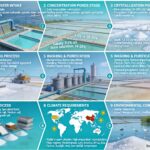
Wheat flour production involves systematic grain processing—cleaning, conditioning, breaking, grinding, and sifting—transforming whole grains into fine powder with controlled particle size and nutrient composition. Understanding milling mechanics reveals that flour properties (protein content, fineness, color) are precisely engineered through milling design.
Wheat Grain Structure
Wheat grain has three main components: (1) Bran (outer layer): ~14% of grain weight, fiber-rich, brown color, protective. (2) Endosperm (middle): ~82% of grain, starch-protein rich, white color, main flour component. (3) Germ (inner): ~2% of grain, nutrient-dense, fat-rich, high enzyme content. Key point: Different flour types result from different extraction ratios (proportion of bran/germ removed).
Flour composition depends on which grain parts are included—this is controlled during milling.
Milling Process Overview
Modern milling sequence: (1) Cleaning: Remove foreign material (rocks, chaff, dirt). (2) Conditioning: Add water to grain (~14-16% moisture), rest 4-12 hours. (3) Breaking: First grinding breaks grain into medium pieces, separates bran. (4) Grinding: Further grinding to fine particles. (5) Sifting: Separate flour by fineness into grades. (6) Enrichment (optional): Add vitamins/minerals. (7) Bagging: Package flour.
Modern mills are automated, continuous-flow systems processing thousands of tons daily.
Cleaning & Conditioning
Cleaning: (1) Magnetic separator removes metal. (2) Air separator removes light materials (chaff). (3) Screen removes foreign particles. (4) Density separator removes stones/damaged kernels. Conditioning: (1) Water added to soften bran, making it easier to separate. (2) Grain rested in bins (allows water penetration). (3) Equilibration ensures uniform moisture. Purpose: Cleaner grain yields better flour; conditioned grain mills more efficiently.
Cleaning/conditioning are essential preprocessing—poor preparation compromises final flour quality.
Breaking & Grinding
Breaking: (1) Steel corrugated rollers break grain into medium pieces. (2) First pass creates ~60-70% flour-sized particles, ~30-40% coarser particles. (3) Sieves separate fine particles (pass as flour) from coarse. Grinding: (1) Smooth roller mills further grind coarser particles. (2) Multiple passes progressively reduce particle size. (3) Temperature controlled (friction creates heat—cooling prevents nutrient damage).
Breaking/grinding is repetitive process—multiple passes through progressively finer mills create uniform powder.
Sifting & Classification
Sifting: (1) Air classification separates flour into particle size grades. (2) Fine flour: <100 micrometers. (3) Medium flour: 100-200 micrometers. (4) Coarse: >200 micrometers. Flour quality metrics: (1) Fineness: Particle size distribution (finer flour better for baking). (2) Ash content: Mineral content (indicates bran inclusion). (3) Protein: Determined by wheat variety, extraction rate. (4) Color: Affected by grain type, bran inclusion, bleaching (optional).
Sifting creates uniform flour—consistent particle size critical for baking performance.
Flour Types & Extraction
Whole wheat flour: 100% extraction (entire grain included). White flour: 70-75% extraction (bran/germ removed). Bread flour: High protein (12-14%), often from hard wheat. Cake flour: Low protein (7-9%), soft wheat, finely ground. Extraction percentage: Higher extraction = darker, more nutritious flour with lower baking performance (fiber interferes with gluten).
Different flour types are intentionally engineered through milling design—specific applications require specific flour properties.
Modern Milling Technology
Roller mills: Steel rollers press grain, more efficient than stone mills. Automation: Computerized control manages moisture, temperature, grain flow. Efficiency: Modern mills extract ~99% of flour from grain (minimal waste). Capacity: Large mills process 500-1000 tons grain per day. Quality control: Continuous monitoring (moisture, protein, ash, falling number) ensures consistency.
Modern milling is precisely engineered—output is consistent commodity with tight specifications.